
Yes. Stainless steel can be spot-welded, mainly on thin sheets, and it’s more common than most people realize. It’s used for quick, clean joints in light fabrication.
The key lies in managing heat and pressure carefully. With the right equipment, clean surfaces, and proper settings, spot welding can produce durable, precise joints in stainless steel for everything from automotive parts to kitchen appliances.
When Spot Welding Works Best?
- Thin stainless sheets
- Light fabrication
- Kitchen and restaurant equipment
- Small brackets and panels
Key Aspects of Laser Spot Welding Stainless
- Laser spot welding is used for better control of thin stainless steel.
Why is spot welding thin stainless steel difficult?
- Holds heat longer than mild steel
- Burns through easily
- Leaves marks if overheated
- Needs exact timing and pressure
Since stainless steel has higher electrical resistance and lower thermal conductivity than regular steel.
What Welding Setup Is Needed for Tiny Spot Welds on Super Thin Stainless Sheets?
- Low current
- Clean electrodes
- Strong clamping pressure
- Very short weld time
If you’re not sure your material can withstand spot welding, it’s better to check with a professional first. A wrong setup can ruin the piece. We can guide you on the right welding repair method before you start.
How Controlled Laser Spot Welding Solves These Issues?
- Focused heat reduces burn-through
- Less discoloration
- More control over thin metal
- Cleaner finish
Welding Results: Appearance and Strength Test
- Clean weld points
- Low distortion
- Strong for light-duty use
- Better surface finish
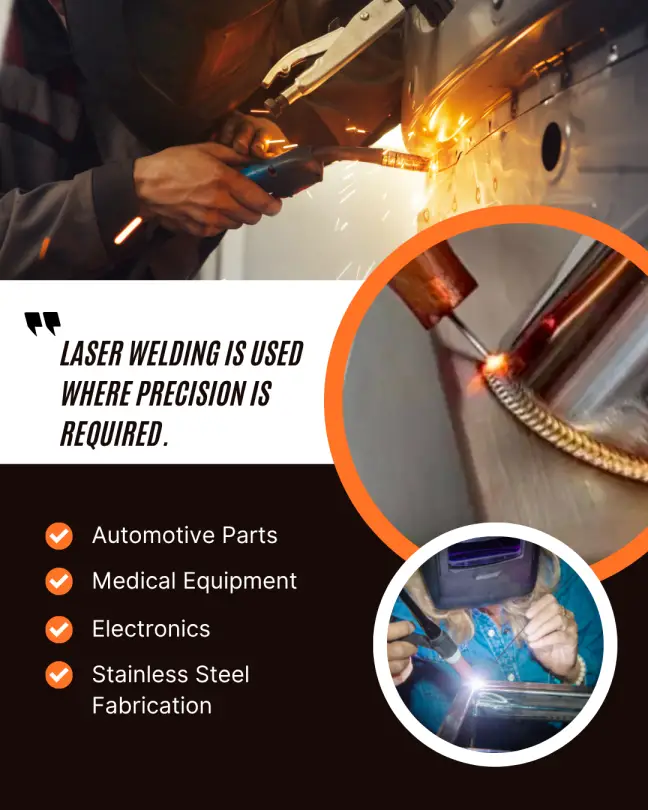
Where Is Laser Welding Used?
What Is Laser Welding?
Laser welding uses a focused light beam to join metal. Heat stays in a small area, reducing damage. Used mostly in shop welding, not mobile welding service.
Benefits of Laser Welding Stainless Steel
- Clean welds
- Low heat spread
- Less warping
- High precisionFast for production
For detailed stainless steel fabrication or precision welding jobs, using the right process matters. You can reach out to American Welding to get the right solution without trial and error.
Types of Laser Welders for Stainless Steel
- Fiber laser welders
- CO2 laser welders
- Pulsed laser systems
Laser Welding Techniques for Stainless Steel
- Pulse welding for thin sheets
- Continuous welding for seams
- Laser spot welding for small joints
- Solutions to Common Problems
- Set the correct heat to avoid burn marks
- Clean the surface before welding
- Control speed for strength
- Use proper shielding if needed
Choosing the Right Welding Method
Laser welding is not ideal for on-site welding or heavy repair. For mobile welding services, TIG (Tungsten Inert Gas) and MIG (Metal Inert Gas) welding are more practical. If you need stainless steel repair, custom metal fabrication, or emergency welding repair, don’t guess.
Contact American Welding for fast, reliable welding service done right the first time.
FAQs (People Also Ask)
Can you weld stainless steel with a laser welder?
Yes. It works well for thin and precise welding.
Can you spot-weld with a laser welder?
Yes. It gives cleaner and more controlled results.
What metals cannot be spot welded?
Very thick metals and low-conductivity metals are difficult.
Can I spot weld stainless steel?
Yes, for thin sheets and light work.
What are the downsides of laser welding?
High cost, not portable, needs a controlled setup
What is the cost of a 3000W laser welding machine?
Around $10,000 to $30,000+, depending on setup.
Is laser welding as strong as MIG?
For thin metal, yes. For heavy work, MIG is stronger.
How thick a steel can a laser welder weld?
Usually thin to medium thickness, based on machine power.
Is it possible to weld stainless steel to regular steel?
Yes, with proper filler and method.
Can you combine steel and stainless steel?
Yes, but control corrosion.
How do you bond stainless steel to stainless steel?
TIG welding is commonly used.
What metals can’t be welded together?
Some combinations, like aluminum and steel, are difficult.
If you’re unsure about your welding job, getting expert advice early can save time, cost, and rework.
Recent Comments