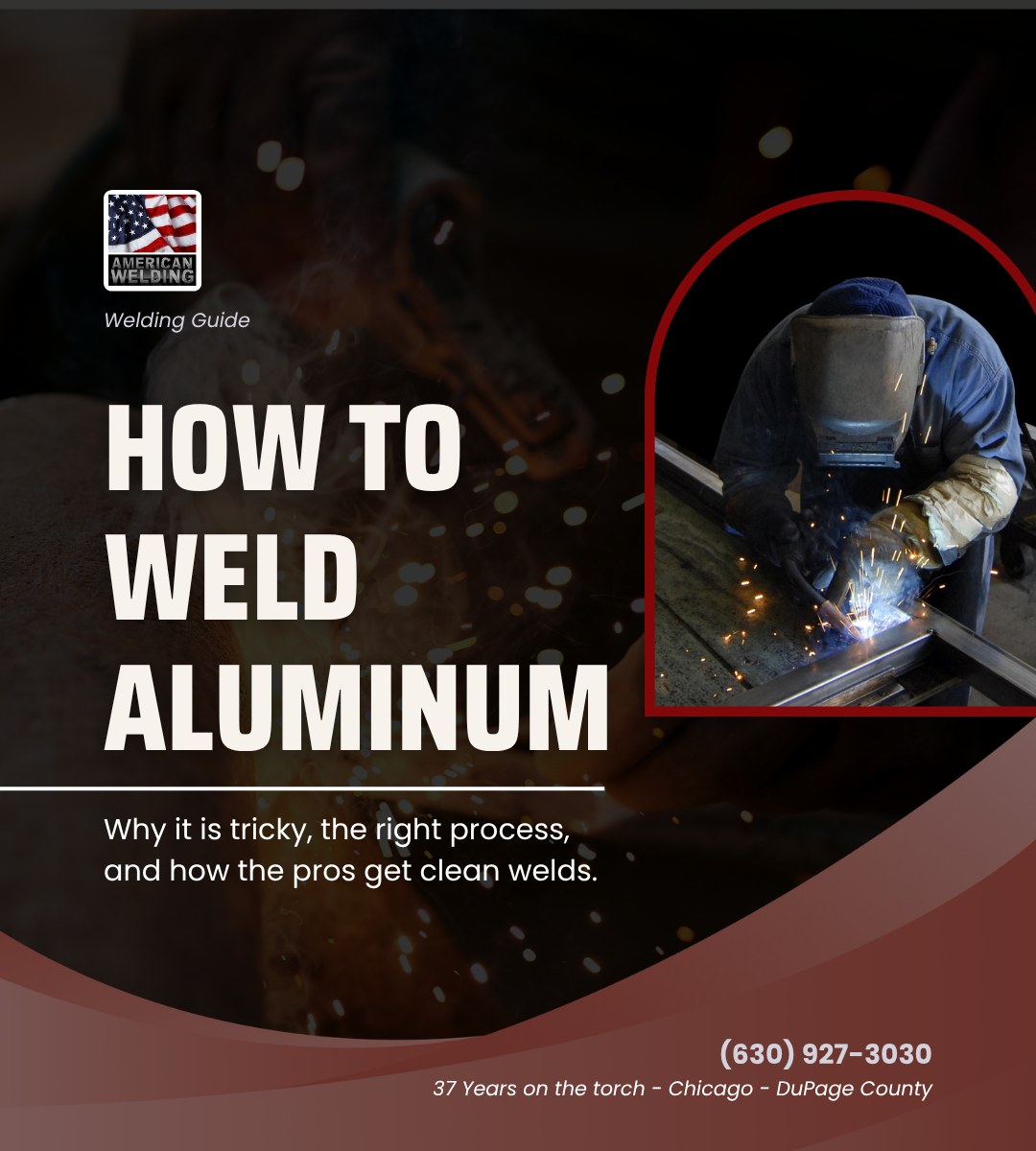
How to Weld Aluminum
If you have ever tried to weld aluminum using the same settings that work on steel, you already know it does not end well.
The puddle drops out, the metal warps, or the weld never really takes.
Aluminum can be welded — and welded cleanly — but it behaves nothing like steel under the arc.
The short answer: yes, aluminum welds well, but it melts fast and hides under a tough oxide skin, so it takes a clean surface, the right process, and careful heat control.
At American Welding, aluminum welding is everyday work. Owner Pete Adams has been welding since 1989 — more than 35 years on the torch — and from our shop in Wayne, Illinois we join and rebuild aluminum on boats, trailers, tanks, and brackets all the time. Below is how aluminum is actually welded, why it trips up so many people, and what separates a weld that holds from one that cracks a week later.
Why Aluminum Is Tricky to Weld
Aluminum is not hard to weld because it is stubborn — it is hard because it fights you in three specific ways at once. Understand those three, and most of the mystery disappears.
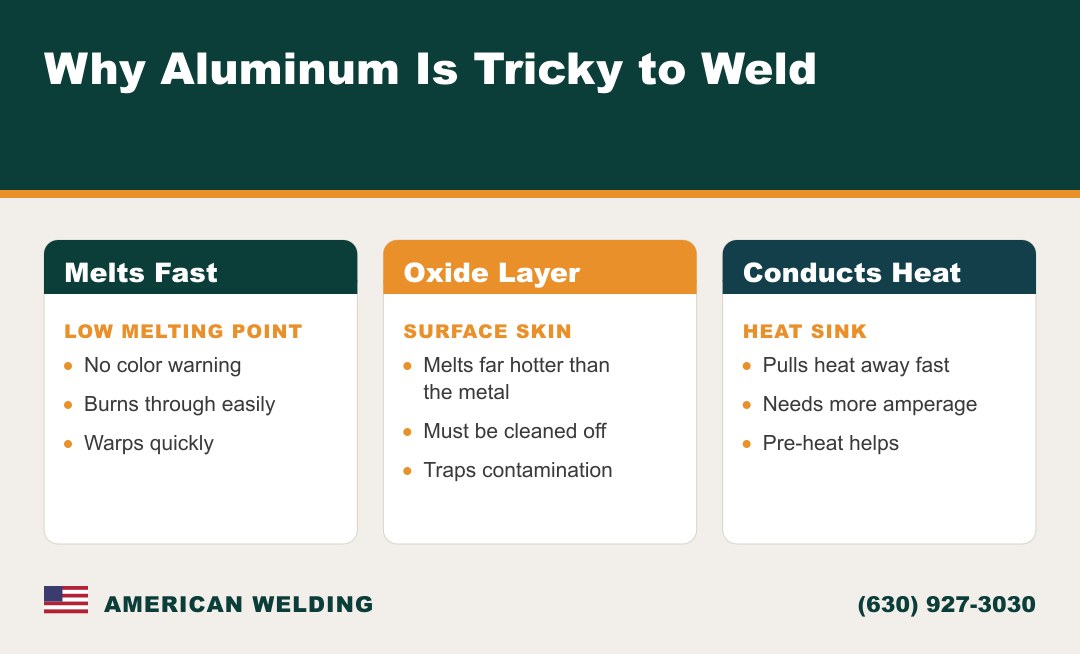
- It melts fast, with no color warning. Steel glows red before it melts; aluminum gives you nothing and stays silver right up to the moment it collapses. Push too far and you burn straight through, and thin sheet warps before you know it.
- It wears a tough oxide skin. That skin melts far hotter than the soft metal beneath it, so it must be cleaned off first — otherwise it refuses to melt while the metal below turns liquid, trapping contamination that leaves the weld porous and weak.
- It pulls heat away fast. Aluminum conducts heat several times quicker than steel, spreading it across the whole part. That means you need more amperage to start, and on thicker pieces a little pre-heat helps the puddle form instead of chasing a cold joint.
The Right Process — TIG or a Spool Gun
Half the battle with aluminum is picking the right process for the part in front of you. Two work well, and one gives beginners endless grief.
For clean, precise, thin work, nothing beats TIG welding. TIG lets you feed filler with one hand and control the heat with the other, so you can dial the puddle up and down as you go — exactly what delicate aluminum needs. It is the go-to for thin sheet, tanks that have to hold, railings, and anything where the weld shows and has to look right.
For thicker aluminum, a spool gun or a push-pull setup is faster and easier to run, laying down metal quickly on a heavy trailer frame or a thick bracket. The reason they exist is the wire itself: aluminum filler is soft, almost like feeding a strand of cooked spaghetti. In a standard MIG gun with a long liner, that soft wire kinks and birds-nests before it reaches the joint. A spool gun mounts the wire right at the handle so it travels only an inch or two, and a push-pull system drives it from both ends — either way, the wire stays straight and the arc stays steady. That is why plain MIG struggles with aluminum and the right feeder makes all the difference.
How to Weld Aluminum, Step by Step
Once the process is chosen, the actual sequence is short and repeatable. Get these five moves right, in order, and aluminum stops fighting you.
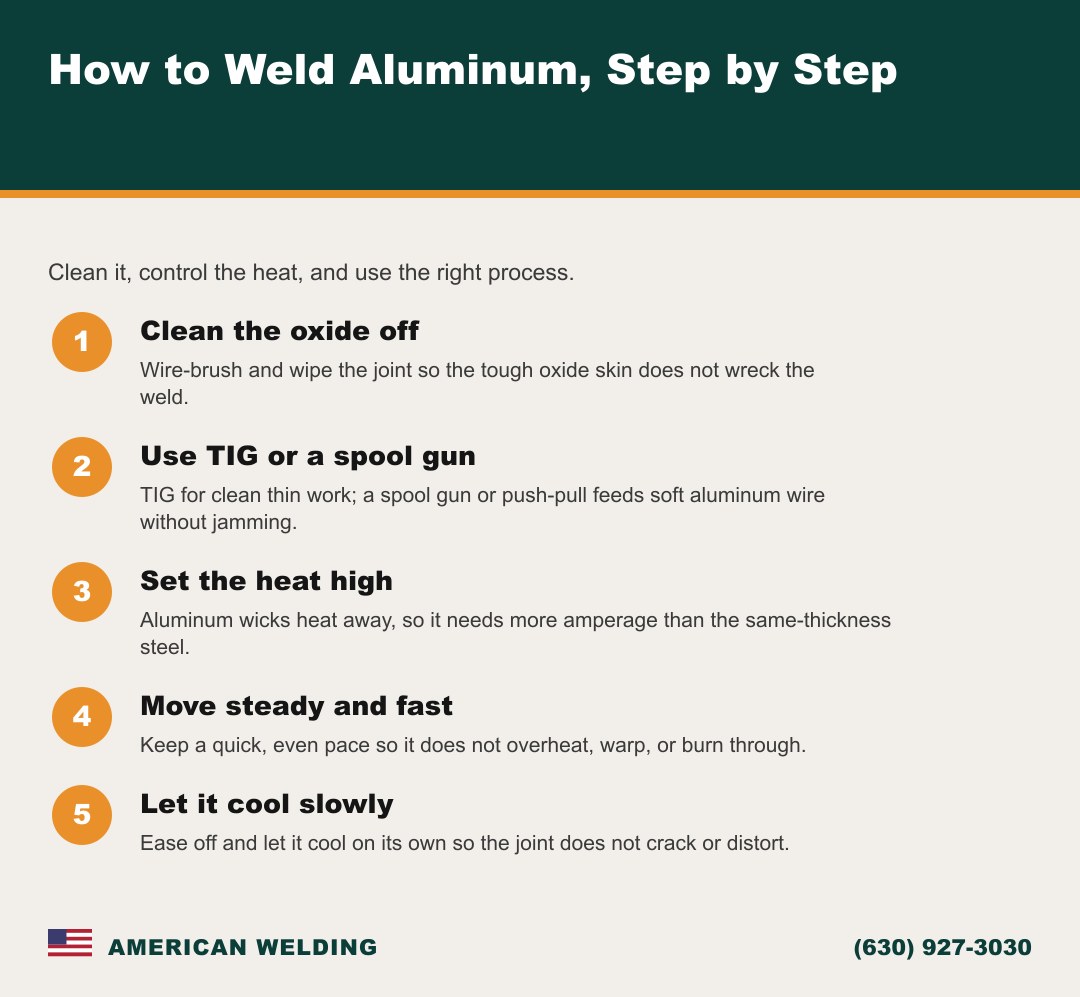
- Clean the oxide off. Wipe the joint with solvent to strip grease, then scrub the bare metal with a clean stainless brush kept only for aluminum. This knocks the tough oxide skin off so the puddle can form — and weld soon after, because that skin starts growing back within minutes.
- Use TIG or a spool gun. Match the tool to the metal — TIG for thin, clean, visible work, and a spool gun or push-pull for thicker frames. Set it up for aluminum so the soft wire feeds without tangling.
- Set the heat high to start. Because aluminum pulls heat away so fast, you need real amperage up front to get the puddle going, and on thicker pieces a little pre-heat helps the joint melt evenly.
- Move steady and fast. Once the puddle forms it grows quickly, so keep a smooth, brisk travel speed. Linger in one spot and you sink through; a steady pace keeps the bead even and the panel flat.
- Let it cool slowly. Do not quench a hot aluminum weld in water to speed things up — a sudden chill can crack it. Let the part come down to temperature on its own so the joint stays sound.
Common Aluminum Welding Mistakes
Almost every failed aluminum weld we are asked to fix comes back to one of three things. Avoid these and you are most of the way there.
- Welding over a dirty surface. Skipping the cleaning step is the number-one cause of a porous, weak weld — grease, dirt, and the oxide skin all get trapped in the joint. Clean bare metal, welded fresh, is not optional with aluminum.
- Not enough heat. People treat aluminum gently because it melts fast, then wonder why the weld sits on top instead of fusing in. It drinks heat, so it needs more amperage up front, not less.
- The wrong wire or process. Pushing soft aluminum wire through a standard MIG gun, or reaching for the wrong filler, leads to tangles and joints that will not hold. Aluminum needs the right feeder and the filler matched to the alloy.
What American Welding Welds in Aluminum
Cracked or broken aluminum is one of the jobs we handle most across Chicago, DuPage County, and the rest of Chicagoland. Common aluminum work we take on includes:
- Boats and pontoons — hull cracks, transom repairs, ladders, and railings that take a beating on the water.
- Trailers — frame repairs, ramps, gates, and mounts on aluminum utility and boat trailers.
- Patio and outdoor furniture — broken joints and legs on aluminum tables, chairs, and framing.
- Brackets and custom parts — mounts, supports, and one-off fabrication built to fit.
- Tanks and containers — leak repairs and seams on aluminum tanks, built to hold.
Because we run a mobile welding and repair operation, we bring the rig to your driveway, marina, shop, or job site instead of asking you to haul a broken part across town. If you are still wondering can aluminum be welded in your case — an old casting, a thin panel, a mystery alloy — the honest answer is usually yes. The fastest way to find out is to send Pete a photo or call for a free quote. No charge to ask, no guesswork on your end.
Aluminum Welding FAQ
Can you weld aluminum like you weld steel?
No — the same settings that work on steel will ruin aluminum. It melts without changing color, hides under an oxide skin, and pulls heat away fast, so it needs a clean surface, the right process, and more heat up front. The skills carry over, but the approach is different.
Why does my aluminum weld crack or come out porous?
Almost always a dirty surface or the wrong filler. If the oxide skin, grease, or dirt is not cleaned off first, it gets trapped in the joint and leaves it porous and weak, and cooling a hot weld too fast can crack it. Clean bare metal, the right filler for the alloy, and slow cooling fix most of it.
Do you need special equipment to weld aluminum?
Yes. Thin, clean work is done with TIG, while thicker pieces use a spool gun or push-pull feeder that can move the soft aluminum wire without tangling. A standard MIG gun struggles because the wire kinks in the long liner. The right feeder is what makes a smooth, steady aluminum weld possible.
Is aluminum harder to weld than steel?
It is less forgiving, yes. Steel warns you with color before it melts and shrugs off a little dirt; aluminum does neither. Once you clean it properly, feed the wire the right way, and manage the heat, it welds cleanly — it just leaves far less room for shortcuts.
How do you weld thin aluminum without burning through?
Use TIG so you can control the heat by hand, keep a brisk and steady travel speed, and do not linger in one spot. On very thin sheet, small tack welds spaced out first help hold shape and spread the heat so the panel does not warp or blow open.
Can aluminum be welded on-site instead of in a shop?
Yes. We run a mobile rig, so aluminum boats, trailers, railings, and brackets can be welded right where they sit — at the marina, your driveway, or a job site around Wayne and the wider Chicagoland area.
Got Aluminum That Needs Welding?
Whether it is a cracked boat hull, a broken trailer frame, a patio chair, or a leaking tank, aluminum is one of the metals we join and repair every week — cleaned right, welded with the correct process, and built to hold.
From our shop in Wayne, Illinois, we bring the mobile rig to you across DuPage County, Chicago, and the rest of Chicagoland. Send Pete a photo and get a free quote — no charge to ask.
Call or text (630) 927-3030 or email pete@americanwelding.us to talk through your aluminum repair.