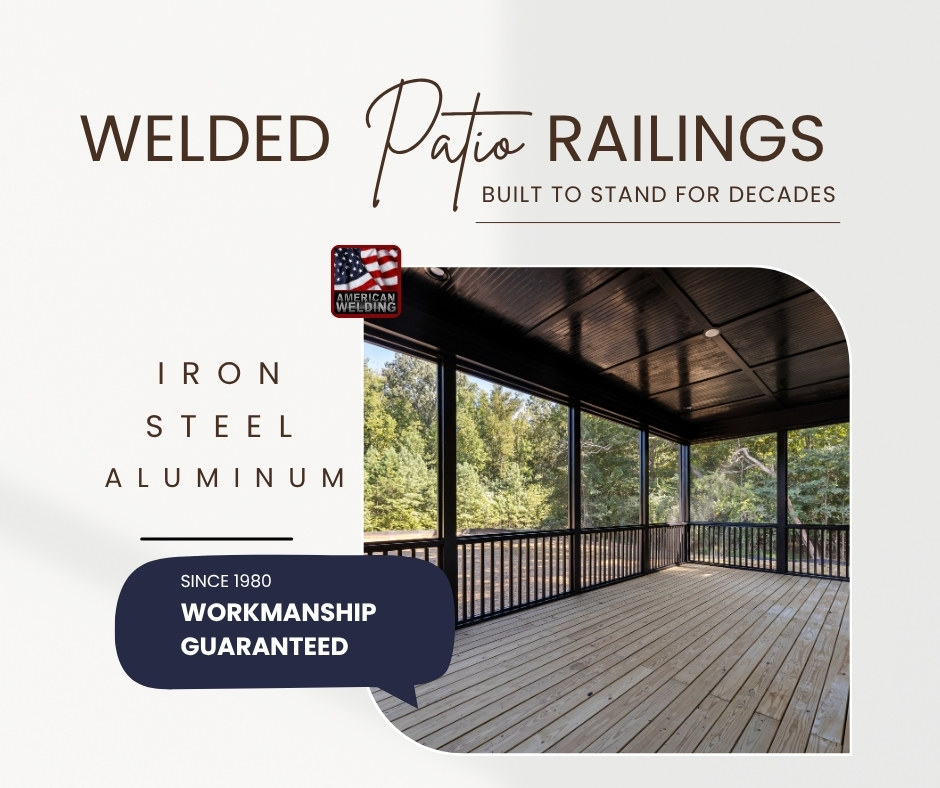
Welded Patio Railings Built to Stand for Decades
Patio railings don't fail all at once. They fail in slow motion: a weld cracking, a post leaning a little more every winter, a bolt working loose under daily use, until one day someone leans on it and it's gone.
The job of a well-built railing is never to reach that day.
We build, repair, and replace custom patio railings across Chicago and the suburbs. A welding career that started right out of high school in 1980 has built a reputation around railings that hold their line for decades; welded steel, wrought iron, and aluminum, designed to fit the home and handle Chicago winters, and backed by a workmanship guarantee.
What Makes a Good Patio Railing?
A patio railing has one job: to keep people from falling. Everything else (curb appeal, code, style) only matters if the railing actually does that one thing for as long as the patio stands.
What makes a railing reliable comes down to four things:
- The Right Metal
- Solid Welded Joints
- Proper Anchoring to the structure
- A finish that holds up to weather
Get those four right, and the railing lasts for decades. Skip any of them, and the slow failure starts the day it's installed.
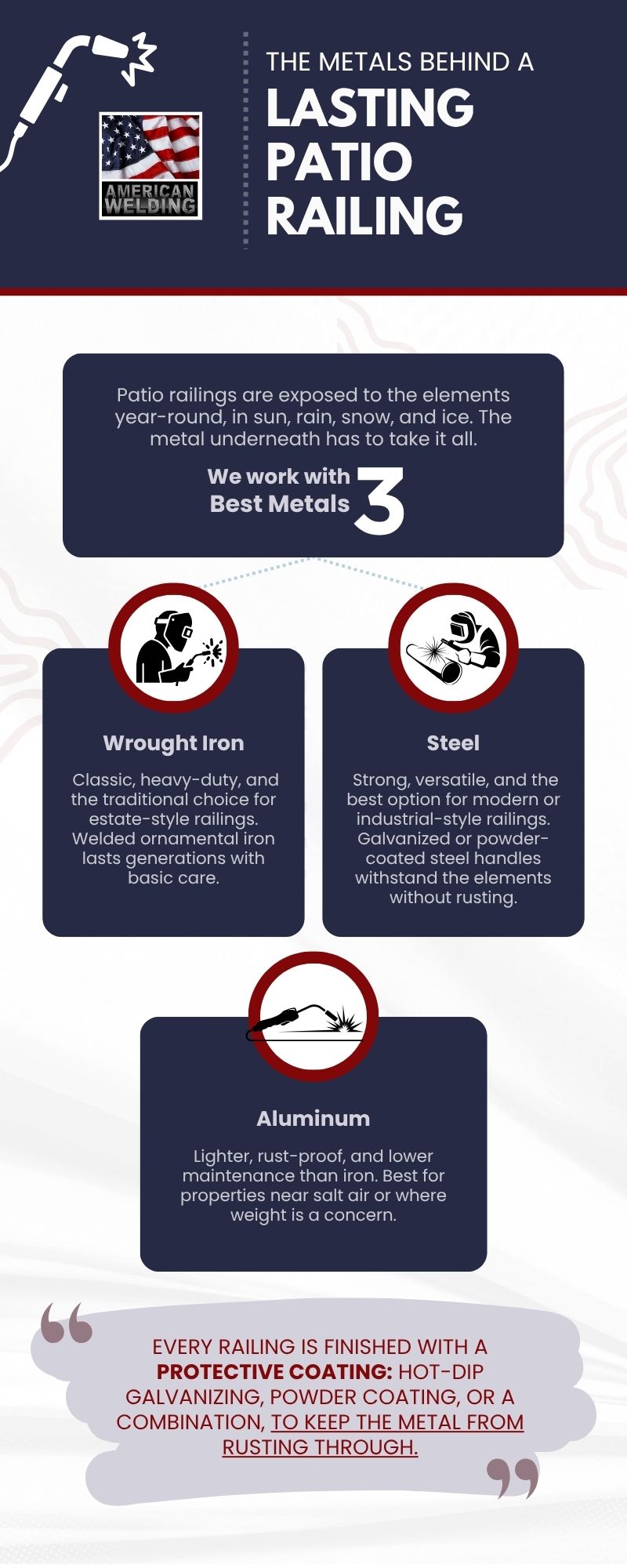
The Metals Behind a Lasting Patio Railing
Patio Railing Styles We Build
Every railing is built to fit the property, the architecture, and the homeowner's taste.
Common styles we fabricate:
- Traditional wrought iron: scrollwork, decorative tops, classic estate look
- Modern minimalist: horizontal lines, clean panels, contemporary feel
- Ornamental: custom patterns, monograms, decorative top rails
- Privacy panels: solid or partial-screen panels for limited sightlines
- Cable railings: modern look with horizontal cable runs
- Glass-panel railings: steel or aluminum frames with glass infill
- Mixed-material: metal frame with wood, composite, or stone caps
- ADA-compliant grab rails for accessible patios and walkways
Send us a photo of your patio or a reference image, and we'll design a railing that fits.
Repair vs Replace — Knowing When Each Is the Right Call
Not every railing needs replacing. Sometimes the right move is a welded repair that gets you another decade out of the original. Other times, repair costs more than starting fresh.
When a repair makes sense:
- A few cracked or broken welds
- One or two loose posts
- Surface rust on otherwise solid metal
- Bent sections that can be straightened and reinforced
When replacement makes more sense:
- Rust has eaten through the bottom rail or post bases
- Multiple posts are loose or moving
- The original installation never met code
- The railing was built from light-gauge metal that won't hold up much longer
We walk the railing with you, point out what's worth saving and what isn't, and give you both numbers, whether to replace or repair; so the choice is yours.
How Patio Railings Quietly Fail
Most patio railing failures don't happen suddenly. They build over time:
- Rust at the post base: moisture sits where the post meets the concrete or wood. The metal corrodes from the inside out, hidden until the base gives way.
- Cracked welds at the joints: old or undersized welds split as the railing flexes through temperature changes.
- Loose anchoring: bolts and brackets work loose over the years due to small movements. The railing wobbles before it falls.
- Heaving from frost: winter freezes lift posts a fraction of an inch each year. Over the course of a decade, the railing pulls itself apart.
- Worn-out finish: once the paint or coating fails, the underlying metal begins to rust quickly.
- Loose top rail: the part people actually lean on works loose first.
Catch any of these early, and a welded repair holds the line. Wait too long, and the whole railing needs replacing.
Code and Safety Requirements
Patio railings have to meet local building code for height, strength, and spacing. The most common requirements across Chicago-area municipalities:
- Minimum railing height
Usually 36 inches for residential patios, 42 inches for raised decks or commercial properties
- Vertical bar spacing
No more than 4 inches between bars (a child can't fit through)
- Load requirement
The railing must withstand a specified horizontal pushing force.
- Anchoring
Posts must be secured to the structure, not just sitting on the surface.
- ADA accessibility
Required for commercial and some multi-family properties
We build to your local code. If your HOA or city inspector has a spec sheet, send it over, and we'll match it.
Why Welded Patio Railings Last Longer
Off-the-shelf railings from a big-box store are bolted together, and the bolts loosen over time.
Welded railings are different:
- Continuous welded joints: no fasteners to work loose
- Built to fit your exact patio: not trimmed on-site or stretched to fit
- Heavier-gauge metal: thicker stock than mass-produced kits
- Properly anchored posts: set into the structure, not surface-mounted
- Weather-protected finish: galvanizing and powder coating that hold up
- Style matched to your home: custom design, not a catalog pick
- Workmanship guaranteed: every weld backed
A welded railing built right costs less over 20 years than an off-the-shelf kit that's replaced every 5 years.
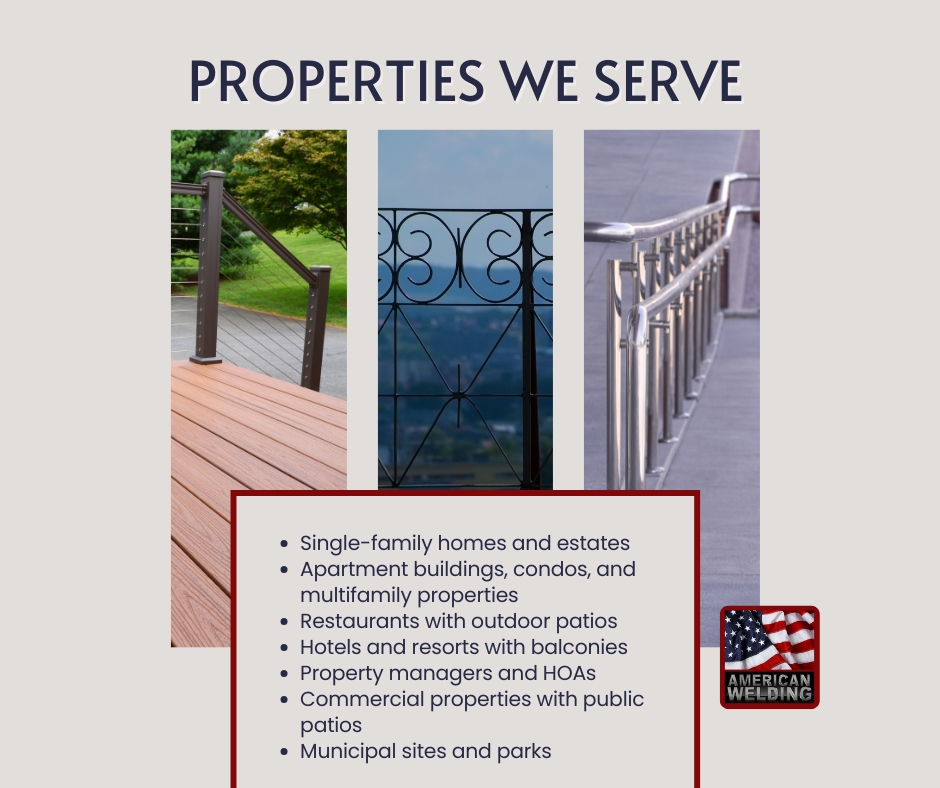
Properties We Serve
Service Areas We Cover
Based in DuPage County, our patio railing services run across:
- Chicago and the surrounding city neighborhoods
- DuPage County — Naperville, Wheaton, Downers Grove, Lisle, Oak Brook, Hinsdale, Wayne
- Cook, Will, Kane, Kendall, McHenry, and DeKalb Counties
- Larger residential and commercial projects across the wider Midwest
Patio Railings in DuPage County, IL
DuPage County's mix of estate properties, established neighborhoods, and commercial developments keeps custom patio railing work coming in steadily. From wrought-iron railings on historic homes in Wheaton and Naperville to modern aluminum railings on newer properties in Oak Brook and Hinsdale, the county covers nearly every style of patio railing imaginable.
Common DuPage railing projects include:
- Estate-style wrought iron
- Ornamental balcony railings
- Repair work on older railings damaged by years of weather
- and custom accessibility rails.
Send a photo and a quick description; most quotes go out the same day.
From Layout to Last Bolt — A Patio Railing Project
Every patio railing project moves through the same path:
- Call or text (630) 927-3030 — describe the patio and send photos if possible
- Free design consultation — material, style, height, and code review
- Site visit and measurement — exact dimensions, post placement, anchoring options
- Design sketch and written quote — clear pricing before any work starts
- HOA and code check — handled with you when needed
- Fabrication — built in our shop to your exact dimensions
- Installation — posts anchored, railing welded in place, finish protected
- Final walkthrough — railing tested, finish checked, shown to you
- Workmanship guarantee on every weld
Most patio railing projects take 1 to 3 weeks from quote to installation, depending on size and finish.
Frequently Asked Questions
How much does a custom patio railing cost?
Pricing depends on the length, height, material, and design. A simple straight railing costs far less than a large ornamental wrought-iron or multi-section run; every project is quoted on a per-project basis, with a clear price before any work begins.
What is the best material for a patio railing?
For Chicago weather, hot-dip galvanized or powder-coated steel and wrought iron last longest. Aluminum is lighter, rust-proof, and lower maintenance, but softer under impact. The right pick depends on the look you want and how much upkeep you're willing to do.
Can a damaged patio railing be repaired?
Yes, in most cases. Cracked welds, loose posts, broken sections, and rust patches can usually be welded back into shape for a fraction of the cost of replacement. If the railing is too far gone, we'll tell you straight.
How tall should a patio railing be?
Most residential patios need a 36-inch-tall railing. Raised decks and commercial patios usually need 42 inches. Local code may require more; we build to your municipality's specs.
How long does a welded patio railing last?
A properly welded wrought iron or steel railing with a good protective finish lasts 30 years or more with basic care—aluminum railings last 25 to 30 years. Off-the-shelf bolted railings often start failing in 5 to 10 years.
Do I need a permit for a new patio railing?
Many Chicago-area municipalities require a permit for new railings, especially on raised decks or commercial properties. HOA approval may also be needed. We handle the check with you as part of the quote.
Can you match the style of my home or existing railings?
Yes. Send us photos of the home or the existing railings, and we'll design something that matches. Most ornamental iron, modern, and accessibility styles can be replicated or extended.
What's the difference between a welded patio railing and a bolted one?
A welded railing has one-piece, fused joints that don't loosen over time. A bolted railing relies on hardware that can work loose over years of use, weather, and small movements. Welded railings are stronger, longer-lasting, and easier to repair down the road.
Ready for a Patio Railing That Won't Quietly Fail?
Whether you need a new custom railing on a fresh patio, a repair on an aging one, or a full replacement to bring your patio up to code, American Welding is the call to make.
📞 Call or text: (630) 927-3030
📧 Email: pete@americanwelding.us
🛠️ Service area: Chicago, DuPage County + suburbs + the Midwest
✅ Welded patio railings. Workmanship guaranteed.
Related services: Stair Railings · Driveway Gates · Dumpster Gates · Mobile Welding & Repair · Service Welding Truck · Portable Welding · Aluminum Welding · TIG Welding Service · Restaurant Stainless Steel Welding · Laser Welding