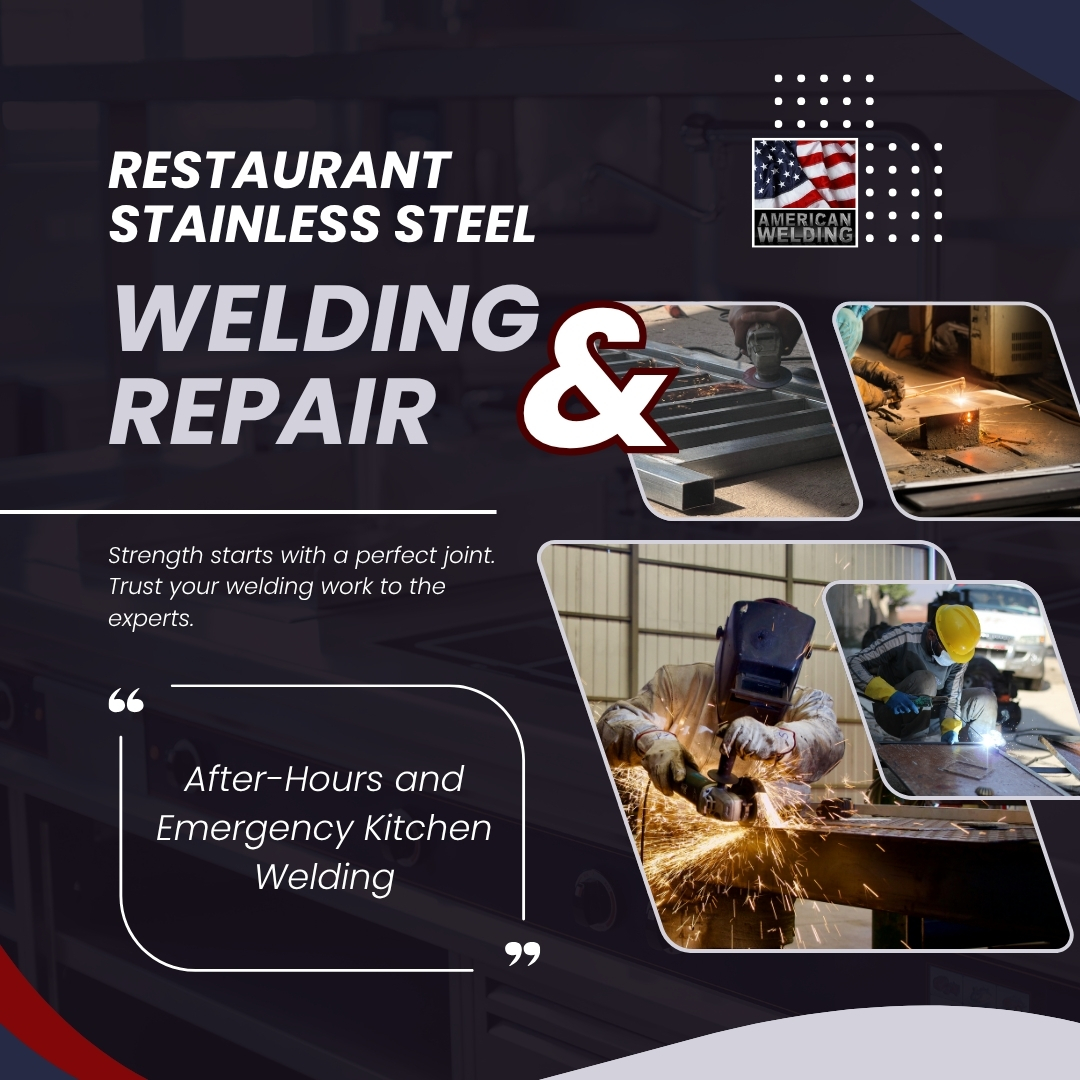
Restaurant Stainless Steel Welding & Repair in Chicago and the Suburbs
Cracked prep table leg during the dinner rush?
Hood failing inspection on Thursday?
A broken chain grill, with metal fatigue binding the chain drive gears?
Restaurant kitchens can't afford downtime, and stainless steel doesn't repair itself.
A working kitchen runs on stainless steel. From prep counters and exhaust hoods to sinks, dish tables, and walk-in racks, every shift puts pressure on every weld. When one cracks, splits, or rusts through, the kitchen loses time, fails inspections, or worst case, has to close.
We specialize in stainless steel welding, food-service repair, and fabrication for restaurants, bars, breweries, hotels, and commercial kitchens throughout Chicago and the suburbs.
"We weld stainless steel on-site, after hours when needed, with clean, durable welds that hold up to daily kitchen use."
What Is Restaurant Stainless Steel Welding?
Restaurant stainless steel welding is the specialized repair and fabrication of food-service equipment, such as prep tables, hoods, sinks, ovens, and racks, using welds clean enough to be safe in a food environment.
Done right, the welds come out smooth, durable, and easy to clean, so the repaired surface looks and works like the original equipment. Done right, the repaired surface is as sanitary as the original equipment.
This isn't shop-grade welding with sparks and slag. Kitchen welds need to look clean, withstand daily cleaning chemicals, and meet the same food-safety standards as the equipment itself.
Restaurant Equipment We Weld and Repair
After nearly 40 years on the job, we've welded just about every piece of stainless steel a kitchen runs on.
Common food service repair and fabrication jobs include:
- Prep tables and counters — cracked surface, bent legs, broken cross-braces
- Stainless sinks and dish tables — cracked basins, leaking drains, broken pedestals
- Exhaust hoods and ductwork — split seams, dented panels, rusted edges
- Walk-in cooler and freezer racks — broken welds, bent shelves, snapped supports
- Steam tables, bain-maries, and warmers — cracked liners, broken frames
- Backsplashes and wall flashing — split seams, missing corners
- Stainless cabinets and shelving — broken legs, cracked welds, dented panels
- Bar tops and ice bins — leak repairs, custom resizing
- Pass-through windows and shelves — built and installed to fit
- Custom fabrication — prep stations, hoods, shelves, splash guards built to spec
If it's stainless and it lives in a kitchen, there's a strong chance we've welded one before.
Why Stainless Steel Needs a Specialist Welder
Stainless is unforgiving. Wrong heat melts it. The wrong rod contaminates it. Wrong shielding gas turns the weld brown and porous. A bad weld doesn't just look ugly; it traps food, fails inspection, and rusts within weeks.
Most kitchen stainless steel is either 304 or 316 grade:
- 304 — most common, used for prep tables, sinks, hoods, and shelving
- 316 — higher corrosion resistance, used near salt, chlorine, or acidic food
We weld both, match the right filler rod and shielding gas, and grind and polish the bead so the joint blends back into the surface.
Welding Techniques for Kitchen Stainless
Stainless steel responds best to careful technique; the right heat, the right rod, the right pace.
TIG welding is the most common choice for kitchen work because it produces clean, precise welds with minimal mess.
Other techniques may be used when the job calls for it. What matters more than the method is the finish: the bead is dressed back smooth so the surface stays easy to clean and the joint blends into the original metal.
What Is 308 Welding Rod Used For?
Picking the right filler rod is half the job in stainless welding. Use the wrong rod, and the weld looks fine for a week; then it rusts, cracks, or fails inspection.
The most common rods for kitchen work are 308, 308L, and 316L.
- ER308 / 308L
The standard filler rod for welding 304 stainless steel. It matches the chromium and nickel content of 304, resulting in a clean, corrosion-resistant weld that withstands daily kitchen cleaning. The "L" stands for low carbon, which prevents weld cracking and rust at the joint.
- ER316L
Used when welding 316 stainless (the higher-grade alloy used near salt, chlorine, or acidic foods). It carries molybdenum, which protects the weld in harsh, corrosive environments.
- ER309L
Used when joining two different metals, like 304 stainless steel to mild steel.
The rod is chosen based on the metal being welded and the conditions the joint will live in. The wrong rod means rust within months. The right rod means the weld outlasts the equipment.
After-Hours and Emergency Kitchen Welding
Most kitchens can't shut down during service. That's why we work around your schedule; early mornings, late nights, weekends, and holidays. The kitchen is yours during business hours; the welder shows up after the last cover.
For true emergencies like a broken sink mid-service, a cracked hood before inspection, or a failed weld on a walk-in rack, we respond same-hour or same-day across Chicago and DuPage County—no after-hours surcharge.
The job gets done before doors open.
Common Challenges and Solutions in Restaurant Stainless Welding
Welding food-grade stainless steel inside a working kitchen comes with its own set of problems. Years of food service repair and fabrication on real job sites teach you how to handle them.
Here are the most common ones we see and how we fix them:
- Heat warping thin stainless panels: thin-gauge stainless warps under excessive heat.
Solution: lower the heat, work in short passes, and support the panel from behind to keep it flat.
- Brown or rainbow discoloration after welding, caused by oxygen reaching the weld zone.
Solution: better shielding and a clean post-weld treatment.
- Rust appears weeks after a repair, usually from carbon left behind by tools used on regular steel.
Solution: Use stainless-steel tools only and finish the joint properly so the natural rust resistance is restored.
- Pitting or pinhole leaks in sink basins are common in older sinks exposed to chlorine cleaners.
Solution: cut out the damaged metal, weld in a fresh patch, grind smooth, and polish to match.
- Weld that won't blend into the original finish
Solution: match the original brushed or polished surface by buffing through finer grits until the weld disappears.\
- Welding near gas, fryers, or grease is a real fire risk in any kitchen.
Solution: Every job is set up with full fire precautions before the first arc is struck.
- Repair scheduled during operating hours
Solution: most kitchen work is scheduled after-hours or on closed days, so service isn't disrupted.
Knowing where the trouble hides is what separates a clean kitchen weld from one that fails inspection three weeks later.
Industries and Customers We Serve
- Independent restaurants and chains
- Bars, breweries, and tap rooms
- Hotel and resort kitchens
- Catering and banquet kitchens
- Hospital, school, and corporate cafeterias
- Food trucks and ghost kitchens
- Bakeries, butcher shops, and delis
- Commissaries and food processors
Service Areas We Cover
Based in DuPage County, our restaurant's routes run through:
- Chicago and the surrounding city neighborhoods
- DuPage County — Naperville, Wheaton, Downers Grove, Lisle, Oak Brook, Aurora, Wayne
- Cook, Will, Kane, Kendall, McHenry, and DeKalb Counties
- Larger food-service projects across the wider Midwest
Not sure if your address is covered? Please call us if we can help; we will.
Why Choose a Specialist Welder for Your Kitchen
Most general welders don't run TIG, don't carry food-grade rod, and don't know how to finish a stainless weld so it passes NSF. The right specialist saves you money, time, and the headache of a weld that won't hold.
What you get with a specialist mobile kitchen welder:
- TIG welding on food-grade 304 and 316 stainless steel
- Sanitary welds that pass health inspection the first time
- Full food service, repair, and fabrication — repairs, custom builds, and one-off pieces under one roof
- After-hours service so the kitchen stays open during the day
- Polished, clean, corrosion-resistant finishes that match the original equipment
- Fast response across Chicago and the suburbs
- Artistry guaranteed — if a weld we made fails, we come back and make it right
- Honest pricing — repair costs are a fraction of replacement costs
A clean weld on a $4,000 prep table or $8,000 hood beats a full replacement every time.
How to Get Work Done?
- Please call or text (630) 927-3030 and describe the equipment; if possible, send a photo.
- Free quote; clear pricing, no surprise trip fees
- Schedule the visit; after-hours or before opening when needed
- On-site safety check: gas, fire, and electrical lockout
- TIG weld, grind, polish, and finish; finished to a food-safe standard
- Final inspection with you; surface clean, sanitary, ready for service
- Artistry guarantee: written warranty on every weld
You stay in the loop at every step. No surprises, no upsells, no rushed jobs.
Frequently Asked Questions
Want the background? why restaurants use stainless steel.
What is food-grade stainless steel welding?
Food-grade stainless steel welding is the process of joining or repairing 304/316 stainless steel equipment using TIG welding, followed by grinding and finishing the joint to meet food-safety and sanitation standards.
Can you weld stainless steel in a working kitchen?
Yes, but it's almost always scheduled after hours, so service isn't disrupted. We work around your hours, set up fire and fume containment, and finish the job overnight or before opening.
What's the difference between 304 and 316 stainless steel?
304 is the most common kitchen grade, used for prep tables, sinks, and hoods. 316 has better corrosion resistance and is preferred in areas exposed to salt, chlorine, or acidic foods. We weld both.
What rod is used to weld 304 stainless steel?
ER308L is the standard filler rod for welding 304 stainless steel. It matches the chromium-nickel content of 304 and produces a corrosion-resistant, food-safe weld.
What is the best welding process for stainless steel kitchen equipment?
TIG welding (GTAW) is the best process for food-grade stainless steel. It produces clean, slag-free welds with minimal heat distortion and meets NSF sanitation standards after polishing and finishing.
Can a cracked stainless steel sink be welded?
Yes. Most cracked sinks, prep tables, and dish stations can be TIG-welded, polished, and finished for a fraction of the cost of replacement.
Is welded stainless steel food safe?
Yes, when the weld is TIG'd with the correct filler rod, ground flush, polished, and finished. Every joint we finish is brought back to NSF and health code standards.
How much does it cost to repair a stainless steel prep table or sink?
Most repairs are quoted at a flat rate based on the equipment and the damage. We always give a clear quote before any work starts, no surprise fees.
How long does a kitchen weld repair take?
Small repairs (cracked sink, broken bracket, hood seam) typically take 1–3 hours on-site. Larger custom jobs are scheduled in stages so the kitchen never closes.
Do you work after hours so we don't have to close?
Yes, most restaurant work is scheduled overnight, early morning, or on a closed day—no after-hours surcharge.
Will the weld pass a health inspection?
Yes. Every joint is polished smooth and finished to meet NSF and health department sanitation standards.
Ready for a Welder Who Won't Shut Your Kitchen Down?
Whether you're prepping for an inspection, recovering from a mid-service breakdown, or planning a custom kitchen build, American Welding is the call to make.
📞 Call or text: (630) 927-3030
📧 Email: pete@americanwelding.us
🛠️ Service area: Chicago + suburbs + the Midwest
✅ NSF-quality welds. Artistry guaranteed.