Welded Stair Railings Built to Be Used Every Day
Stair railings get used a lot. Every other railing on a property, patio, balcony, or fence exists for looks and the occasional lean. The stair railing actually does work. It catches kids, it steadies grandparents, it holds firm when someone slips.
A well-built one does that quietly for thirty years. A poorly built one becomes a problem the day it's installed.
American Welding builds, repairs, and replaces custom stair railings across Chicago and the suburbs. Four decades of repair work have shown what makes a stair railing hold its line: solid welded joints, the right metal for the location, and proper anchoring at every post—quality work, guaranteed.
What Makes a Stair Railing Different?
A stair railing isn't just a patio railing turned sideways. The forces on it are different; every step puts a small load on the rail, every grip pulls or pushes on the connection points, every season's expansion and contraction tugs at the joints between posts.
Indoor stair railings are subject to daily contact and the wear that comes with it. Outdoor stair railings handle that plus weather, ice, and freeze-thaw cycles that loosen anything bolted together. Either way, the railing has to be welded and anchored to take it all without giving up.
The Metals That Hold the Stairs
The right metal depends on where the railing lives. Indoor railings can be lighter and more decorative; outdoor railings need to handle the weather.
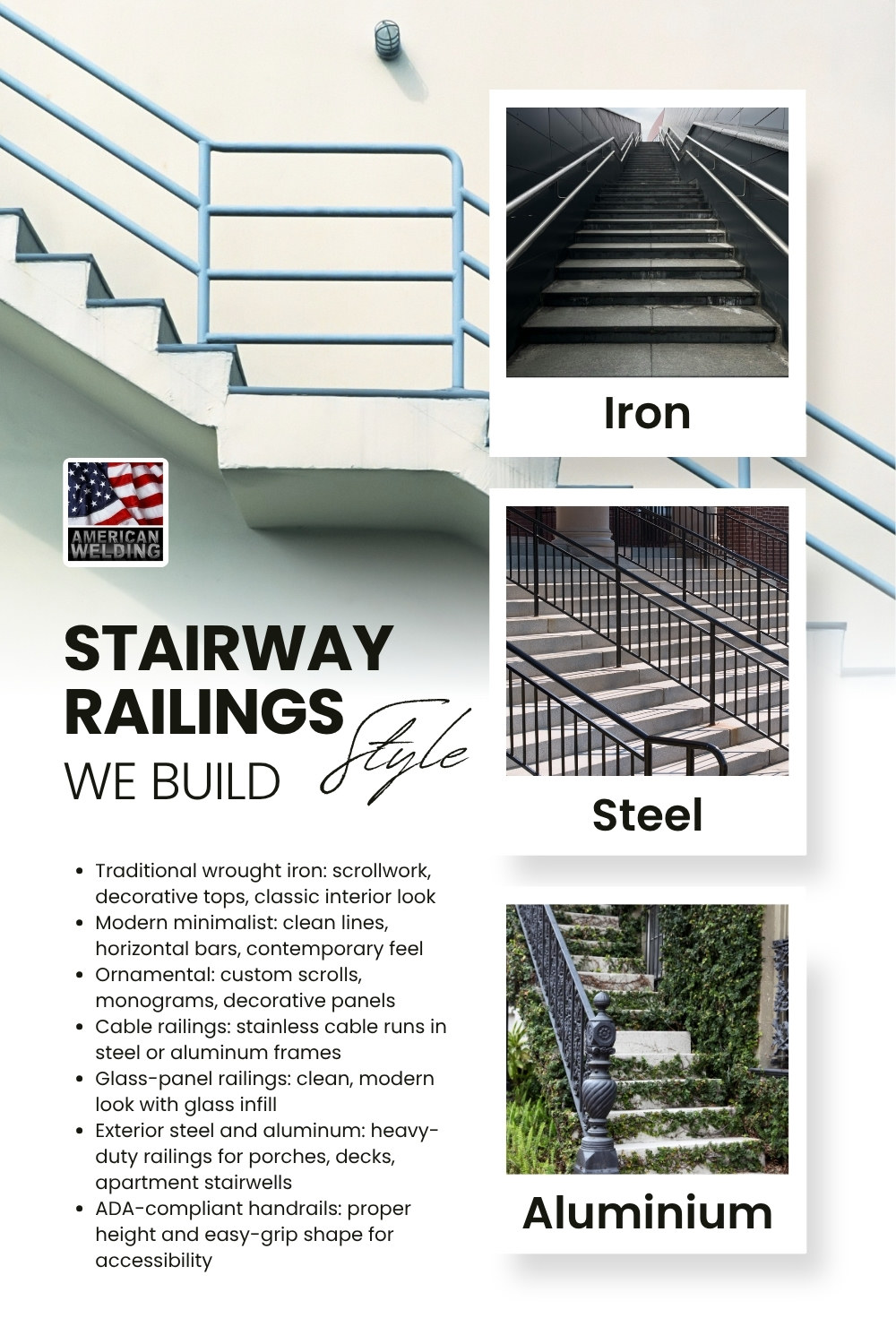
We work with the three that hold up best:
- Wrought iron:
The classic for interior staircases. Ornamental, heavy-duty, and built to last generations. Common in historic homes and traditional architecture.
- Steel:
Versatile and strong, used for everything from modern interior railings to exterior stair systems. Galvanized or powder-coated steel handles withstand year-round weather.
Lighter, rust-proof, and lower maintenance. Best for exterior stair railings on decks, apartment buildings, and properties where weight is a concern.
Every railing, indoor or out, gets a finish that holds up: powder coating, hot-dip galvanizing, or a quality protective paint for interior work.
Stair Railing Styles We Build
Every railing is built to fit the staircase, the architecture, and the homeowner's taste. Common styles:
Send us a photo of your staircase or a reference image, and we'll design a railing that fits.
Indoor vs Outdoor Stair Railings
These two are really different jobs:
Indoor stair railings are about look, feel, and daily comfort. They need to feel solid under the hand, sit right with the home's style, and withstand years of use and touch. Wrought iron and decorative steel are most common.
Outdoor stair railings are about weather first. Ice, snow, expansion and contraction, and constant moisture take a steady toll. Galvanized or powder-coated steel and aluminum hold up best, with welded joints that don't loosen the way bolted connections do.
A lot of stair railing replacement work happens when an indoor or outdoor railing was built with the wrong approach. Outdoor-grade metal indoors looks heavy; indoor-grade metal outside rusts within a few seasons.
Where Stair Railings Loosen Over Time
Stair railings rarely fail all at once. They loosen, wobble, then fail. The common spots:
- The top of the rail: where hands grip and pull. Years of use loosen the joint between the rail and the newel post (the heavy main post at the top of the stairs).
- Newel posts at the bottom of the stairs — anchored to the floor, but anchoring loosens over time, especially in older homes where the floor itself has shifted.
- Welded joints between the rail and vertical bars — small cracks form as the railing flexes under daily use.
- Outdoor connection points — moisture sits at every bolt and joint, and rust starts there first.
- Wall-mounted brackets — pulled-out drywall anchors, loose bolts, broken brackets.
- Bottom edges of exterior railings — where snow piles up against the metal and freezes.
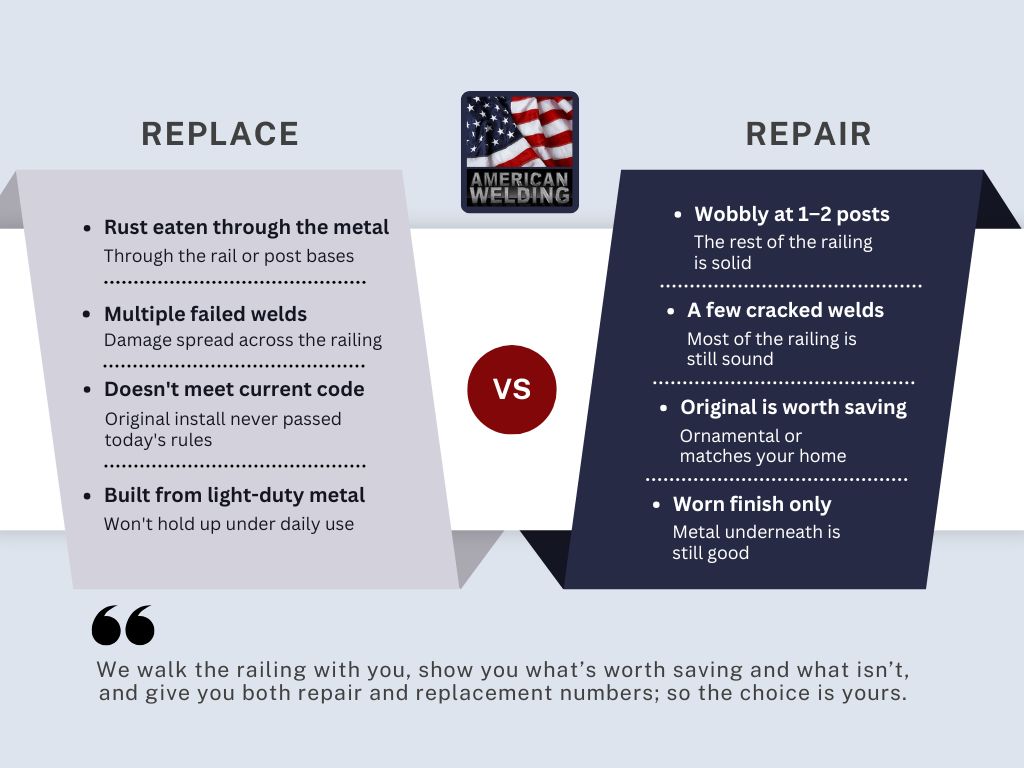
Catch any of these early, and a welded repair holds the line. Wait too long, and the whole railing needs replacing.
Code and Safety Requirements
Stair railings have specific code rules because of their safety role:
- Handrail height — usually 34 to 38 inches above each step for residential, 42 inches for commercial
- Easy-grip shape — handrails have to be a shape and size that hands can wrap around
- Vertical bar spacing — no more than 4 inches between bars (a child can't fit through)
- Continuous handrail — the rail has to run the full length of the stairs without a gap
- ADA accessibility — required for commercial properties and some multi-family buildings
- Load requirement — the rail has to hold up to a defined horizontal push and pull
We build to your local code. If your HOA, building inspector, or property manager has a spec sheet, send it over, and we'll match it.
Repair vs Replace — When Each Makes Sense
Not every old stair railing needs replacing. Some need a few welded fixes; others are beyond saving.
Why Welded Stair Railings Don't Wobble
Off-the-shelf stair railings from a big-box store are bolted together at every connection. Bolts loosen every time a hand grips the rail, every time someone leans on it, every time the temperature shifts. Welded railings are different:
- Continuous welded joints — no fasteners to work loose
- Built to fit your exact staircase — measured on-site, fabricated to spec
- Heavier-gauge metal — thicker stock than mass-produced kits
- Newel posts anchored deep into the structure — not surface-mounted
- Weather-protected finish — galvanizing and powder coating built to last
- Style matched to your home — custom design, not a catalog pick
- Workmanship guaranteed — every weld backed
A welded railing built right costs less over 20 years than an off-the-shelf kit that is replaced every 5 years.
Properties We Serve
- Single-family homes and estates
- Apartment buildings, condos, and multifamily properties
- Restaurants and businesses with public stairs
- Hotels and resorts with interior and exterior stair systems
- Property managers and HOAs
- Commercial properties with accessibility requirements
- Municipal buildings and public access stairs
Service Areas We Cover
Based in DuPage County, our stair railing services run across:
- Chicago and the surrounding city neighborhoods
- DuPage County — Cities like Naperville, Wheaton, Downers Grove, Lisle, Oak Brook, Hinsdale, Wayne
- Cook, Will, Kane, Kendall, McHenry, and DeKalb Counties
- Larger residential and commercial projects across the wider Midwest
Stair Railings in DuPage County, IL
Stair railing work in DuPage County splits cleanly into two kinds of calls — indoor and outdoor. Indoor work tends to come from older homes: wrought-iron banisters that have loosened over decades, ornamental rails in need of restoration, and modern updates to interior stairs in remodeled homes across Naperville and Wheaton. Outdoor work tends to be repair-driven — exterior steel and aluminum railings on decks, porches, and apartment stairwells in Downers Grove, Oak Brook, and Hinsdale.
Common DuPage stair railing jobs include loose interior banisters, broken newel posts, exterior railing repair after winter damage, code-compliant replacements for older systems, and custom ornamental work for restored homes. Drop a photo or call with a description — most quotes go out the same day.
From First Step to Final Coat — A Stair Railing Project
Every stair railing project follows the same path:
- Call or text (630) 927-3030 — describe the staircase and send photos if possible
- Free design consultation — material, style, height, and code review
- Site visit and measurement — exact dimensions, post placement, anchoring options
- Design sketch and quote — clear pricing before any work starts
- HOA and code check — handled with you when needed
- Fabrication — built in our shop to your exact dimensions
- Installation — posts anchored, railing welded in place, surfaces protected
- Final walkthrough — railing tested, finish checked, shown to you
- Workmanship guarantee on every weld
Most stair railing projects take 1 to 3 weeks from quote to installation.
Frequently Asked Questions
How much does a custom stair railing cost?
Pricing depends on the staircase's length, height, material, and design. A simple straight stair railing costs far less than a large ornamental wrought-iron system; every project is quoted on a per-project basis, with a clear price before any work begins. Every quote is clear and upfront before work begins.
What is the best material for a stair railing?
Indoors, wrought iron and decorative steel are the most common, long-lasting, and traditional. Outdoors, galvanized or powder-coated steel and aluminum hold up best in Chicago weather. The right pick depends on the location, look, and budget.
Can a loose or wobbly stair railing be repaired?
Yes, in most cases. Wobbly railings usually trace back to loosened posts, cracked welds, or worn anchoring. A welded repair tightens the connections and brings the railing back to solid, often for a fraction of the replacement cost.
How tall should a stair railing be?
Residential stair railings are usually 34 to 38 inches above each step. Commercial properties often require 42 inches. Local code may vary; we build to your municipality's spec.
Do I need a permit for a new stair railing?
Many Chicago-area cities require a permit for new stair railings, especially on raised decks, exterior stairs, or commercial properties. HOA approval may also be needed. We handle the check with you as part of the quote.
Can you match the style of my home or existing railings?
Yes. Send photos of the home or existing railings, and we'll design something that matches. Most wrought iron, modern, and traditional styles can be replicated or extended.
How long does a welded stair railing last?
A properly welded wrought iron or steel stair railing lasts 30 years or more with basic care—aluminum stair railings last 25 to 30 years. Off-the-shelf bolted railings often begin to loosen within 5 to 10 years.
What's the difference between a welded stair railing and a bolted one?
A welded railing has one-piece, fused joints that don't loosen over time. A bolted railing relies on hardware that works loose every time hands grip the rail. Welded railings are stronger, longer-lasting, and easier to repair down the road.
Ready for a Stair Railing That Holds Firm?
Whether you need a new custom railing for a fresh staircase, a repair on a wobbly old one, or a code-compliant upgrade to your existing system — American Welding is the call to make.
📞 Call or text: (630) 927-3030
📧 Email: pete@americanwelding.us
🛠️ Service area: Chicago, DuPage County + suburbs + the Midwest
✅ Welded stair railings. Workmanship guaranteed.
Related services: Patio Railings · Driveway Gates · Dumpster Gates · Mobile Welding & Repair · Service Welding Truck · Portable Welding · Aluminum Welding · Cast Iron Welding · TIG Welding Service ·