Specialty TIG Welding Services Across Chicagoland
There's welding, and there's TIG welding.
The difference shows in every joint; the seam you can run your finger over, the weld that doesn't warp the metal around it, the beads that disappear into the surface.
After almost 40 years, TIG remains the most demanding process in the trade, and the one that separates a welder from a craftsman.
American Welding provides specialty TIG welding services across Chicago and the suburbs, for:
Where the weld has to look as good as it holds. Backed by a workmanship guarantee on every joint.
What Is TIG Welding?
TIG stands for Tungsten Inert Gas welding (also called GTAW). It uses a tungsten electrode and a clean stream of shielding gas (usually argon) to create a precise, controlled arc. Unlike other welding methods, the welder controls the heat with one hand and feeds the filler rod with the other.
The result is a slow, clean, controlled weld. No spatter. No slag. No mess to clean up afterward. Just a smooth, finished joint that often doesn't need grinding or polishing.
TIG is the method used when the weld matters as much as the metal underneath.
When TIG Is the Right Choice
When the job calls for:
- Thin metals: TIG runs cooler and won't burn through
- Visible welds: the bead is clean and finished without grinding
- Sensitive metals: aluminum, stainless, magnesium, copper, brass, titanium
- Tight tolerances: minimal heat means minimal warping
- Food-safe or sanitary surfaces: smooth welds that wipe clean
- Decorative or architectural work: the joint becomes part of the design
If the weld is seen, touched, cleaned, or scrutinized, TIG is usually the answer.
TIG welding isn't the fastest method. MIG welding lays down metal faster. Stick welding handles thicker, dirtier steel.
Advantages of TIG Welding
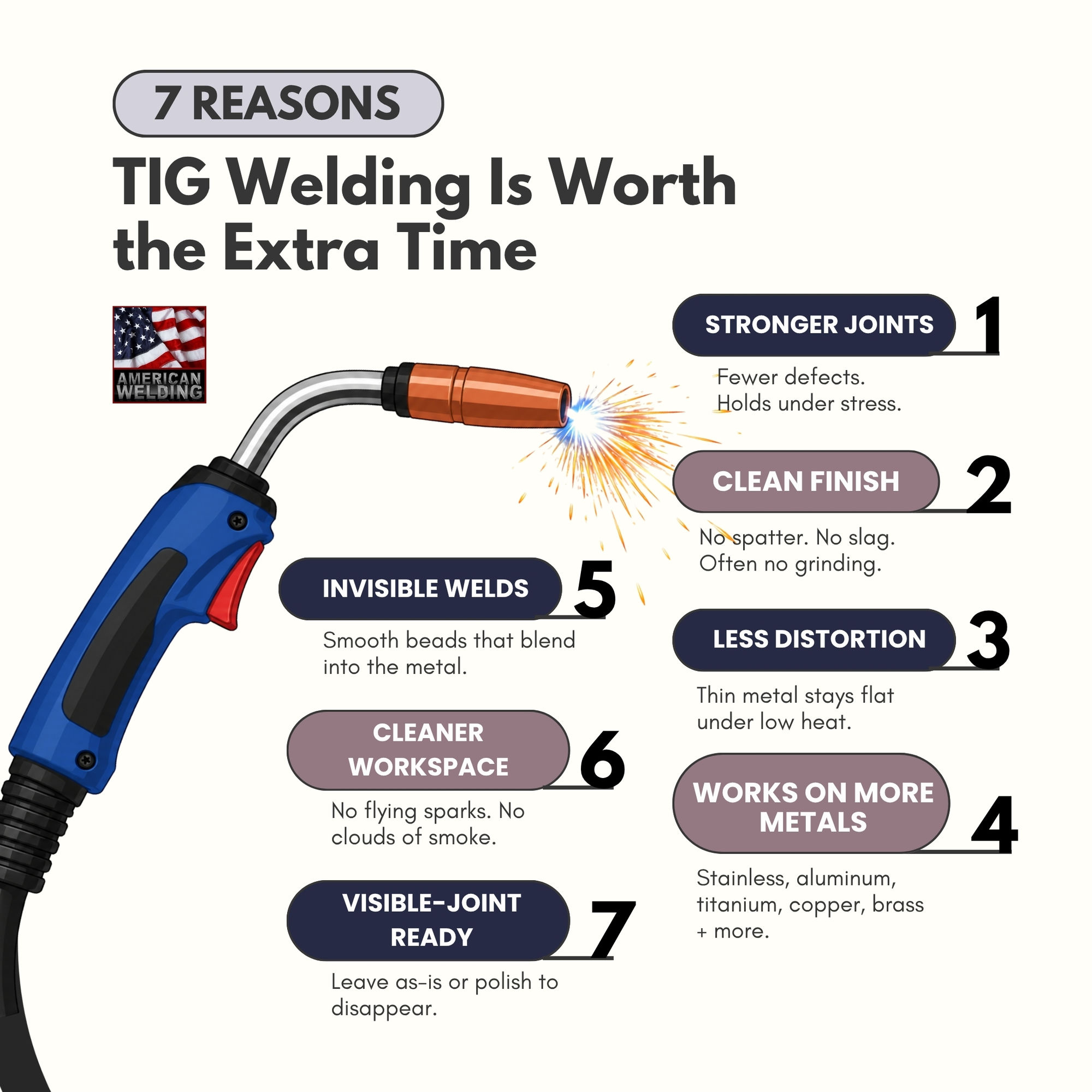
There's a reason TIG is the method of choice for high-end work. The advantages add up across the whole job:
Where appearance matters as much as strength, such as restaurant equipment, ornamental metalwork, and custom builds, TIG is almost always worth the extra time.
The Metals TIG Welding Handles
TIG welding works on metals that other processes can't safely touch. Common ones we work with:
- Stainless steel: 304 and 316, used in kitchens, food service, and architectural work
- Aluminum: all common grades, from thin sheet to structural tube
- Carbon steel: when the finish has to be clean
- Mild steel: thin gauge or decorative pieces
- Copper, brass, bronze: plumbing, art, restoration
- Magnesium: automotive, aerospace
- Titanium: high-performance and specialty parts
- Exotic and mixed alloys: restoration and one-off projects
The filler rod and shielding gas change with the metal. So does the technique. Knowing which combination to use is half the craft.
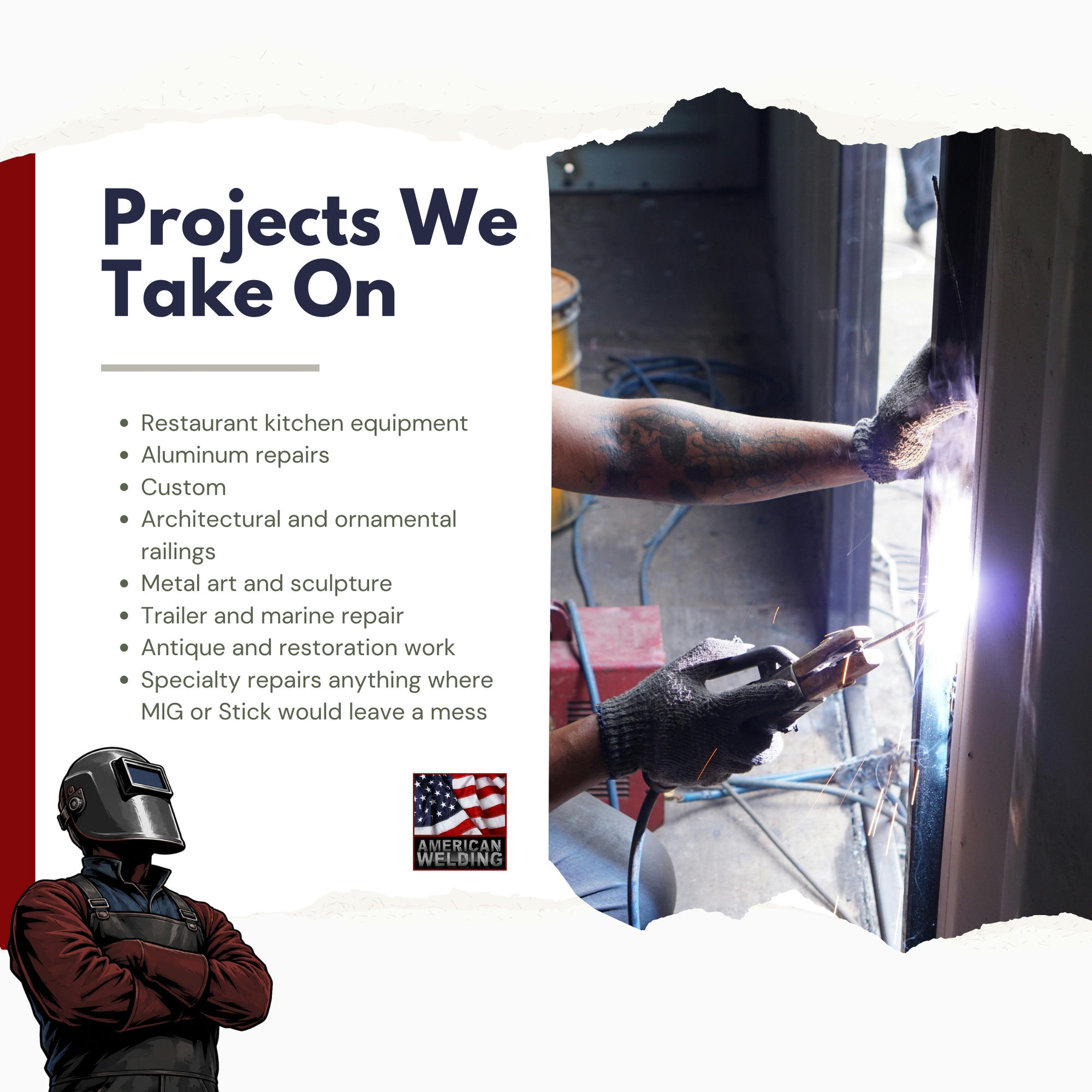
Projects We Take On
TIG welding work covers a wide range of one-off and repair jobs:
If you've been told a piece can't be welded, send us a photo. Many of those jobs can be done with TIG.
Industries We Serve
- Restaurants, bars, breweries, and commercial kitchens
- Architects and interior designers
- Manufacturers and fabrication shops
- Marine and boatyards
- Motorsport, hot rod, and custom bike shops
- Artists and metal sculptors
- Property managers and facility operators
- Other contractors who need a TIG subcontractor
TIG Welding Applications
TIG welding shows up in almost every industry where metal has to be joined cleanly:
- Automotive: exhaust systems, chassis components, body panels, custom builds
- Aerospace: fuel tanks, engine parts, landing gear, lightweight aluminum components
- Food service: kitchen equipment, sinks, prep tables, sanitary surfaces
- Marine: aluminum boat hulls, fittings, trailers
- Construction: pipes, structural steel where finish matters, architectural metalwork
- Custom builds: motorcycle frames, hot rod parts, bike frames, race car components
- Art and design: sculpture, decorative panels, restoration of vintage pieces
- Manufacturing: precision parts, prototype work, small-run production
Wherever metal has to be joined, and the joint can't fail or has to look perfect, TIG is the method called in.
Where TIG Welds Go Wrong — And How They're Done Right
TIG is unforgiving. Small mistakes show up as obvious flaws: discoloration, cracks, burn-through, contamination.
Here's what we watch for on every job:
- Brown or rainbow discoloration around the weld is caused by oxygen reaching the joint—the right way: better shielding, slower travel, and clean post-weld treatment.
- Cracking after the weld cools is caused by cooling too fast or the wrong filler rod.
Right way: match the rod to the metal, control the cool-down.
- Distortion or warping in thin metal occurs due to excessive heat.
Right way: lower amperage, short passes, support the metal from behind.
- Tungsten contamination in the weld occurs when the electrode contacts the puddle.
Right way: steady hand, proper arc length, sharp tungsten.
- Lack of penetration is caused by too little heat or moving too fast.
Right way: slower travel, higher amperage, proper joint prep.
- Contaminated welds on aluminum occur due to surface oxides.
The right way: clean the metal thoroughly before striking the arc.
TIG mistakes are obvious. That's why the people who do it well charge for the skill, not just the time.
Why TIG Work Goes to Specialists
Most welders can MIG or stick-weld a steel frame. TIG is a different skill set, and it shows fast.
Specialist TIG work brings:
- Clean, finished welds that often need no grinding or polishing
- Minimal warping on thin or sensitive metal
- The right rod and gas for every metal, every time
- Both hands working; torch and filler controlled separately
- Quiet, controlled welding; no spatter, no fumes flying
- Decades of muscle memory; TIG is a hand skill that takes years to build
- Workmanship guaranteed
For thin metal, visible welds, or anything where MIG won't cut it, TIG is the method, and the welder behind the torch matters as much as the equipment.
On-Site vs In-Shop TIG Welding
TIG welding needs controlled conditions, clean gas, no wind, and no contamination. That means most TIG fabrication is built in the shop. On-site visits are mainly for repairs of existing equipment that can't be moved; broken kitchen sinks, on-site railings, marine work, and small fixes.
Most repairs are wrapped up in one visit. Larger fabrication projects are built in the shop and installed on-site, which usually takes two or three trips, depending on size.
Service Areas We Cover
Based in DuPage County, our TIG welding services run across:
- Chicago and the surrounding city neighborhoods
- DuPage County — Naperville, Wheaton, Downers Grove, Lisle, Oak Brook, Hinsdale
- Cook, Will, Kane, Kendall, McHenry, and DeKalb Counties
- Larger projects across the wider Midwest
TIG Welding in Wheaton, IL
Wheaton has a steady mix of restaurants, retail kitchens, custom homes, and small manufacturers, all of which need TIG welding done right. From stainless prep tables in Front Street restaurants to ornamental aluminum railings in older homes, the work spans both ends of the trade.
Common Wheaton-area TIG jobs include:
- Stainless kitchen repairs for local restaurants and cafés
- Aluminum trailer and boat repair
- Ornamental and architectural welding
- Custom motorcycle and bike work
- Restoration and antique repair
Send a photo and a quick description; most quotes go out the same day.
From First Tack to Final Bead — The TIG Project Workflow
Every TIG project moves through the same clean path:
- Call or text (630) 927-3030 — describe the metal, the job, and send photos if possible
- Free consultation — confirm the metal, the joint, and whether TIG is the right method
- Site visit if needed — for larger fabrication projects or on-site repairs
- Written quote — clear pricing on paper before any work starts
- The work — most repairs done in one visit; fabrication built in the shop and installed on-site (usually 2–3 trips)
- Final inspection with you — clean joint, finished surface, ready for use
- Workmanship guarantee — written warranty on every weld
Frequently Asked Questions
What is TIG welding used for?
TIG welding is used wherever the joint needs to be clean and precise, or when working with metals that other processes can't handle — stainless kitchen equipment, aluminum boats and trailers, decorative railings, custom bike frames, sculpture, and restoration work.
How is TIG welding different from MIG welding?
MIG welding feeds wire automatically and lays down metal quickly — good for thicker structural steel. TIG welding uses a non-consumable tungsten electrode and a separate filler rod, giving the welder full control over heat and metal placement. TIG is slower and cleaner, and is used where finish or thin metal matters.
Is TIG welding stronger than MIG?
Both can produce strong welds. TIG generally produces cleaner welds with fewer defects, which makes the joint more reliable in thin or sensitive metals. MIG is better for heavy structural work where speed matters.
What metals can be TIG welded?
Stainless steel, aluminum, carbon steel, mild steel, copper, brass, bronze, magnesium, titanium, and most specialty alloys. The filler rod and shielding gas are matched to the metal.
How much does TIG welding cost?
TIG welding generally costs more than MIG because it takes longer and requires more skill. Pricing depends on the metal, the size of the job, and the finish needed. Every quote is sent in writing before work starts — no surprises.
Can TIG welding be done on-site?
Yes, for repairs and smaller jobs where conditions can be controlled. Larger TIG fabrication is built in the shop and installed at the site, usually over 2–3 visits.
Why is TIG welding more expensive than other methods?
TIG is slower, more precise, and harder to do well. It also uses cleaner gas, finer filler rod, and more setup time. The price reflects the skill, not just the materials.
Can you TIG weld a cracked aluminum part?
Often, yes. Cracked aluminum on boats, trailers, automotive panels, and marine fittings can usually be TIG-welded back together for a fraction of replacement cost. Send a photo for a quote.
Is TIG welding suitable for thin materials?
Yes — TIG is one of the few welding methods that handles thin metal well. The low heat input and precise control make it ideal for thin-gauge stainless, aluminum, and decorative work where other methods would warp or burn through.
What safety precautions should I take during TIG welding?
Common TIG welding safety practices include proper eye and face protection, gloves, flame-resistant clothing, good ventilation to manage fumes, and a clean work area free of flammable material. Every job site we work on is set up carefully before the first arc is struck. Fully insured on every call.
How can I troubleshoot common TIG welding problems?
Most TIG welding issues come down to a few causes — poor shielding gas coverage, the wrong filler rod, contaminated metal, or excessive heat. See the section above on where TIG welds go wrong for the most common problems and how to handle them. If you're not sure what's wrong with an existing weld, send us a photo, and we'll diagnose it.
Ready for a Weld That Looks as Good as It Holds?
Whether it's a cracked stainless sink, a broken aluminum trailer, a custom build, or a repair nobody else wants to take on — American Welding is the call to make.
📞 Call or text: (630) 927-3030
📧 Email: pete@americanwelding.us
🛠️ Service area: Chicago, Wheaton + suburbs + the Midwest
✅ Precision TIG work. Workmanship guaranteed.
Related services: Mobile Welding & Repair · Restaurant Stainless Steel Welding · Driveway Gates · Dumpster Gates · Patio Railings · Stair Railings