How to Weld an Exhaust Pipe
A blown-out exhaust is loud, embarrassing, and usually an easy fix if you respect how thin the metal is.
Most people who burn a hole through a pipe did not fail at welding — they just ran too much heat for too long.
Exhaust tubing is thin, so the trick is low heat, a tight fit, and short stitch welds so you do not blow through.
At American Welding, we patch and splice exhaust and tubing on trucks, trailers, and equipment all over Chicagoland. Owner Pete Adams has been on the torch since 1980 and has run this shop out of Wayne, Illinois since 1989, so he has seen every way a tailpipe fails. Here is how exhaust welding actually works, how to do it yourself without wrecking the pipe, and when it is smarter to call someone in.
What Makes Exhaust Pipe Hard to Weld
Exhaust is not like welding a trailer hitch or a gate. The metal is unforgiving, and three things fight you the whole way.
- The wall is paper-thin. Most exhaust tubing runs around sixteen to eighteen gauge, far thinner than structural steel. There is almost no metal to absorb heat, so the puddle wants to drop straight through.
- It blows through in an instant. Hold the arc one beat too long and you trade a small crack for a big hole. Thin tube gives you no warning the way thick plate does.
- It is usually rusty or aluminized. Factory pipe is often aluminized or stainless, and older pipe is scaled with rust and road salt. Welding over that scale gives you a weak, pin-holed bead that leaks and fails fast.
Get past those three and exhaust welding is straightforward. The whole game is managing heat and starting with clean, well-fitted metal.
The Best Welding Process for Exhaust
Not every process suits thin tubing. The right one comes down to how much control you have over the heat going into that fragile wall.
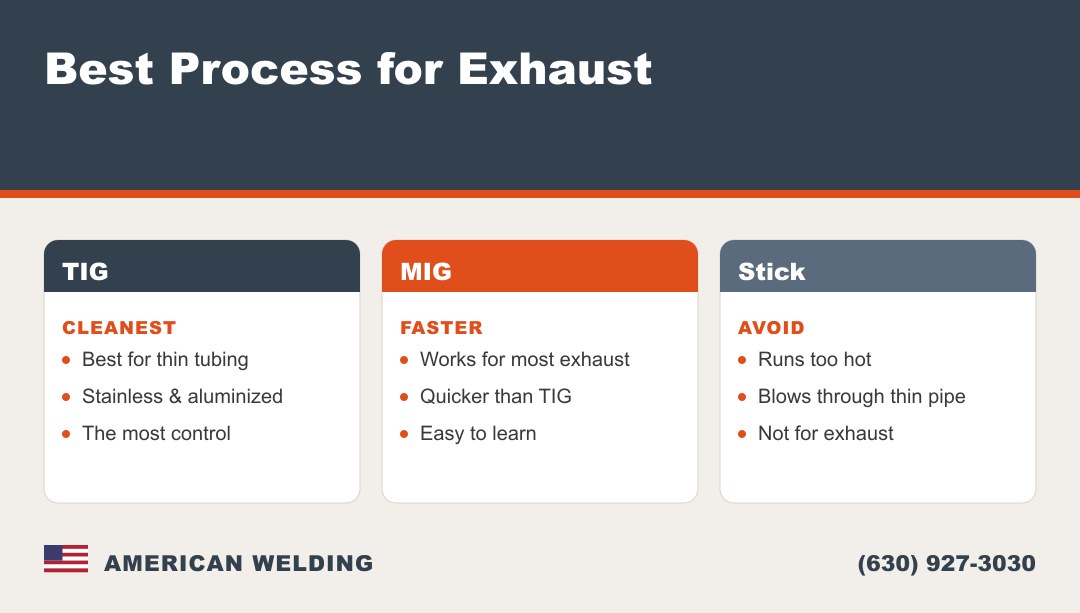
- TIG — the cleanest option. TIG welding gives you fine control of the heat, so it is the best choice for thin tubing and for stainless or aluminized pipe. The bead comes out tidy and strong, which is exactly what a high-vibration exhaust joint needs.
- MIG — faster, and plenty good. MIG lays down quick, solid welds and works well for most mild-steel exhaust repairs. With the heat dialed down and short stitches, it is the go-to for everyday patches and muffler work.
- Stick — leave it in the truck. Stick runs too hot and too aggressive for thin pipe. It will punch straight through exhaust tubing before you get a usable bead, so avoid it for this job.
If you only own a stick machine, this is a job worth handing to someone with a TIG or MIG rig — the pipe is simply too thin to fight.
How to Weld an Exhaust Pipe, Step by Step
A clean exhaust weld is less about skill and more about discipline. Rush the prep or chase one long bead and you lose the pipe. Work it in this order instead.
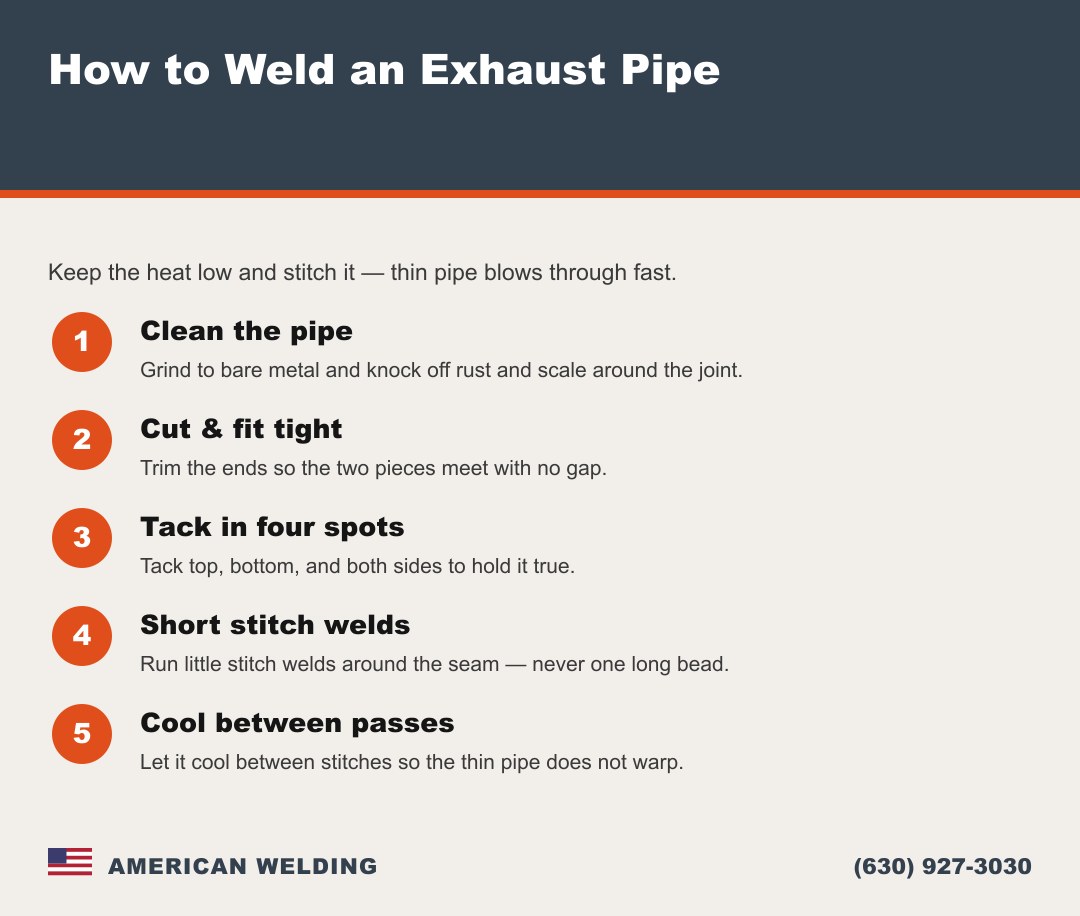
- Clean the pipe to bare metal. Grind or sand off all rust, scale, and any aluminized coating until you see shiny steel on both sides of the joint. A clean start is the single biggest reason a bead holds instead of leaking.
- Cut and fit the joint tight. A clean, square cut with no gap means the heat bridges the seam instead of dropping into a void. The tighter the fit, the less filler and heat you need.
- Tack it in four spots. Put small tacks at twelve, three, six, and nine o'clock to lock the alignment before you commit. This keeps the pipe from pulling crooked as it heats.
- Run short stitch welds around the seam. Lay a short bead, stop, move a quarter-turn, and lay another. Short stitches keep the puddle from ever getting hot enough to blow through.
- Let it cool between passes so it does not warp. Give the tube a minute between stitches. Patience here is what separates a tight, leak-free seam from a wavy pipe full of pinholes.
Once the seam is capped all the way around, let it cool, then start the engine and feel along the joint for leaks. A good exhaust weld is quiet and built to hold through heat cycles and road vibration.
Repair vs Replace a Rusted Exhaust
Welding a tailpipe is only worth it if there is sound metal to weld to. The honest call depends on how far the rust has gone.
Welding makes sense when the pipe is solid and the damage is contained — a cracked flange, a split seam, a pinhole leak, or a broken hanger. In those cases a clean splice or patch restores the system for a fraction of a full replacement, and it is often stronger than the factory joint it replaces.
Replacement wins when the tubing itself has gone soft. If the metal flakes and crumbles when you press a screwdriver into it, there is nothing left for a bead to grip, and welding a patch onto rotten pipe just moves the next hole an inch down the line. When the good steel outnumbers the bad, we weld in a fresh section; when the whole run is paper-thin, a new section is the smarter money.
Not sure which side of that line your exhaust falls on? Snap a photo of the rusty spot and send it to Pete — a quick look usually settles it.
Need It Done Right? We Come to You
Exhaust work is one of those jobs where the right tool and a steady hand save you a world of trouble. If you do not have a TIG or MIG setup, or you would rather not drop the car and crawl under it, that is exactly what we are here for.
American Welding runs mobile welding and repair rigs across Chicago, DuPage County, and the wider Chicagoland area, so we handle exhaust and thin-wall tubing right in your driveway, shop, or lot — no towing, no service-bay queue. Our portable welding gear welds on-site wherever the vehicle sits, and for stainless or aluminized pipe we bring the TIG rig to keep the heat in check.
One cracked flange or a full splice on a work truck, we build the fix to hold up to heat, salt, and years of road vibration. Send a photo or call Pete for a free quote — no surprise trip fees.
Exhaust Pipe Welding FAQ
Can you weld an exhaust pipe instead of replacing it?
Yes, as long as there is solid metal around the damage. A cracked flange, split seam, or pinhole leak welds up cleanly and lasts for years. If the tubing itself crumbles when you press on it, though, there is nothing left to weld to and a new section is the better call.
What is the best welder for exhaust pipe?
TIG gives the cleanest, most controlled weld and is ideal for thin tubing and stainless or aluminized pipe. MIG is faster and works well for most mild-steel exhaust repairs. Stick runs far too hot for thin pipe and will blow through it, so skip it for exhaust.
Why does my exhaust keep blowing through when I weld it?
Almost always too much heat held in one spot. Exhaust tubing is only about sixteen to eighteen gauge, so dial the amperage down and run short stitch welds with cool-down time between them. Clean the metal to bare steel first, too — welding over rust or coating causes pinholes that look like burn-through.
Do you have to grind off the aluminized coating before welding?
Yes. The aluminized or rusted layer has to come off down to bright, bare metal on both sides of the joint. Welding over that coating traps contamination in the puddle and leaves a weak, porous bead that leaks and fails early.
Will a welded exhaust repair pass inspection and hold up?
A proper weld-in splice on sound pipe is built to hold and is often stronger than the original factory seam. It stands up to heat cycles, vibration, and road salt. A sloppy patch over rotten metal will not — which is why we only weld where there is good steel to work with.
Can you weld an exhaust at my house or shop?
That is what our mobile rigs are for. We bring portable TIG and MIG equipment to your driveway, shop, or lot anywhere around Chicago and DuPage County, so there is no towing and no waiting in a service bay. Send a photo of the damage and we will tell you what the fix takes.
Blown Exhaust? We Will Come Weld It.
No need to fight thin tubing with the wrong machine or tow the vehicle anywhere. We bring the TIG and MIG rigs to you and splice your exhaust clean, tight, and built to last through the heat and the road salt.
From our base in Wayne, Illinois, Pete Adams and the crew handle exhaust, tubing, and mobile repairs across Chicago, DuPage County, and all of Chicagoland.
Call or text (630) 927-3030 or email pete@americanwelding.us for a free quote — just send a photo of the pipe.