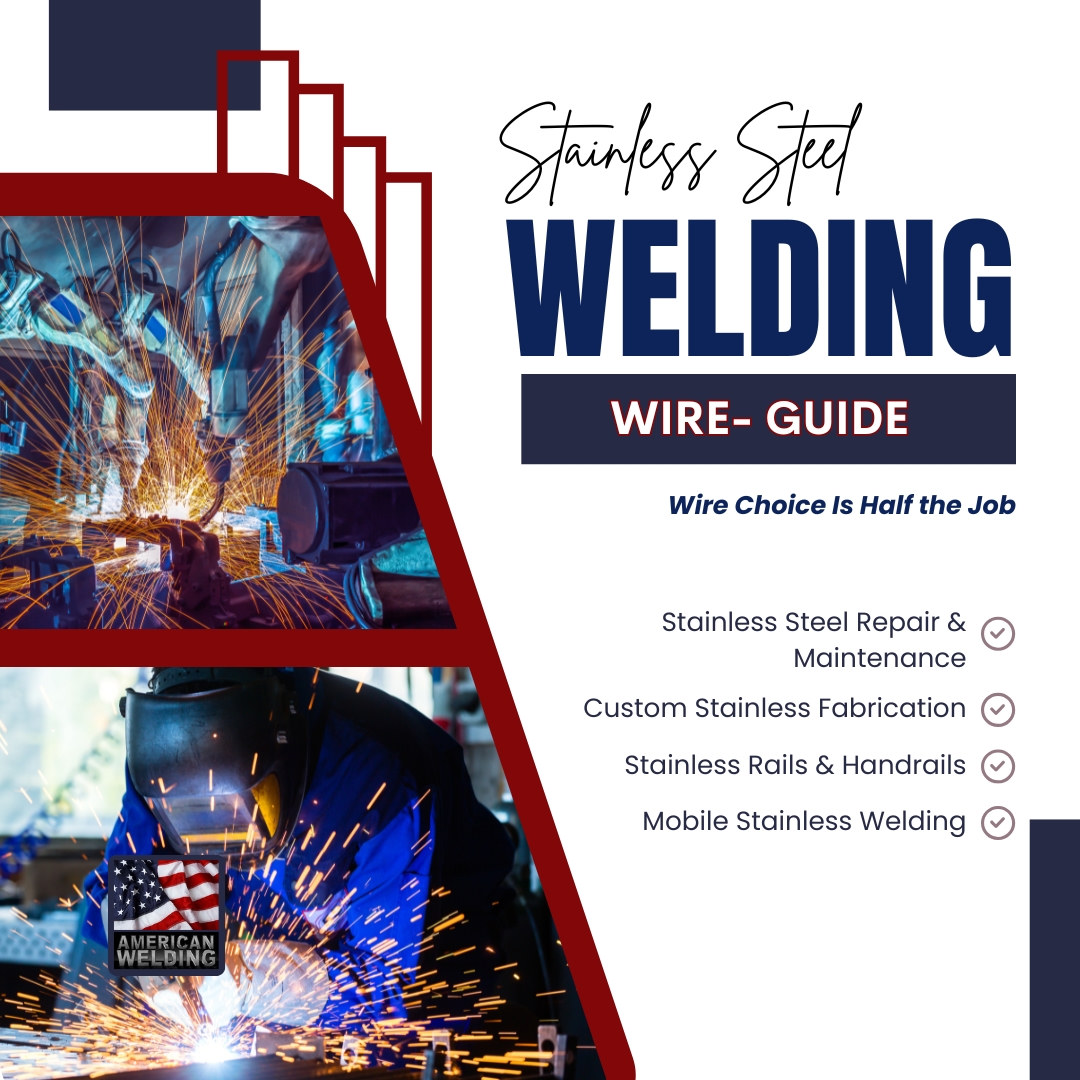
Stainless Steel Welding Wire: A Welder's Plain English Guide
When people call about a stainless steel weld, they ask about the welder.
They ask about the price.
They ask how long the job will take.
Almost nobody asks about the wire.
But the wire is half the weld. Pick the wrong wire and even a clean-looking weld can crack, rust, or pop loose down the line. Pick the right one and the joint holds up quietly for years, with no callbacks.
This guide walks through:
What Is Stainless Steel Welding Wire?
Welding wire is the metal that gets melted into the joint to hold two pieces of metal together. For stainless steel jobs, the wire is also made of stainless steel, but not just any stainless steel. It's a specific blend matched to the stainless being welded.
Think of it like this: the two pieces of stainless steel are the bricks. The wire is the mortar. The mortar has to be strong enough for the wall and matched to the bricks. If the mortar is the wrong type, the wall still goes up; it just falls sooner.
Stainless welding wire comes on spools (rolls of wire) or as straight rods. Spools feed into wire-fed welding machines. Rods are held by hand on jobs that need more control.
Why the Wire Matters as Much as the Welder
Most people think the welder does all the work. The welder matters, but the wire has to match three things at once:
- The metal being welded. Different stainless steel grades need different wires.
- The job's conditions. Indoor or outdoor. Food contact or industrial. Hot environment or cold.
- The strength the joint needs. A guardrail and a kitchen prep table both use stainless steel, but they hold different loads.
Use the wrong wire, and one of those three things gets compromised. The weld might look fine on day one and crack on day three hundred.
Wire choice is what separates a hobby weld from a job that holds. More than 40 years of fixing what others replace have taught one lesson over and over: most of the stainless repairs that come into the shop trace back to the wrong wire being used the first time.
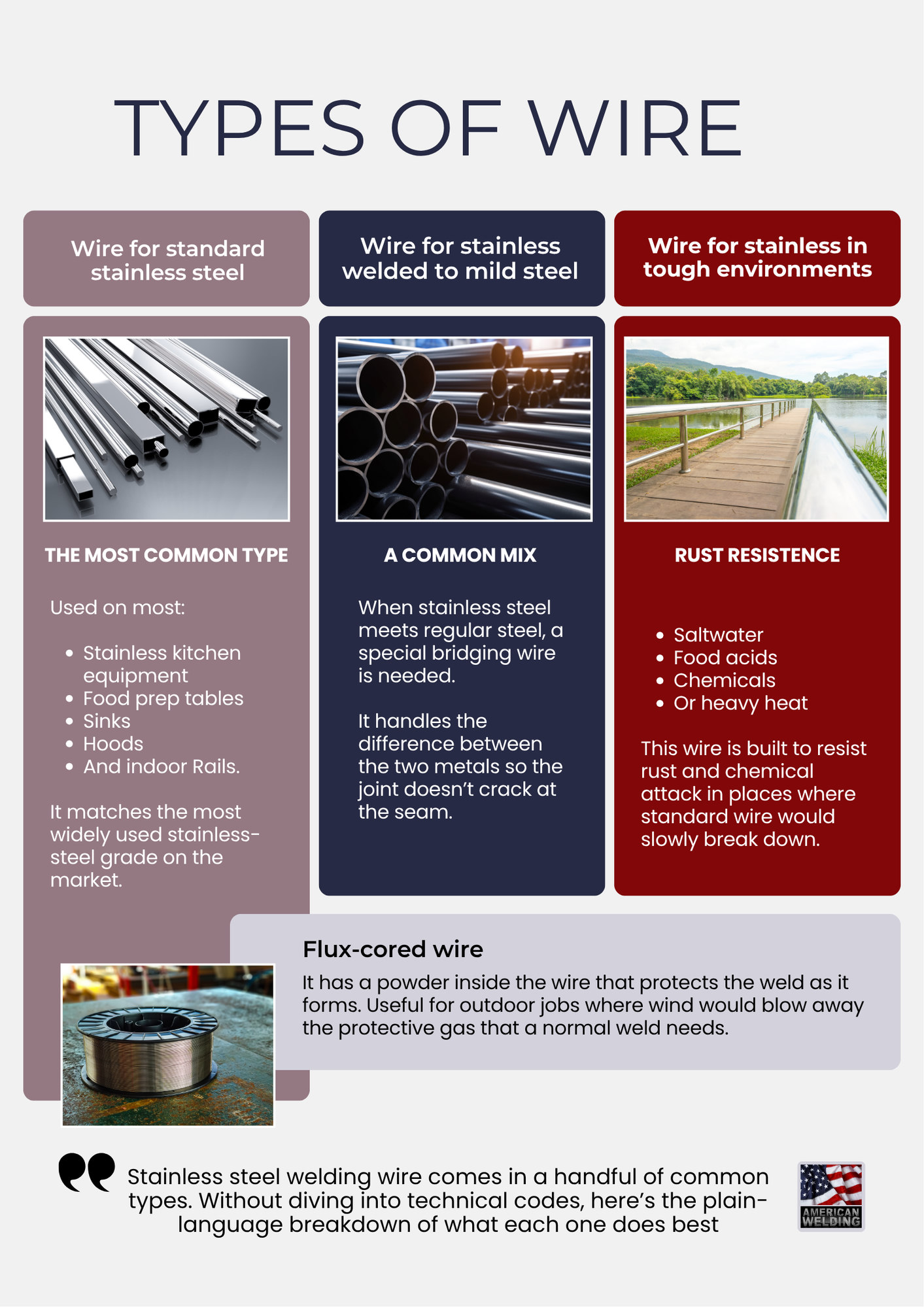
Types of Wire We Reach For
American Welding keeps several wire types in stock and picks the right one once the job is in front of us. The wrong choice means a do-over later. The right choice means the weld holds, and the customer never has to think about it again.
Matching the Wire to the Job
Picking the right wire is part experience, part asking the right questions:
- What kind of stainless steel is it? Restaurant prep tables and food-service equipment typically use a single grade. Marine, chemical, or high-heat jobs use another.
- What will the welded area face every day? A bar rail gets touched all day but never sees acid. A sink for raw meat gets wet, acidic, and scrubbed.
- Is the stainless steel joined to anything else? Welding stainless to stainless is one job. Welding stainless steel to regular steel is a different job and needs a different wire.
- Indoor or outdoor? Outdoor jobs need wire that handles the weather. Indoor jobs can use lighter-duty wire.
Asking those questions before the first weld saves the customer money and saves a callback six months later. Workmanship is guaranteed when both the wire and the welding are done right.
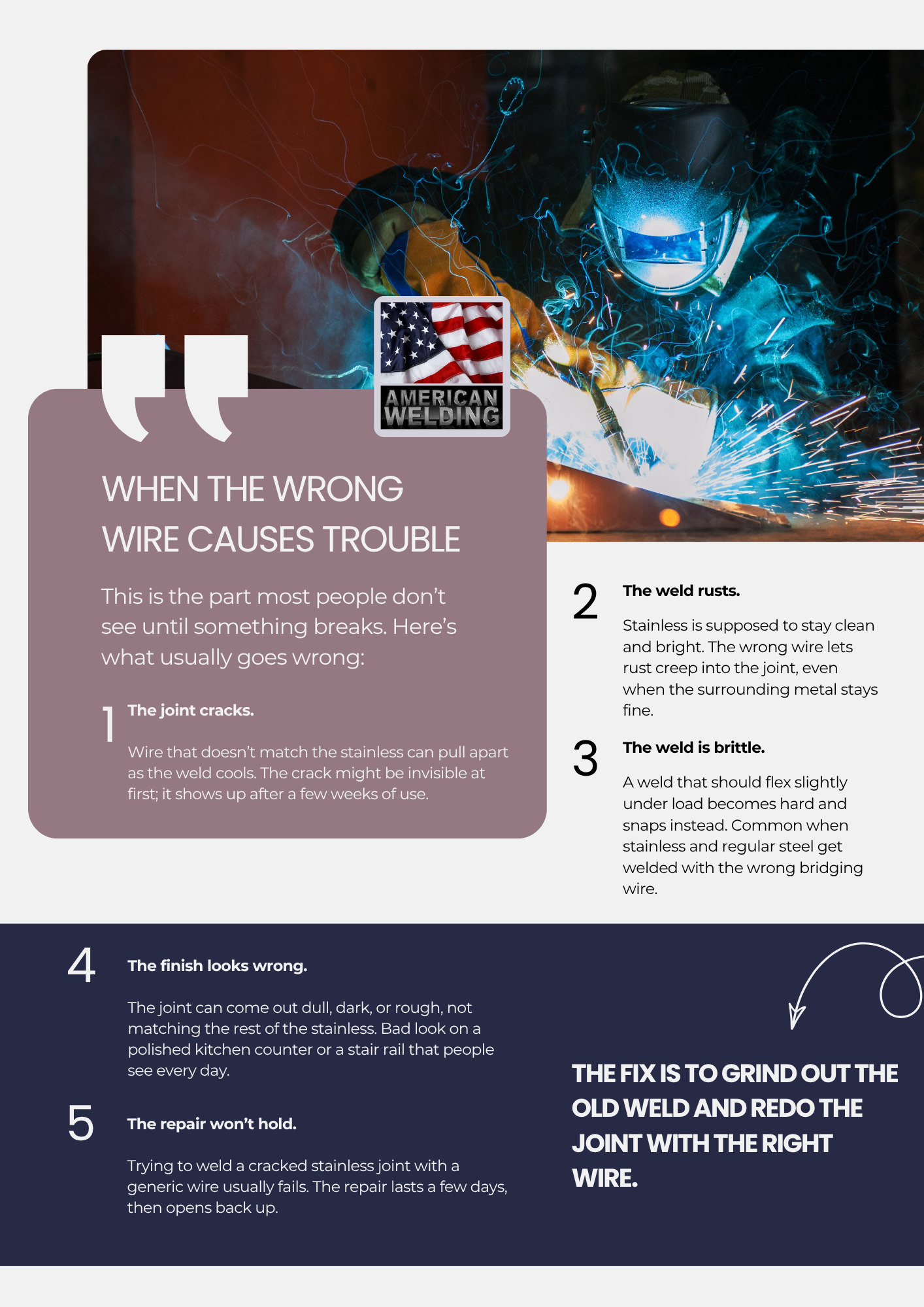
When the Wrong Wire Causes Trouble
From Spool to Strong Weld
Here's roughly what happens between a fresh spool of wire and a finished joint:
- Look at the job. Figure out the stainless grade, what's being joined, and what the weld will face every day.
- Match the wire. Pick the type that fits the metal, the load, and the environment.
- Prep the metal. Stainless welds best when the surface is clean. Grease, paint, and dirt all weaken a joint.
- Set up the machine. Wire speed, heat, and gas (when used) get dialed in for the wire and the metal.
- Make a test weld. On thicker or more sensitive jobs, a quick test on scrap confirms the settings are right before the real piece gets touched.
- Run the weld. Steady, controlled, no rush.
- Cool and clean. Stainless welds get cleaned after cooling, so the finish stays bright and the metal's protective surface keeps doing its job.
Same process every time. The choice of wire is what sets the rest up to succeed.
Service Areas
American Welding serves Chicago and the surrounding suburbs, including:
- DuPage County — Naperville, Wheaton, Downers Grove, Lisle, Oak Brook, Hinsdale
- Cook County — Schaumburg, Bartlett, Hoffman Estates
- Kane County — St. Charles, Geneva, Batavia, Aurora
- Will County — Joliet, Bolingbrook, Plainfield
- Kendall County — Oswego, Yorkville
- McHenry County and DeKalb County
- Milwaukee to Illinois corridor and NW Indiana for larger jobs
Stainless Steel Welding Wire in DuPage County
Stainless work in DuPage County splits two ways.
Indoor stainless: restaurant kitchens, hospital food service, cafeterias, food prep lines — call for one set of wires.
Outdoor stainless: patio rails, gates, equipment exposed to weather and salt air — need another set entirely.
Both come through the shop in steady rhythm. A restaurant in Naperville might need a stainless hood patched on Monday. A homeowner in Hinsdale might need a stainless steel rail repaired on Tuesday: same metal, different jobs, different wires. The right one gets matched before any welding starts. Workmanship guaranteed.
Why Choose American Welding for Stainless Work
- Stainless is a specialty here. Restaurant kitchens, food-service repairs, custom stainless fabrication; Pete has been welding stainless for decades.
- The right wire, every time. No grabbing the closest spool. The wire is matched to the job before any spark is struck.
- Repairs that hold. Most stainless repairs that come in were done wrong the first time. They get redone so they don't come back again.
- Plain answers. Customers get a straight explanation of what's needed and why.
- Workmanship guaranteed on every job.
For more on stainless work, see our guides:
- How to Weld Stainless Steel: A Practical Guide
- Welding Stainless Steel to Mild Steel: The Right Way
- Can You Spot Weld Stainless Steel?
- Restaurant Stainless Steel Welding Repair
FAQs About Stainless Steel Welding Wire
Q: Can any welding wire be used on stainless?
No. Stainless needs stainless wire, and the type must match the grade of stainless being welded. Using a regular steel wire on stainless steel will cause it to rust out, crack, or both.
Q: How do I know what stainless steel I have?
Most modern equipment is stamped or tagged with the grade. If it isn't, an experienced welder can usually tell from the look, weight, and how the metal reacts to a magnet. Most kitchen stainless steel isn't magnetic.
Q: Can stainless steel be welded to regular steel?
Yes, but it requires a special wire to bridge the two metals. Using a normal stainless steel wire here will cause it to crack at the seam.
Q: Why is my stainless weld rusting?
The most common cause is the wrong wire. The second most common is dirt or grease left on the metal before welding. The third is heat damage from welding at too high a temperature for too long.
Q: Is stainless welding wire more expensive than regular welding wire?
Yes, stainless steel wire costs more because the metal itself is more expensive. But the cost is small compared to the cost of redoing a failed weld.
Q: Can a hobby welder weld stainless at home?
With the right wire, gas, and machine, yes, for simple jobs. For anything that holds weight, has food contact, or needs to last, professional welding is worth the cost. The wire alone won't make up for bad welding technique.
Q: How long does a stainless weld last when the right wire is used?
With the right wire and proper welding, a stainless joint can last as long as the rest of the equipment, often decades.
Ready for a Stainless Job Done Right?
If you've got a stainless steel project: repair, fabrication, or replacement - American Welding handles it from the right wire on out. Mobile service across Chicago and the surrounding counties. Workmanship guaranteed.
Call (630) 927-3030 or email pete@americanwelding.us to walk through your job.