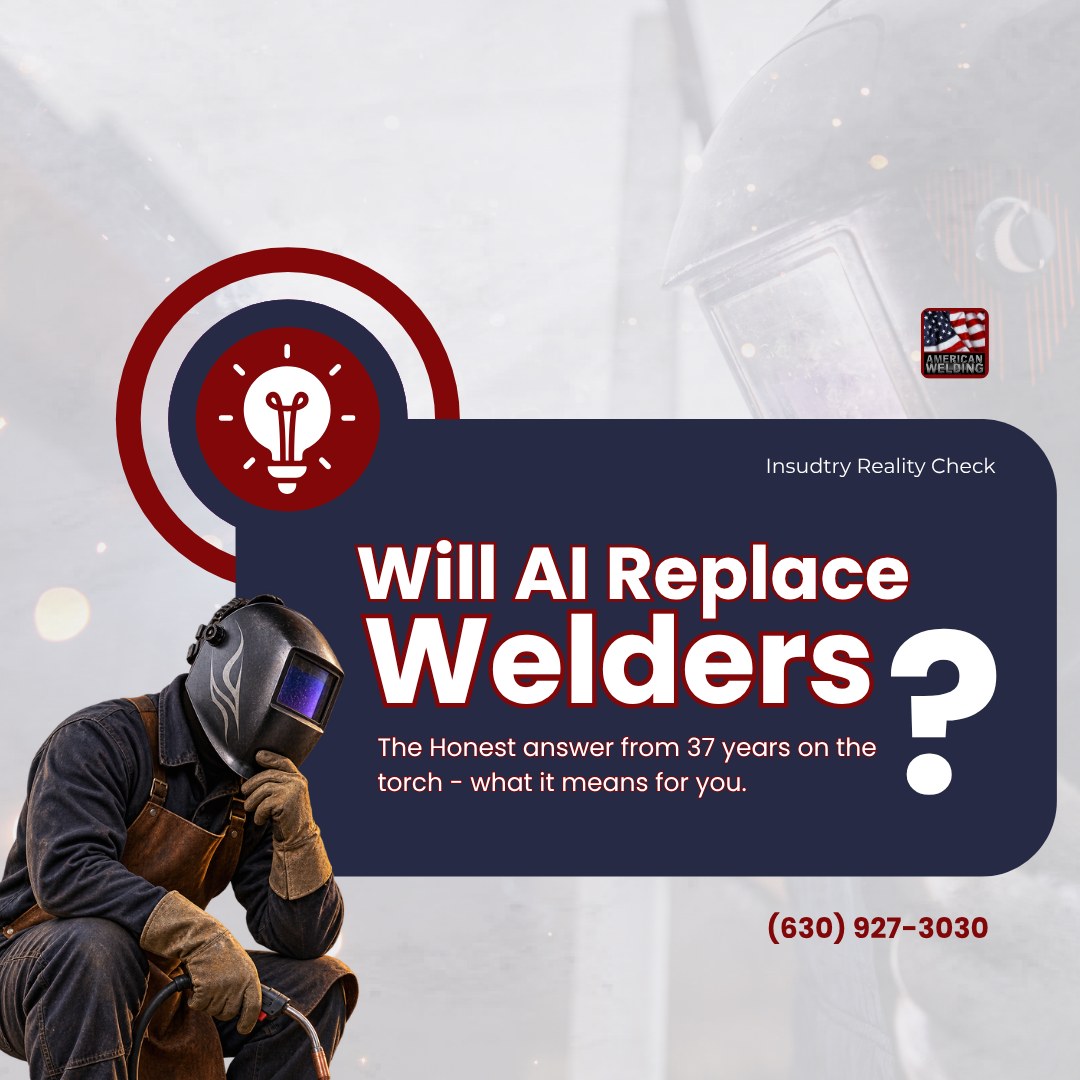
Will AI Replace Welders?
Every few months, a customer asks me the same thing.
"Pete, is a robot going to take your job?"
So let me answer it straight: will AI replace welders? No. Not the ones who do the work I do.
I've been on the torch for 37 years, since 1989. I've watched machines get smarter, faster, and cheaper. Robotic welding is real, and it's growing fast. But I've also seen what those machines can and can't do on real jobs. The honest picture is more interesting than the headlines.
The Short Answer: No — and Here's Why
Robots are already everywhere in welding. But they live in one very specific world: the factory floor, doing the same weld a thousand times a day.
The moment a job gets unpredictable — a rusty gate, a cracked part, a repair in a tight corner — the robot is useless and a human is essential. Most welders spend their whole careers in exactly that world. That's why the machines aren't coming for us. They're coming for the boring, repetitive stuff, and honestly, they're welcome to it.
What AI and Robots Already Do in Welding
I won't pretend automation isn't impressive. In the right setting, it's remarkable.
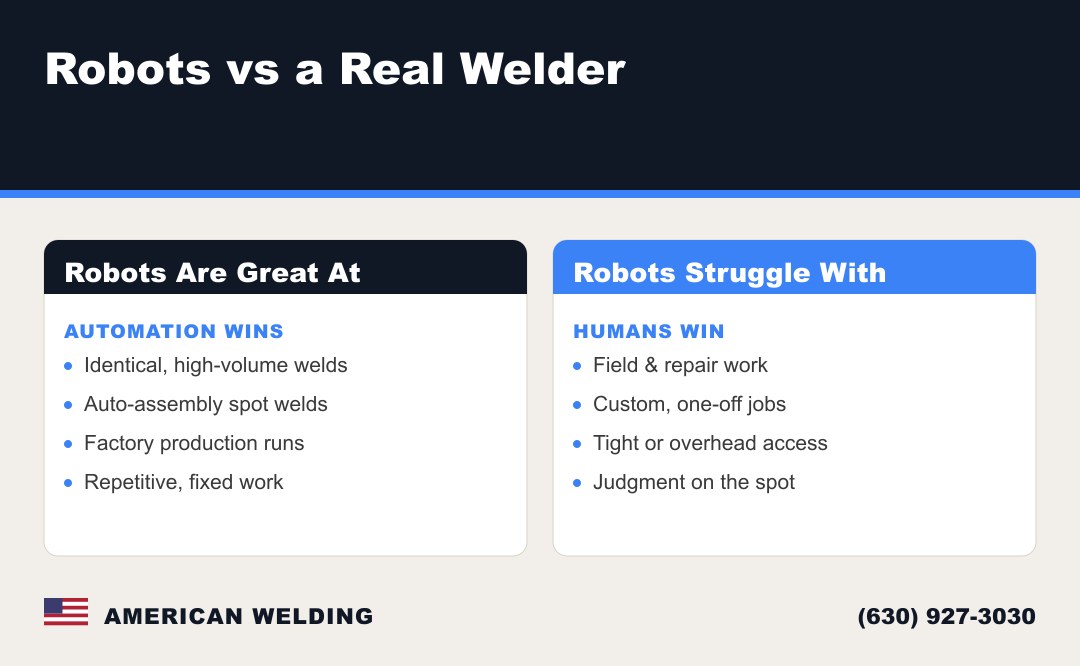
Robots shine at high-volume, identical, repetitive work. Think of the spot welds on a car assembly line — the same joint, the same angle, the same metal, all day. A robotic arm bolted to the floor does that better than any human could, and it never gets tired. The robotic-welding market is expanding for a reason: for mass production, it pays off.
Here's what today's automated systems are genuinely good at:
- Repeating one exact weld thousands of times without drifting
- Running long, straight, predictable seams on big production runs
- Working in fixed jigs where every part is clamped in the identical spot
If your business stamps out ten thousand identical brackets a week, a robot is the right tool. No argument from me.
What Robots Still Can't Do
Now here's the other half of the story — the half that doesn't make headlines.
A robot needs everything perfect. The part has to be clean, identical, and clamped in exactly the right place. Automation stalls hard in construction, repair, maintenance, custom fabrication, and field work — which is exactly where most of us earn our living.
Think about what a real job looks like. A robot can't:
- Improvise on a rusty gate in someone's backyard that's never been measured
- Weld overhead, upside down, in a cramped mechanical room with no space to move
- Look at a cracked casting and judge whether it can be saved or should be scrapped
- Adapt to a one-off job where no two pieces are ever the same
- Read a customer's real problem and figure out the smart fix on the spot
Take custom fabrication — a one-of-a-kind railing, a repair on old equipment, a bracket that has to fit a space nobody planned for. There's no program for that. There's just experience, a good eye, and a steady hand. Even precise work like TIG welding on thin stainless leans on constant human judgment, reading the puddle and the heat as you go. That's a feel you earn over years, not something you download.
The Welder Shortage Nobody Talks About
Here's the part that surprises people most. The real story in welding isn't a surplus of workers about to be replaced. It's a shortage.
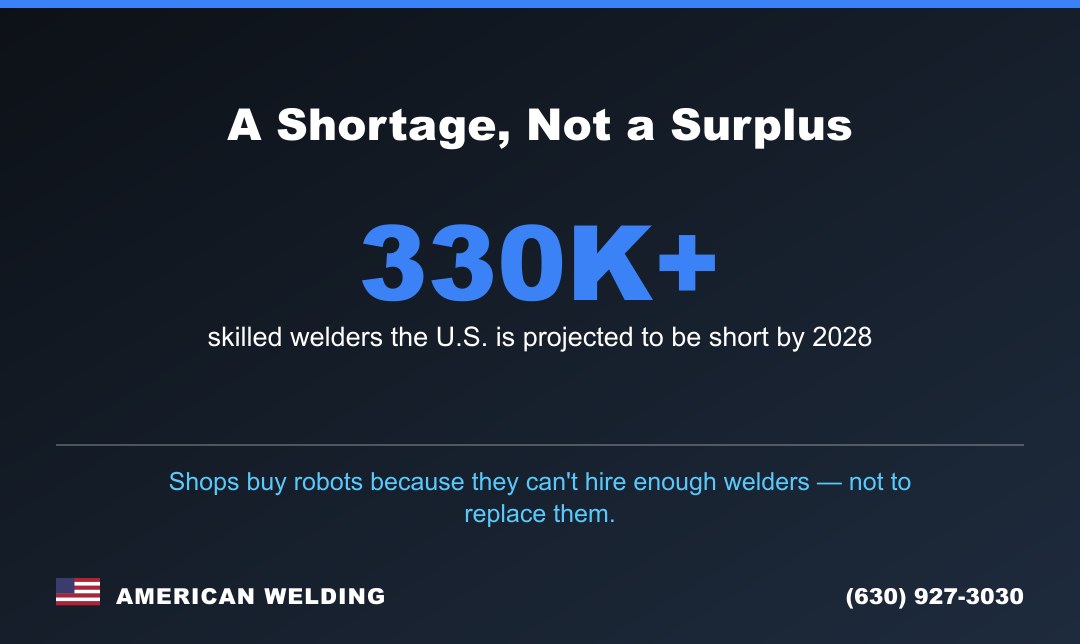
The industry is short hundreds of thousands of skilled welders. The American Welding Society has projected a shortfall of around 330,000 welders by 2028. We simply can't find enough qualified people to fill the work that already exists.
So when a shop buys a welding robot, it's usually not to fire anyone. It's because they can't hire enough welders to keep up. The machine fills a gap, it doesn't create unemployment. The trade needs more good hands, not fewer.
How AI Actually Helps Welders, Not Replaces Them
I'm not against the new tools — I'm for anything that helps me do better work.
The right way to think about AI and collaborative robots, or "cobots," is that they augment a welder instead of replacing one. They take the heavy, dull, repetitive parts off my plate so I can focus on the parts that need a brain and an eye.
In practice, that looks like this:
- Cobots hold and position heavy parts so a welder isn't fighting the weight
- Software helps dial in a sensible starting point for machine settings
- Smart cameras and sensors flag a weld that looks off, so it gets a second look
But notice what still belongs to the human every time: the setup, the judgment, the final call on quality. The machine handles the muscle. The welder handles the decisions. That's a partnership, not a replacement.
The Welding Jobs Safest From Automation
The welding work that's bulletproof against robots is the work that changes every single day.
Mobile welding, repair, maintenance, and custom one-off jobs are the safest of all. You can't bolt a robot to a floor and send it to a farm, a loading dock, or a restaurant kitchen at 6 a.m. Every job is different, and different is exactly what machines can't handle.
That's the work I've built my business around: mobile welding, on-site repairs, and custom fabrication. When a restaurant needs restaurant stainless steel welding on a busted prep table or a hood, they call a person, not a factory arm — every kitchen is laid out differently, and the job has to be clean and food-safe. A robot can't back a truck up to your door. I can.
What This Means If You Need a Welder Today
If you've got a job right now, none of the robot talk matters. The work most people need — a repair, a custom piece, something welded on-site — is the exact work automation can't touch. You need a skilled human who can show up, size up the problem, and fix it properly the first time. That's what I do.
And if you like to understand the craft, I've got plain-English guides too. If your project involves stainless, our companion guide "How to Weld Stainless Steel" walks through why that metal is trickier than it looks and why the right hands matter. The tools keep changing. Good workmanship doesn't.
Service Areas
American Welding comes to you across Chicago, DuPage County, and the wider Chicagoland and Midwest area, both mobile and in-shop.
- DuPage County — Naperville, Wheaton, Downers Grove, Lisle, Oak Brook, Hinsdale
- Cook County — Chicago, Schaumburg
- Kane County — Aurora, St. Charles
- Will County, Kendall County, and McHenry County
Why Choose American Welding — a Real Welder on the Job
When you call American Welding, you get me — Pete Adams — or someone I've trained to my standard. Not a machine, and not a rotating crew of strangers. Thirty-seven years on the torch, in business since 1989, with the same simple promise: it gets done right the first time.
I show up mobile or take it in-shop, whichever suits the job. I set the work area up carefully, I'm fully insured, and I guarantee my workmanship in writing. You'll get a clear quote before any work starts, with no surprise trip fees. That's the kind of accountability no robot signs its name to.
Frequently Asked Questions
Will AI replace welders in the next 10 years?
No. Automation will keep taking over repetitive factory welds, but repair, maintenance, custom fabrication, and field work all depend on human judgment that machines can't match.
Are welding robots taking jobs away from people?
Not really. The industry is short hundreds of thousands of welders — the American Welding Society projects a shortfall near 330,000 by 2028. Shops buy robots because they can't hire enough people, not to replace them.
What kind of welding can't be automated?
Anything unpredictable. Mobile welding, on-site repairs, custom one-off pieces, overhead and tight-space work, and judging damaged parts all need a skilled human. Robots only work when every part is identical.
Is welding still a good career with AI coming?
Yes, and arguably better than before. There aren't enough skilled welders to meet demand, and the hands-on repair and custom work that pays well is exactly the work automation can't do.
Can a robot do custom or repair welding?
No. Custom fabrication and repairs are different every time, and a robot needs everything identical and pre-programmed. That work belongs to an experienced welder who can adapt on the spot.
Do you use robots or automation at American Welding?
Our work is hands-on mobile and in-shop welding — repairs, custom pieces, and on-site jobs — the kind that needs a real welder, not a factory arm.
How much does a welding job cost?
It depends on the work, so we give a clear quote before any work starts, with no surprise trip fees.
Ready for Work a Robot Can't Do?
If you've got a repair, a custom piece, or an on-site job, you don't need a factory arm — you need an experienced welder who shows up and gets it right the first time. That's exactly what we do, mobile or in-shop, across Chicago and DuPage County.
Thirty-seven years of experience, fully insured, workmanship guaranteed in writing. Let's talk through what you need.
Call or text (630) 927-3030 or email pete@americanwelding.us to walk through your project.