Can You Weld Galvanized Steel?
You found a galvanized post, rail, or bracket that needs a weld, and now you are wondering if you can even do it.
Yes, you can weld galvanized steel — but not the way you would weld bare steel.
The zinc coating has to be ground off the weld area first, because the zinc gives off fumes you do not want to breathe and ruins the weld if you leave it on.
Clear the zinc, work in fresh air, lay a clean bead, and seal it back up afterward — that is the whole job.
At American Welding, we join galvanized steel all the time — fences, railings, gates, and dock hardware that live outdoors and have to resist rust. Owner Pete Adams has welded since 1989, and from our shop in Wayne, Illinois we see galvanized repairs come through constantly, because it is everywhere once you start looking. The metal welds fine; the silvery coating on top is what trips people up, so that is where we will start.
Why Galvanized Steel Is Tricky to Weld
Galvanized steel is just ordinary steel dipped in a zinc coating that shields it from rust. The steel underneath welds like any other steel. The problem is that zinc melts and boils at a far lower temperature than the steel does, so the instant your arc touches it, the coating starts burning off and causing trouble. There are three ways that shows up.
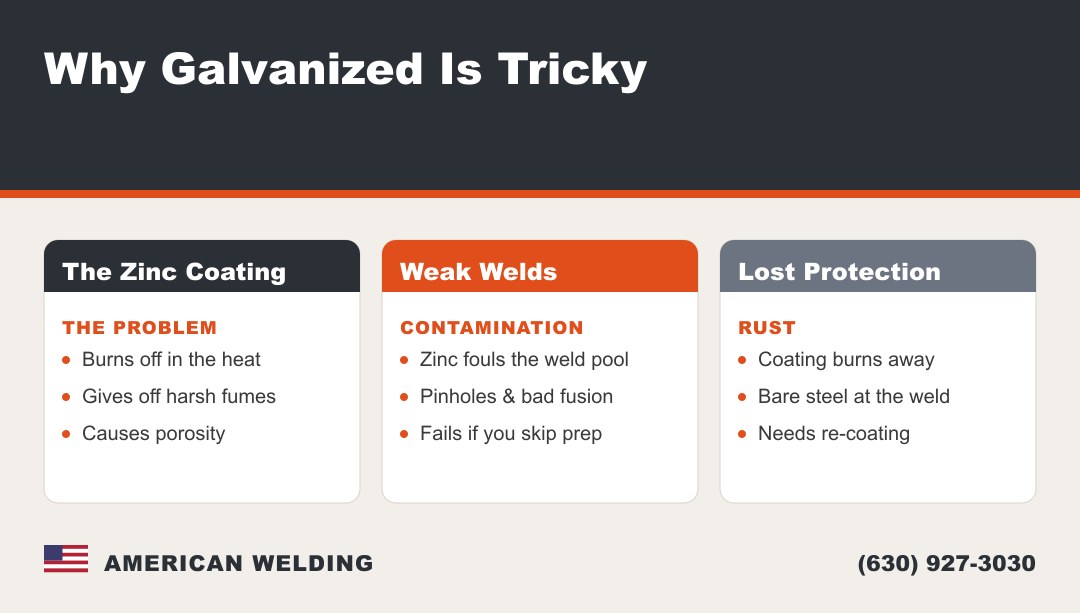
- The zinc coating. Zinc burns off well before steel melts, and as it vaporizes it gives off a white fume. Those boiling gases also get trapped as they try to escape the molten puddle, leaving pinholes and pockets — porosity — scattered through the bead.
- Weak welds. Any zinc that works its way into the weld pool contaminates it. You end up with a bead that looks rough, splatters as you run it, and simply does not hold the way a clean weld on bare steel would.
- Lost rust protection. The heat burns the zinc away right at the joint — exactly where you just added stress. Leave it bare and that spot becomes the first place the piece rusts, which defeats the whole point of galvanized steel.
The Zinc-Fume Problem
The white smoke that rolls up when you weld galvanized steel is zinc oxide, and it is the part you cannot ignore. Breathe enough of it in a closed space and you can end up with what welders call metal-fume fever — chills, a headache, a tight chest, and a rotten night that usually fades by morning. It is unpleasant, and it is completely avoidable.
The fix is air and distance. Work outdoors or in a wide-open bay, never a sealed garage, and keep your head out of the plume so the smoke drifts away from your face. A fan pushing air across the joint, or a fume extractor pulling it off, makes a real difference. Grinding the zinc off before you strike an arc — which you should be doing anyway for a sound weld — also cuts the fume you make in the first place. Good ventilation is simply part of welding galvanized the right way, not an afterthought.
How to Weld Galvanized Steel the Right Way
Done properly, welding galvanized steel is straightforward — it just has a couple of extra steps on either end of the actual welding. Here is the sequence we follow on a galvanized repair, start to finish.
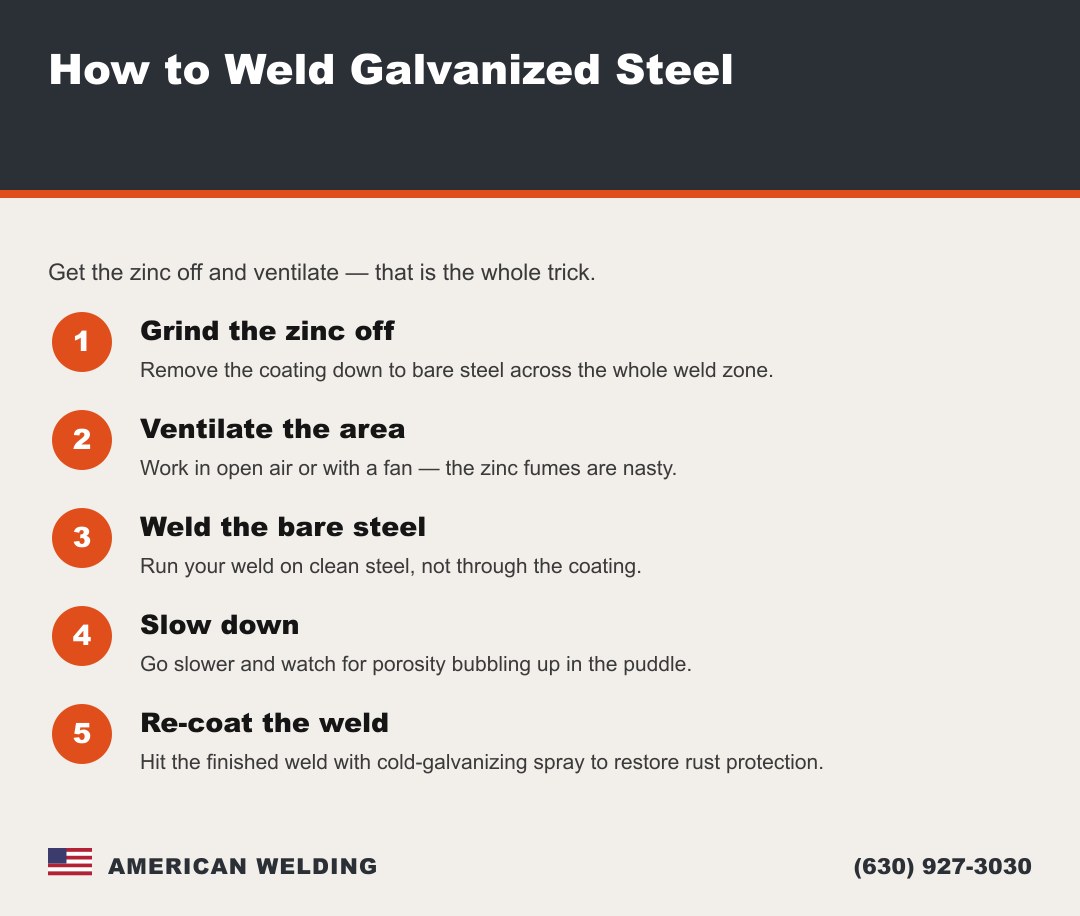
- 1Grind the zinc off the weld zone. Take the coating down to clean, bright steel an inch or so back from the joint on both sides, using a grinder or flap disc. This is the single most important step — no bare steel, no good weld.
- 2Ventilate the area well. Move outside or open everything up, point a fan to carry the smoke away, and keep your face clear of the plume before any arc is struck.
- 3Weld the bare steel. With the zinc gone, you are joining clean steel, so you can run your normal process — MIG, TIG, or stick — and get a solid, good-looking bead.
- 4Slow down and watch for porosity. Any zinc left near the edge will try to bubble into the puddle, so travel a touch slower than usual and keep an eye on the bead. See pinholes forming? Stop, clean that spot back further, and run it again.
- 5Re-coat the weld. Once it cools, hit the bead and the ground-back area with a cold-galvanizing spray. That puts the zinc protection back over the bare steel so the joint resists rust just like the rest of the piece.
Home welders skip that last step most often, which is why so many do-it-yourself galvanized repairs rust out at the weld within a season. Put the coating back and the fix lasts.
What American Welding Welds in Galvanized
Galvanized steel shows up anywhere metal has to stand up to weather, so a big share of what we repair and build is galvanized. Common jobs include:
- Fences — chain-link posts, top rails, and galvanized panels that have been bent, snapped, or pulled loose.
- Railings — stair, porch, and balcony rails where a cracked joint or a sagging section needs to be made solid again.
- Gates — galvanized gate frames, hinges, and latches that take daily abuse and eventually crack or sag.
- Dock hardware — brackets, posts, and frames down by the water, where rust protection is not optional.
Because our rigs come to you, there is no hauling a heavy galvanized frame across town — our mobile welding and repair crew brings the shop to your property. We run TIG welding service when a job needs a clean, precise bead, and our portable welding service handles on-site fixes across Chicago, DuPage County, and the rest of Chicagoland. Got a galvanized gate giving you grief? That is squarely in our lane for welded gate services. Send Pete a photo or call for a free quote.
Galvanized Steel Welding FAQ
Can you weld galvanized steel without removing the zinc coating?
You can strike an arc through it, but you should not. Welding over the zinc traps gas in the puddle and leaves a porous, weak bead, and it throws off far more fume. Grinding the coating back to bare steel first takes a minute and is the difference between a weld that holds and one that fails.
Is it safe to weld galvanized steel?
It is, as long as you control the fume. The zinc smoke can give you a short bout of metal-fume fever if you breathe it in a closed space. Weld outdoors or in a well-aired bay, keep a fan moving the smoke away from your face, and grind the zinc off first, and you take that risk off the table.
What happens if you weld over the galvanized coating?
The zinc boils as the arc hits it and fights its way out through the molten metal, leaving pinholes and pockets behind. The bead ends up rough, spattery, and weaker than it looks, and you breathe a lot more zinc oxide while you run it. It is the main reason galvanized repairs fail.
What is the best way to weld galvanized steel — MIG, TIG, or stick?
All three work once the zinc is ground off, because at that point you are welding clean steel. MIG is fast and easy for fences and general repairs, TIG gives the cleanest, most precise bead for finer work, and stick is handy outdoors and on heavier pieces. The prep matters far more than which process you pick.
How do you protect a galvanized weld from rust afterward?
Spray the finished bead and the ground-back area with a cold-galvanizing compound once it has cooled. That lays zinc back over the bare steel so the joint resists rust like the rest of the piece. Skip it and the weld becomes the first spot to corrode — a common mistake on outdoor fences and railings.
Can I weld galvanized steel at home, or should I call a pro?
A small outdoor repair is doable at home if you grind the zinc off, keep the air moving, and re-coat the weld. But if the piece carries weight, has to look clean, or needs to hold for years, it is worth having someone who welds galvanized regularly do it. Around Wayne, Chicago, and DuPage County, we are a call away.
Got a Galvanized Repair That Needs Doing Right?
Galvanized steel welds up strong when it is prepped, welded, and re-coated the right way — and that is exactly what we do, day in and day out, from our home base in Wayne, Illinois.
Whether it is a fence, a railing, a gate, or dock hardware anywhere across Chicago and DuPage County, our mobile rigs come to you. Pete Adams has welded since 1989, and the workmanship is guaranteed.
Call or text (630) 927-3030 or email pete@americanwelding.us for a free quote — a clear photo of the piece is all we need to get started.