How to Fix a Sagging Gate
A gate that droops, drags in the dirt, and never quite lines up with the latch is one of the most common problems we get called about.
Here is the one-line answer: a sagging gate is almost always loose or worn hinges, or a gate frame with no diagonal brace to hold its shape.
Tighten the first, add the second, and most gates swing level and latch clean again.
At American Welding, owner Pete Adams has built and repaired gates since 1989, and from our shop in Wayne, Illinois we see the same worn hinges and unbraced frames over and over. Here is how to diagnose the sag, the do-it-yourself fixes that actually hold, and when it is smarter to have the gate welded than to patch it again — our welded gate services handle exactly that.
Why Gates Sag
It helps to know why a gate sags. A gate is a heavy rectangle hanging off one edge, and gravity spends all day dragging the far corner down. Three things usually let it win.
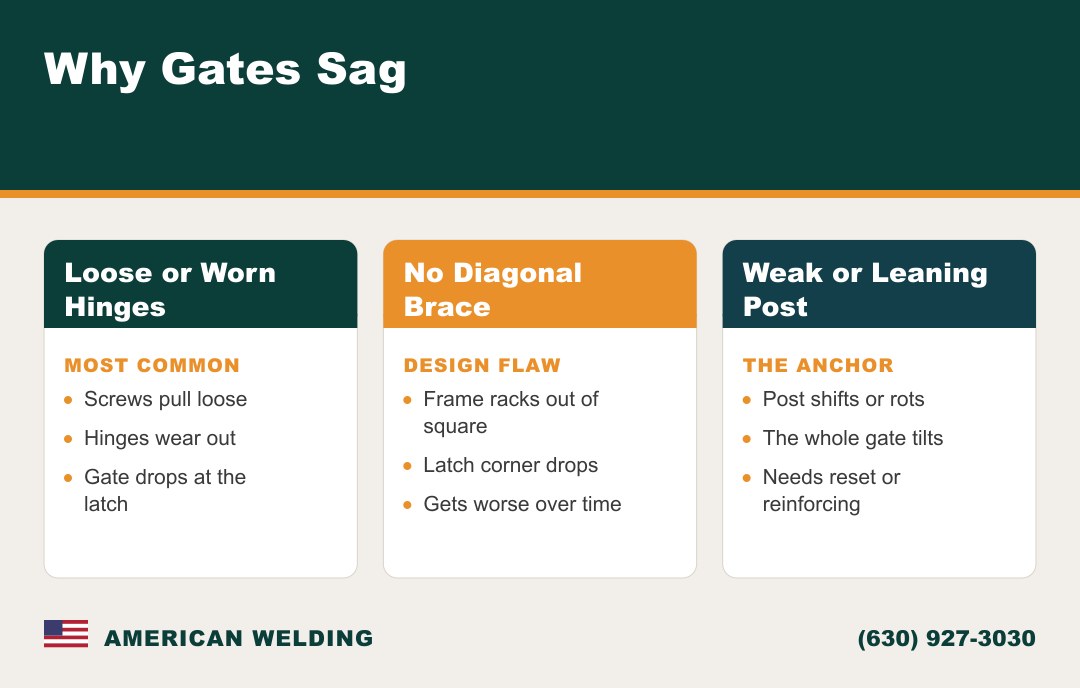
- Loose or worn hinges. The most common cause by far. Screws back out of the post, the wood softens, and hinge pins wear — so the gate drops on the hinge side and the latch corner scrapes.
- No diagonal brace. A plain four-sided frame has nothing to stop it racking into a parallelogram. With no diagonal corner to corner, the frame leans and the latch corner sinks — even when the hinges are fine.
- Weak or leaning post. If the hinge post was never set deep or plumb, the gate's weight tips it outward and the gate leans right with it. No amount of hinge tightening fixes a post that is falling over.
Quick Checks to Try First
Start with the easy wins. A surprising number of sagging gates come right in ten minutes with no new parts.
- Tighten or replace the hinge screws. Snug up every hinge screw. If any spin in a stripped hole, swap them for longer, thicker screws or lag bolts that bite into solid wood.
- Check that the hinge post is plumb. Hold a level against the post the gate hangs from. If it leans out even a little, the gate will always sag — straighten or reset the post before anything else.
- Shim the lower hinge. A thin washer or shim behind the bottom hinge tips the gate a few degrees and can lift a dragging latch corner just enough to clear and catch again.
If the screws hold and the post is plumb but it still droops, the frame has racked out of square — that needs a brace.
The Real Fix — an Anti-Sag Brace
A rectangle folds; a triangle does not. The permanent cure is a diagonal that ties two opposite corners together and locks the frame in shape. There are two ways to do it, and the direction matters most — get it backwards and it does nothing.
- A cable and turnbuckle (works in tension). This is the common bolt-on anti-sag kit. The cable must run from the top hinge corner down to the bottom latch corner. Tightening the turnbuckle pulls that sagging latch corner up toward the hinge and squares the gate. Run it the other way and it does nothing.
- A rigid wood or steel brace (works in compression). A solid brace runs the opposite way — from the bottom hinge corner up to the top latch corner. Being stiff, it pushes the latch corner up from underneath. A cable can only pull; a rigid strut can only push — that is why each runs the way it does.
The most common mistake is running the cable the wrong way. Remember: a cable pulls the low corner up toward the high hinge, so it always starts at the top hinge. If the gate is too far gone to save, our guide on how to make a welded wire fence gate shows how a welded frame builds the diagonal in from the start, so it never racks.
How to Fix a Sagging Gate, Step by Step
The repair follows a simple order. Do not skip the diagnosis — bracing a gate whose real problem is a leaning post only hides the fault for a few weeks.
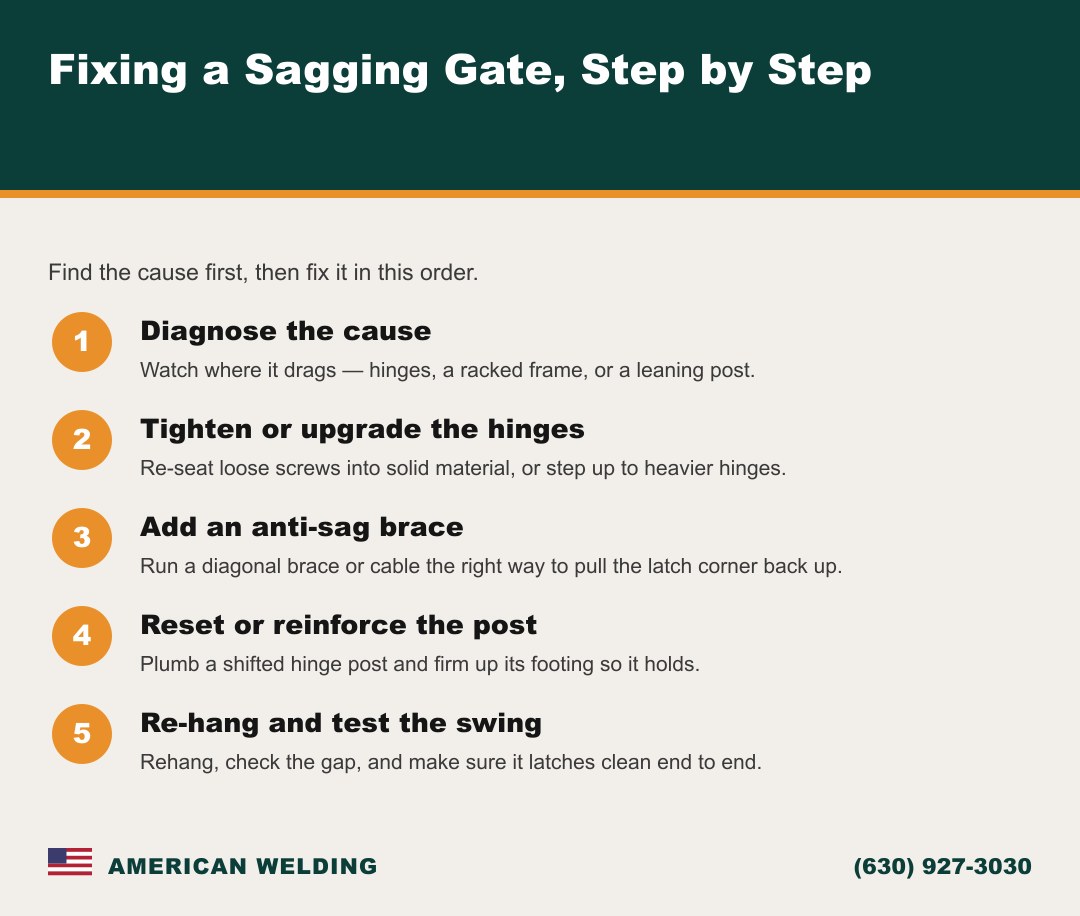
- Diagnose the cause. Wiggle the gate and watch where it moves — loose on the hinges, folding at the corners, or leaning with the post. Fix what is actually wrong.
- Tighten or upgrade the hinges. Snug every screw, replace stripped ones with lag bolts, and step up to a heavier hinge if the old one is worn or bent.
- Add the anti-sag brace. Fit a cable and turnbuckle from the top hinge corner to the bottom latch corner, or a rigid brace from the bottom hinge corner to the top latch corner, and tension it until the gate sits square.
- Reset or reinforce the post. If the hinge post leans, plumb it and set it in fresh concrete so the whole repair has something solid to hang from.
- Re-hang and test the swing. Open and close it a dozen times, check the latch catches cleanly with an even gap, and fine-tune the brace tension until it does.
When to Weld It or Call a Pro
Some sagging gates are past a screwdriver and a turnbuckle. These are the signs it is time to weld the gate rather than fix it again:
- A frame that will not stay tight. Bolted and screwed joints work loose and sag again and again. A welded steel frame becomes one solid piece that cannot rack — which is why our welded gate services are usually the last repair a gate needs.
- A rusted metal gate. Cracked old welds, rusted-through tubing, or a snapped hinge cannot be tightened back to life. The bad section has to be cut out and new steel welded in.
- A heavy driveway gate. Big driveway gates carry far more weight than a hardware-store kit was built for, and a sagging one drags, jams, and stops latching. These usually need reinforced hinges and a welded repair on-site.
Getting a Gate Fixed in Chicagoland
You do not have to haul a heavy gate anywhere — American Welding comes to you. Pete brings the rig to your property and welds the repair right there, whether it is a walk gate that will not latch or a driveway gate on the ground.
The easiest way to start is to snap a photo of the gate and its hinges and send it over, or just call and describe it. Pete will tell you whether it is a quick weld or a bigger job and give you a free quote. Our mobile welding and repair service runs from Wayne, Illinois and covers Chicago, DuPage County, and the wider Chicagoland area.
Sagging Gate FAQ
Why does my gate sag or drag on the ground?
Almost always one of three things: loose or worn hinges letting the gate drop, a frame with no diagonal brace racking out of square, or a leaning hinge post. Check the hinges and post first, then brace the frame if it still droops.
Which way should an anti-sag cable run?
A cable-and-turnbuckle kit works in tension, so it runs from the top hinge corner down to the bottom latch corner. Tightening the turnbuckle pulls the drooping latch corner up. A rigid brace works in compression and runs the opposite way — bottom hinge corner up to the top latch corner.
Can I fix a sagging gate without replacing it?
Usually, yes. Most sagging gates come back to square by tightening or upgrading the hinges, plumbing the post, and adding a diagonal anti-sag brace. You only need a replacement when the frame is rusted through or cracked, and even then a welded repair often saves it.
How do I stop a metal gate from sagging for good?
Bolt-on kits keep working loose on metal gates. The permanent fix is welding a diagonal brace into the frame and reinforcing the hinges so the gate becomes one rigid piece that cannot rack — the repair that lasts instead of returning next season.
When should a sagging gate be welded instead of repaired?
When the frame keeps loosening no matter how you tighten it, when the metal is rusted or cracked at the joints, or when it is a heavy driveway gate too big for a bolt-on kit. A welded repair is stronger and cheaper over time than fixing it every few months.
Do you fix sagging driveway gates on-site?
Yes. American Welding is mobile — Pete welds heavy driveway and walk gates in place, so nothing has to be taken down and hauled off. We cover Chicago, DuPage County, and Chicagoland from Wayne, Illinois. Send a photo for a free quote.
Tired of Fighting a Gate That Will Not Latch?
Some sagging gates come right with a screwdriver and a brace. When yours keeps dropping, cracks at the welds, or is too heavy for a bolt-on kit, a welded repair is the fix that finally holds — done on-site.
Serving Chicago, DuPage County, and Chicagoland from our shop in Wayne, Illinois, Pete Adams has been welding gates back to square since 1989.
Call or text (630) 927-3030 or email pete@americanwelding.us — send a photo of the gate for a free quote.