Laser Welding Advantages: What Sets It Apart From Traditional Welding
When customers first ask about laser welding, most of them ask the same question: what's it actually better at?
Laser welding didn't replace older welding methods. TIG, MIG, and stick welding are still the right call on plenty of jobs. But there are specific things a laser can do that a regular torch can't, and those are the jobs customers keep coming back for.
This guide walks through the real advantages of laser welding, where it shines, where it doesn't, and the kinds of jobs where it makes the biggest difference.
What Is Laser Welding? (Quick Refresher)
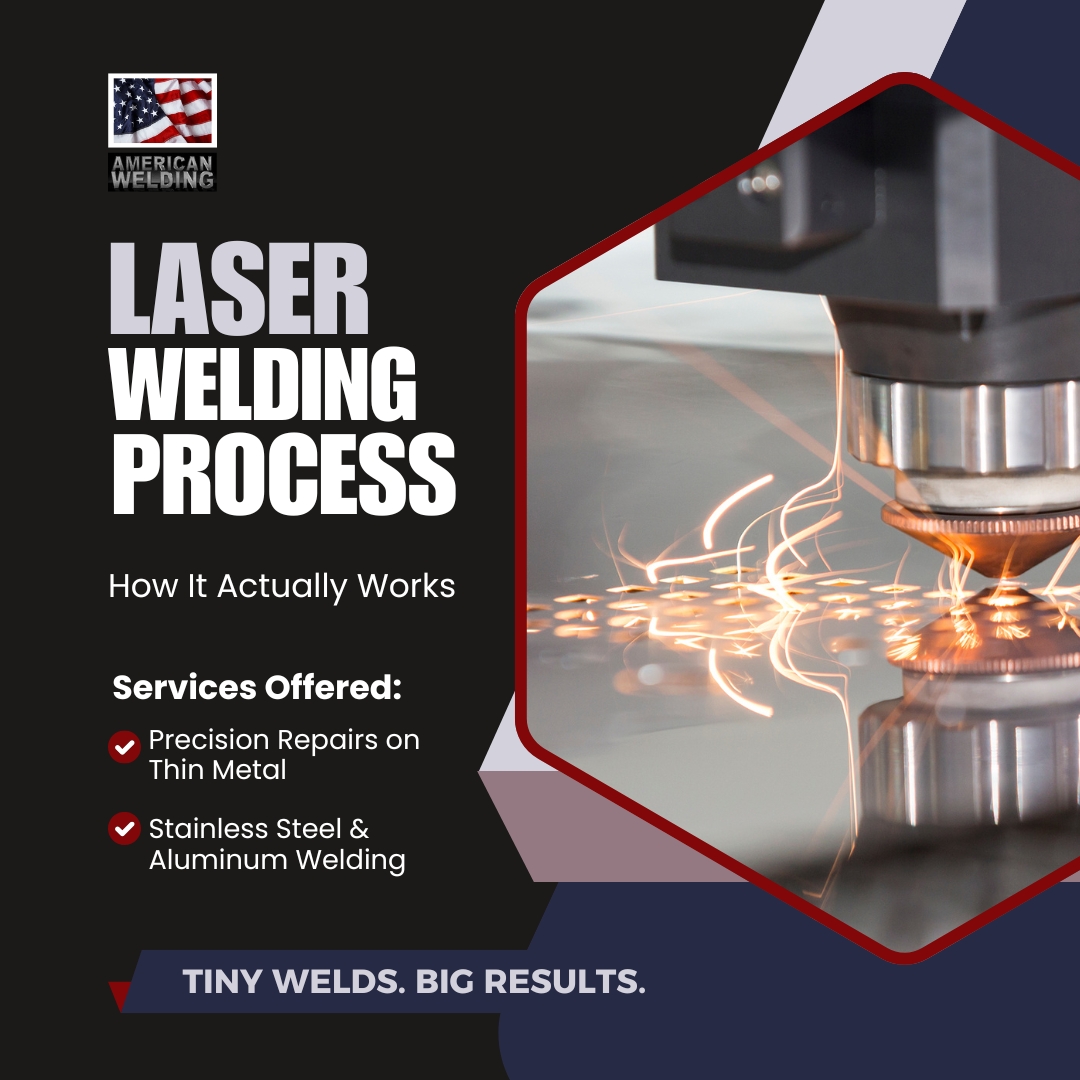
Laser welding uses a very narrow, very concentrated beam of light to melt metal together. The heat is focused on a tiny spot, smaller than the tip of a pen. That's the key to almost every advantage that follows.
For a longer breakdown of how the process actually works, see our guide: The Laser Welding Process Explained.
The Advantages of Laser Welding
Here are the real reasons customers switch to laser welding for certain jobs.
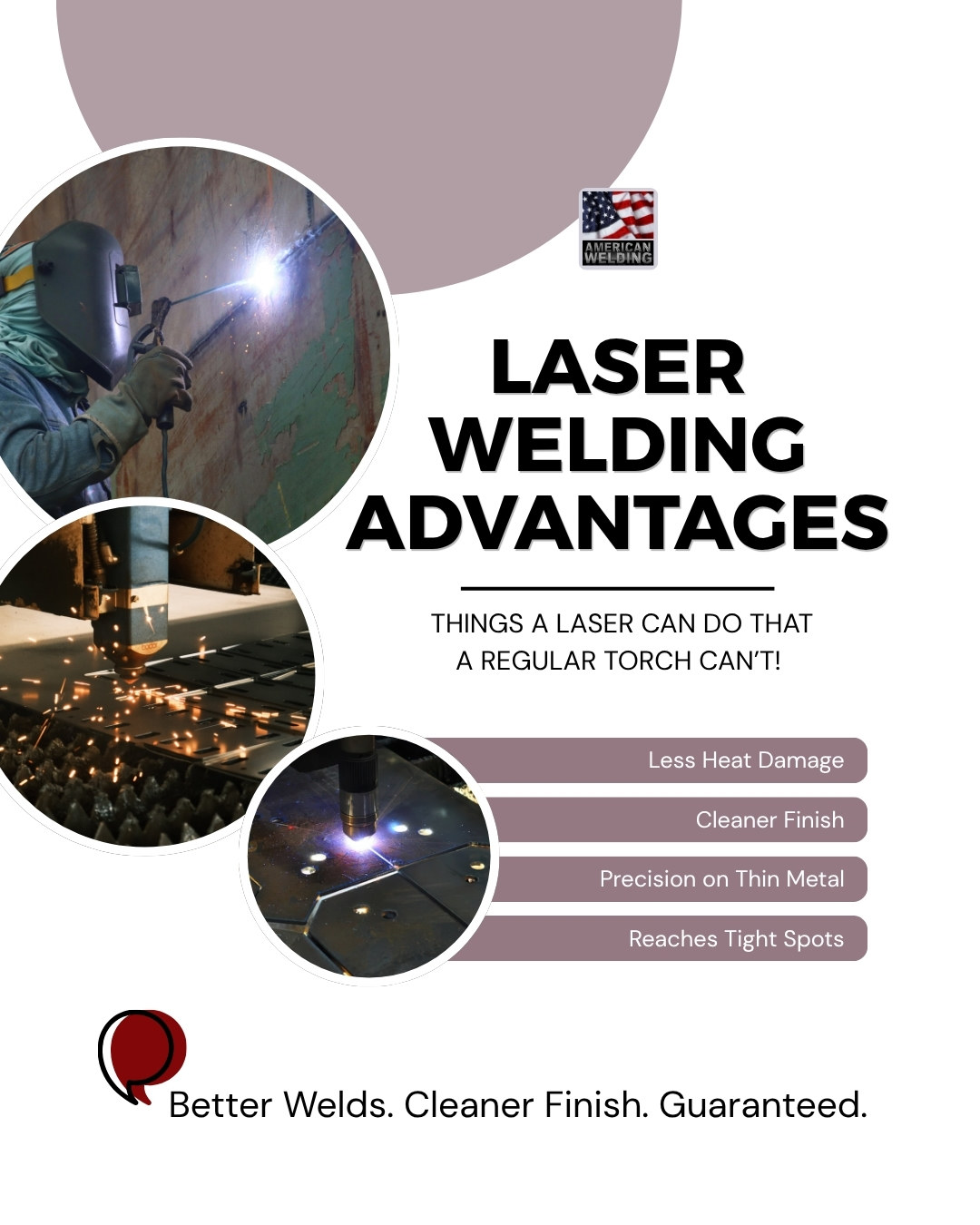
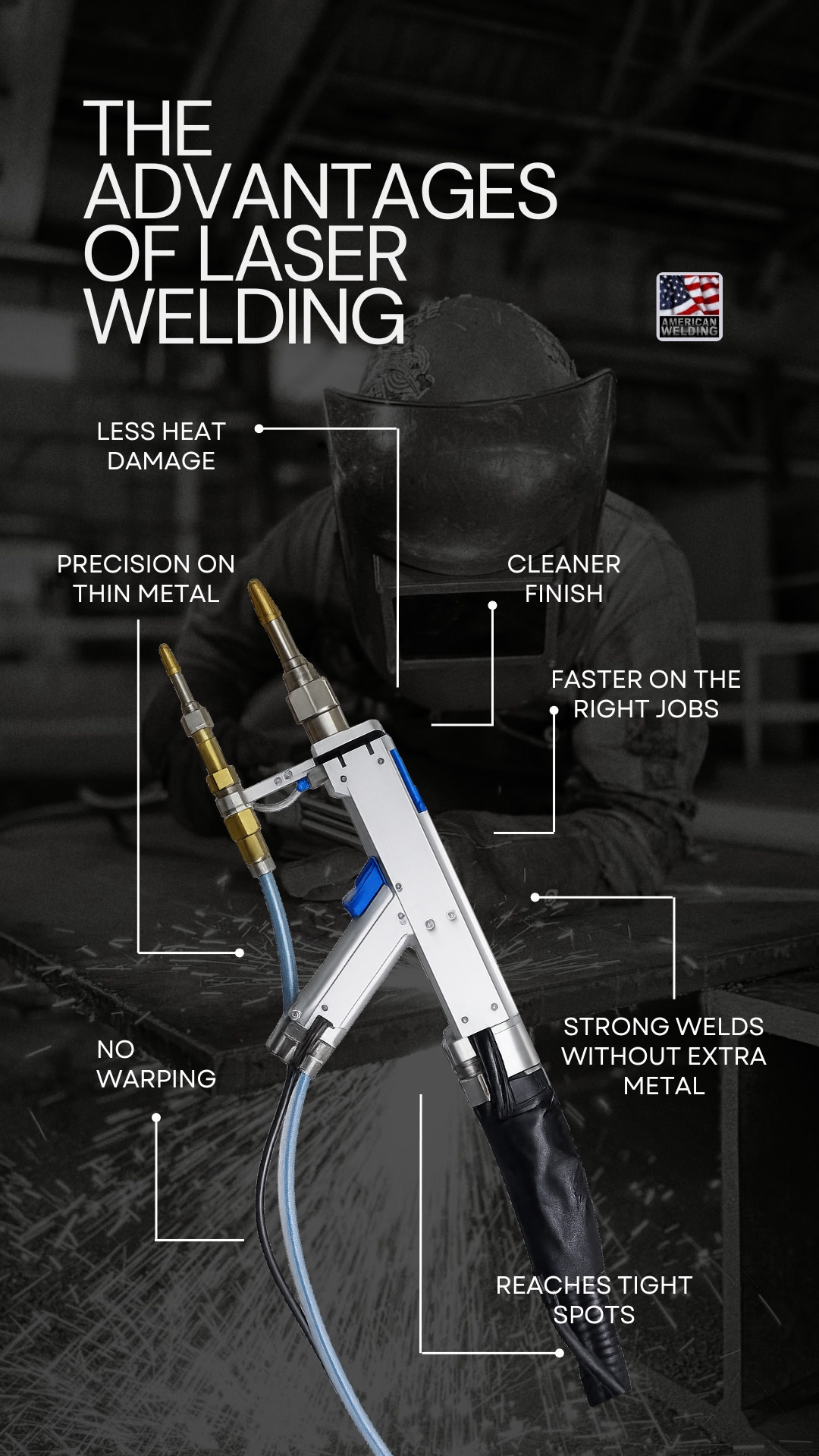
1. Less Heat Damage to the Metal Around the Weld
Regular welding spreads heat over a wide area. The metal near the weld can warp, discolor, or lose strength. On thin metal, this is a constant fight.
Laser welding heats only a tiny area. The rest of the piece stays cool. That means less warping, less color change, and less damage to nearby parts. For thin stainless steel, aluminum, or delicate parts, this is often why customers choose laser.
2. Cleaner Finish, Less Cleanup
Because the laser weld is narrow and controlled, the finished weld is smoother and needs less grinding or polishing to look clean.
For visible work such as restaurant equipment, decorative rails, and display stands, this saves on finishing work. For hidden repairs, it saves time.
3. Precision on Small and Thin Parts
Some jobs are too small or too thin for a regular torch. A regular weld can blow right through thin metal or damage a nearby small part.
Laser welding handles previously impossible jobs, repairing worn tool edges, sealing tiny cracks, and joining thin sheets without burning through. The precision is what makes it possible.
4. Faster on the Right Jobs
Laser welding is not faster on every job. But for the right jobs, such as thin metal, small parts, and repetitive work, it can sharply reduce welding time. Less setup, less cleanup, fewer passes needed.
5. Less Warping
Warping happens when heat spreads and cools unevenly. Because a laser weld puts heat in a tiny spot, the rest of the metal doesn't get hot enough to move.
This matters most on:
- Thin sheet metal
- Long, flat pieces that would bend under heat
- Precision parts that have to stay in shape
6. Better Reach on Tight Spots
The laser beam can reach into corners, seams, and gaps that a torch can't. The tool that delivers the beam is narrow and steady, and the beam goes exactly where it's aimed.
For repair work on complex parts, such as a broken mold or a cracked casting inside a machine, this reach is often the deciding factor.
7. Strong Welds Without Extra Metal on Many Jobs
Some laser welds don't need extra welding wire. The two pieces of metal are joined directly by the beam: fewer materials, less mess, and a cleaner-looking weld.
For jobs that do need extra metal, laser welding can use wire too, but a lot of thin-metal work skips the wire completely.
Where Laser Shows Its Best Side
Laser welding gives the biggest advantage on these types of jobs:
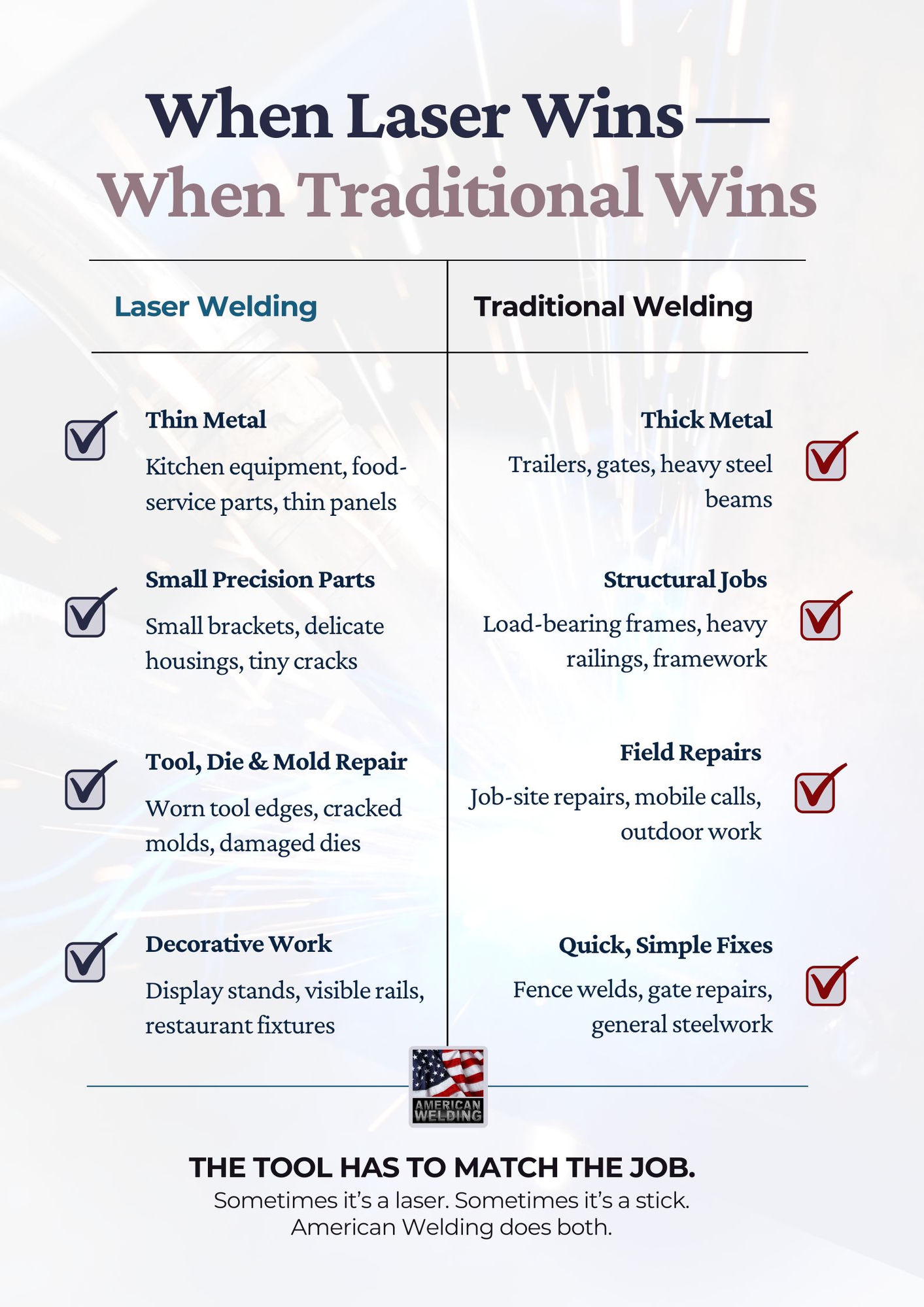
- Thin stainless steel — kitchen equipment, food-service parts, decorative panels
- Thin aluminum — small parts, brackets, delicate housings
- Tool, die, and mold repair — sealing worn edges, filling small cracks, restoring parts
- Small precision parts — where a regular torch would ruin the piece
- Decorative work — where the finish matters and cleanup should be minimal
- Hard-to-reach repairs — corners, seams, tight spaces
Not every job fits. That's why traditional welding methods are still used alongside laser welding at American Welding.
When Traditional Welding Is Still the Right Call
Laser welding isn't the answer for everything. Regular welding usually wins on:
- Thick metal: A laser is built for precision, not for driving deep welds through thick steel. TIG, MIG, or stick handles heavy work.
- Structural jobs: Load-bearing frames, heavy railings, trailer repairs — traditional welding is the right tool.
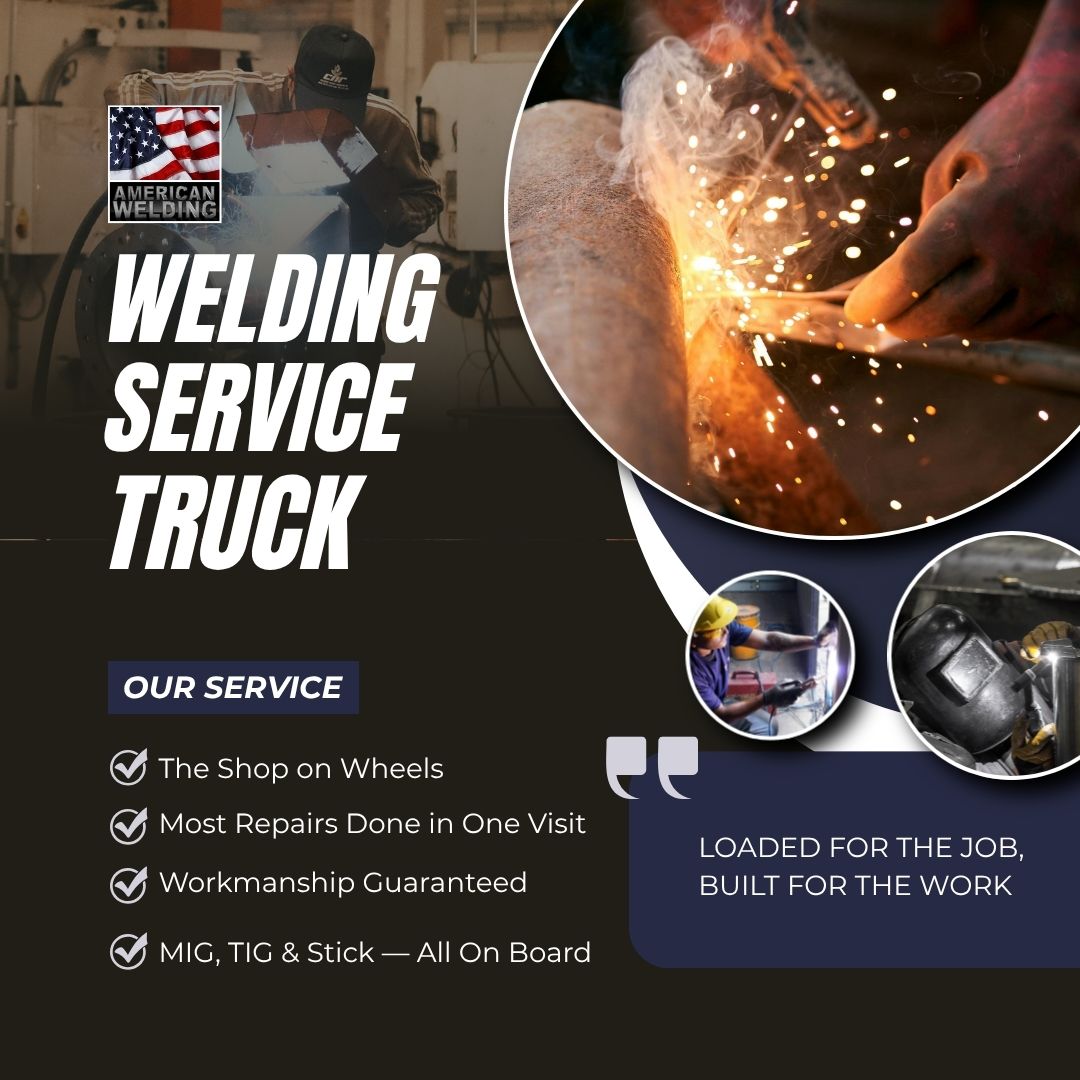
- Field repairs on-site: Laser welders aren't as portable as a mobile TIG or stick setup. For on-site work, the truck usually carries traditional gear.
- Cost-sensitive quick fixes: Laser welding equipment is more expensive to operate than traditional welding equipment. For simple jobs, the extra cost isn't worth it.
A welding career that started right out of high school in 1980 has taught one clear lesson: the tool has to match the job. Sometimes that tool is a laser. Sometimes it's a stick electrode.
The best welding shops know when to use each one.
From Setup to Finished Weld
Here's roughly how a laser welding job comes together:
- Review the piece. Look at the metal, the thickness, the damage, and what the finished weld has to do.
- Decide if laser is the right fit. If a regular weld would work just as well and cost less, that's what gets used. A laser is chosen when the job actually needs its advantages.
- Prep the metal. The surface is cleaned. Any old weld metal or damage is dressed back.
- Set up the laser. The beam is dialed in: power, spot size, and speed are matched to the metal.
- Make a test weld. On sensitive jobs, a test weld on scrap confirms the settings before touching the real piece.
- Run the weld. Steady and controlled. The narrow beam does the work.
- Cool and clean. Because the finish is already clean, cleanup is short. The piece is checked before it leaves.
Same care every time. Workmanship guaranteed.
Service Areas
American Welding serves Chicago and the surrounding suburbs, including:
- DuPage County — Naperville, Wheaton, Downers Grove, Lisle, Oak Brook, Hinsdale
- Cook County — Elk Grove Village, Schaumburg, Hoffman Estates, Bartlett
- Kane County — St. Charles, Geneva, Batavia, Aurora
- Will County — Joliet, Bolingbrook, Plainfield
- Kendall County — Oswego, Yorkville
- McHenry County and DeKalb County
- Milwaukee to Illinois corridor and NW Indiana for larger jobs
Laser Welding in Elk Grove Village
Elk Grove Village is home to one of the largest industrial parks in the country. Machine shops, tool and die shops, food equipment manufacturers, and packaging plants line the streets. Precision matters here; a worn tool has to hold its exact shape; a bent bracket has to sit clean in a machine.
Those are the jobs where laser welding earns its keep. A cracked tool that would take days to replace can be sealed and back in service the same week. A stainless part that would warp under a regular torch stays true. Local shops across Elk Grove Village bring precision work in for laser repair because the advantages show up on the shop floor, not just on paper. Workmanship guaranteed.
Why Choose American Welding for Laser Work
- The right tool for the right job. Lasers are used where they make a difference. Where it doesn't, traditional welding does the work.
- Precision without waste. No experimenting on your part. Test welds happen on scrap first when the job calls for it.
- Repair over replace. Broken tools, cracked castings, and worn edges are brought back into service rather than discarded.
- Plain answers. Straight explanations of what's needed and why.
- Workmanship guaranteed on every job.
For more on laser welding and related work, see:
- The Laser Welding Process Explained
- Laser Welding Service
- Aluminum Welding Service
- Cast Iron Welding Service
FAQs About Laser Welding Advantages
Q: Is laser welding stronger than TIG or MIG welding?
Not always. On thin metal, a well-set laser weld can be just as strong as, or stronger than, the base metal. On thick metal, TIG and MIG usually win. Strength depends on the metal, the joint, and the job, not just the tool.
Q: Does laser welding damage the metal around the weld?
Much less than regular welding. Because the heat remains confined to a small area, the metal outside the weld remains close to room temperature. This is one of the biggest reasons customers pick laser for thin or delicate work.
Q: Is laser welding worth the extra cost?
On the right jobs, yes. Thin metal, precision parts, and tool repair often save enough time or replacement cost to make laser welding cheaper in the end. On simple thick-metal jobs, traditional welding is usually the better deal.
Q: Can laser welding be done on aluminum?
Yes, but aluminum reflects light, which makes it trickier to work with than stainless steel or regular steel. It works well with the right setup.
Q: Does laser welding leave a clean finish?
Yes. The weld itself is narrow and smooth. Very little grinding or polishing is usually needed, especially on visible work.
Q: Can laser welding fix broken tools or dies?
Yes, this is one of its most useful jobs. Worn edges, small cracks, and damaged corners can be sealed and rebuilt, saving the cost of a full replacement.
Q: Is laser welding faster than regular welding?
On the right jobs, yes. For thin metal, small parts, and repetitive work, lasers can noticeably reduce welding time. On thick metal, traditional welding is usually faster.
Ready to See What Laser Welding Can Do for Your Job?
If you've got a repair or a project where a regular weld might not fit- thin metal, a broken tool, a small part, a precision piece- laser welding is worth a call. American Welding handles laser and traditional welding side by side and selects the right one for the job.
Call (630) 927-3030 or email pete@americanwelding.us to talk it through. Workmanship guaranteed.