Why Do Commercial Kitchens Use Stainless Steel?
Ask why do commercial kitchens use stainless steel, and any line cook who has worked a Friday night rush will tell you the same thing.
It wipes clean in seconds.
It shrugs off heat, steam, and heavy pans.
And it passes the health inspection, year after year.
A commercial kitchen is brutal on building materials. Ovens run hot all day, sinks stay wet, grease gets everywhere, and every night the cleaning crew hits every surface with strong sanitizers. Most materials rot, warp, rust, or crack under that. Stainless steel just keeps going.
This is the back-of-house story. The dining-room side is a different guide — "Why Do Restaurants Use Stainless Steel" covers the front-of-house look. Here we are talking about the working kitchen: the prep line, the dish pit, the cookline, and everything an inspector puts a finger on.
The Short Answer: Why Commercial Kitchens Choose Stainless
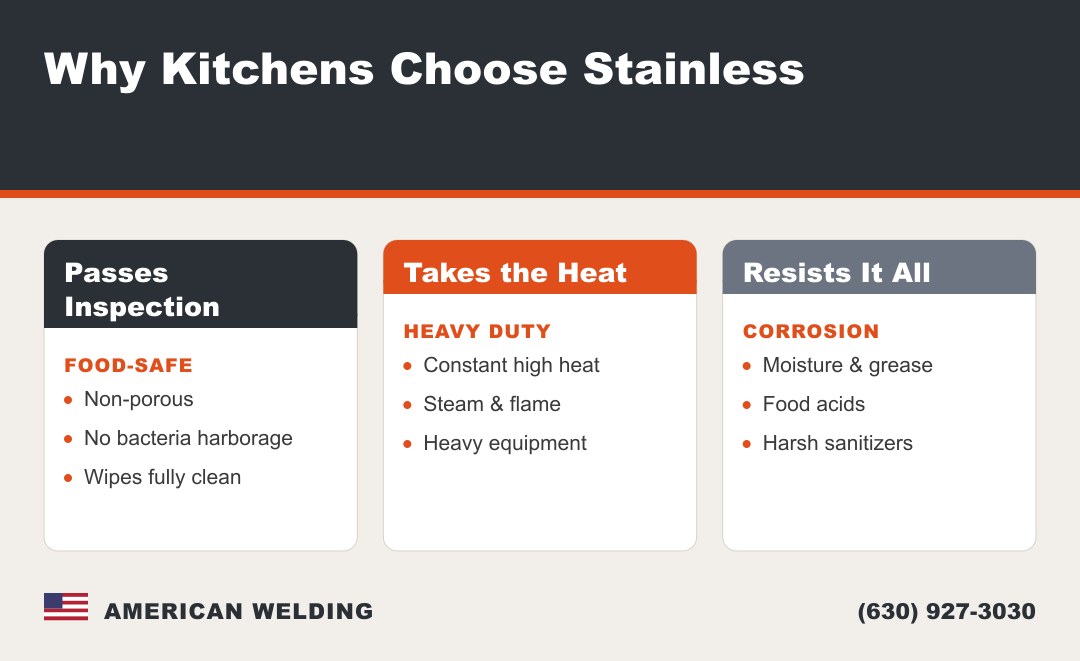
Stainless steel does four things no other affordable material does all at once. Its non-porous surface stays food-safe and wipes clean. It survives constant high heat without warping. It resists moisture, grease, food acids, and harsh cleaning chemicals without rusting. And it lasts for decades. In short, it checks the health-code box, the heat box, and the durability box at the same time — which is why nearly every hard surface in a professional kitchen is made of it.
Passing the Health Inspection
Health inspections come down to one question: can this surface really be cleaned, every single day? Stainless answers yes. It is smooth and continuous, with no grain to soak things up and no soft spots to crumble — a wet cloth and sanitizer take it back to clean in one pass.
Inspectors also look hard at seams, corners, and joints — the hidden spots where food and grease collect. This is where good welding matters. A properly welded stainless seam is ground smooth and continuous, with no gap or crevice for gunk to hide in. A sloppy seam gives bacteria a home and an inspector a reason to write you up.
Non-Porous: Bacteria Have Nowhere to Hide
This is the heart of it. Stainless steel is non-porous. There are no tiny pores, cracks, or open grain for bacteria to sink into and multiply. What is on the surface stays on the surface, and what is on the surface wipes away.
Compare that to the alternatives. Wood surfaces scar and split, and plastic scratches over time — every one of those marks traps food and moisture for bacteria to live in. Stainless does not open up into a bacterial nest that way, which is why raw-protein prep and plating happen on it. It stays genuinely food-safe shift after shift.
Built for Constant Heat and Heavy Use
A commercial kitchen never really cools down. Ranges, ovens, fryers, and steam tables run for hours. Stainless takes that heat in stride — it does not melt, scorch, or break down next to a hot line. That is why the cookline, the exhaust hoods over the burners, and the shelving around them are all stainless.
Then there is the physical beatdown. Cooks slam heavy stockpots down, sheet pans get dropped, carts bang into table legs all day. Stainless takes the abuse and keeps its shape. One honest note: it holds heat and moves more with temperature than plain steel, so it warps if over-heated during a repair — one more reason to have that work done by someone who understands the metal.
Standing Up to Moisture and Cleaning Chemicals
Kitchens are wet, greasy, and acidic. Sinks and dish pits stay soaked, tomato and citrus and vinegar hit prep surfaces all day, and every night the crew comes through with strong degreasers and sanitizers. Ordinary steel would be a rusted mess in a month.
Stainless resists all of it thanks to a thin, invisible chromium-oxide layer on its surface. That layer is what makes stainless "stainless" — it fights off rust, stands up to grease and food acids, and takes strong sanitizers without pitting. If the surface gets scratched, that layer heals itself in air. The catch is that welding and cutting disturb it right at the joint, which is why a pro cleans and finishes each weld so it resists rust like the rest of the panel.
Which Stainless Grade a Kitchen Uses: 304 vs 316
Not all stainless is the same, and picking the right grade matters. Two grades cover almost every commercial kitchen.
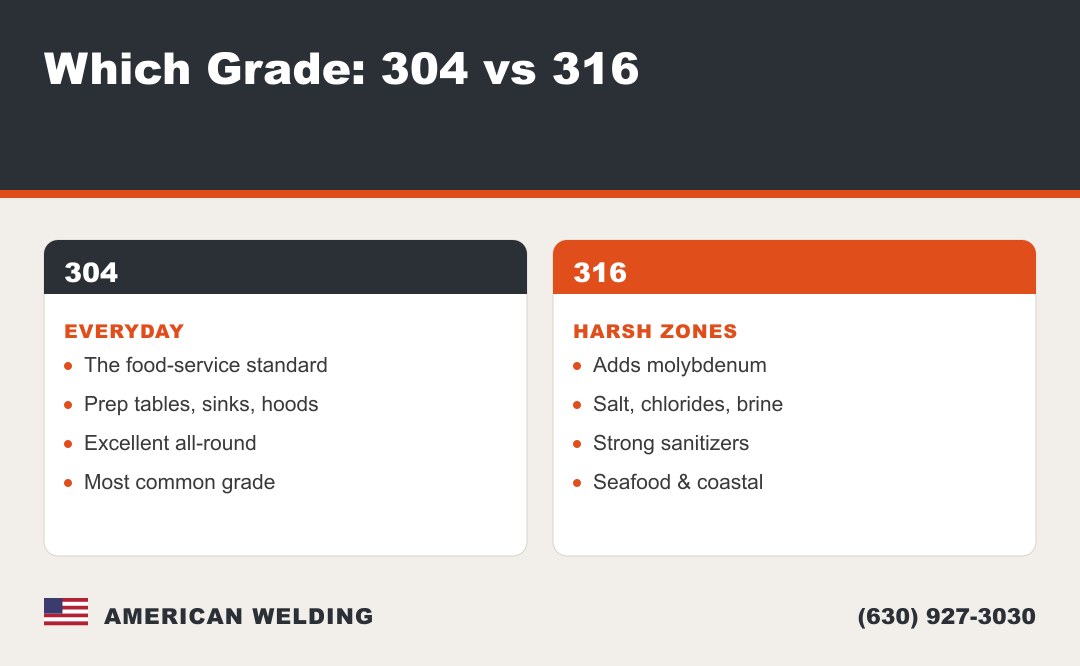
304 is the everyday food-service grade — what most prep tables, sinks, hoods, shelving, and worktops are made of. It handles the heat, moisture, and cleaning of a normal kitchen beautifully, and it is the sensible, cost-effective choice for the vast majority of jobs.
316 is the heavy-duty grade. It adds a metal called molybdenum for extra resistance to salt, chlorides, and harsh chemicals. You step up to 316 when the environment is more aggressive — near the coast, spaces washed down with strong chloride sanitizers, or areas that deal with a lot of brine. It costs more, so you use it where you actually need it. A good welder helps you make that call and matches the filler metal to whichever grade you have, so the finished joint resists corrosion as well as the parent metal.
Where Stainless Shows Up in a Commercial Kitchen
Once you start looking, stainless is nearly everywhere back-of-house:
- Prep tables and worktops where food is cut, portioned, and plated
- Exhaust hoods and ductwork over the cookline
- Sinks — hand sinks, prep sinks, and three-compartment wash sinks
- Dishwashing stations and the tables that feed them
- Splash walls and wall panels behind ranges and sinks
- Shelving and storage racks in dry and walk-in storage
- The cookline itself — range surrounds, equipment stands, and legs
Every one of these takes abuse, gets wet, and has to pass inspection. That is the exact job stainless is built for.
Keeping Kitchen Stainless in Service: Repair and Fabrication
Stainless lasts for decades, but a busy kitchen still puts it to the test. A prep table develops a cracked seam, a hood needs a new section, a sink gets dented or a leg gets bent. And off-the-shelf equipment rarely fits an odd corner, so many kitchens need pieces built to measure. That is where welding and custom fabrication come in.
Kitchen stainless is not a job for a general handyman. The metal moves under heat, the welds have to stay smooth enough to be food-safe, and the finish has to resist rust when the work is done. TIG welding is the cleanest, most precise way to join food-grade stainless, leaving a tidy bead that grinds smooth for inspection. A pro also uses stainless-only tools and brushes — carbon steel dragged across stainless leaves specks that rust later and ruin an otherwise perfect job.
Whether it is repairing a worn table, extending shelving, or building a splash panel from scratch, restaurant stainless steel welding keeps a kitchen running and inspection-ready. Mobile welding means the work can happen on-site, so a heavy hood or built-in table never has to leave the building. If you are adding new surfaces, the companion guide "How to Install Stainless Steel Panels for Commercial Kitchens" walks through fitting them cleanly.
Service Areas
American Welding serves commercial kitchens across Chicago and the surrounding suburbs, both on-site and in the shop:
- DuPage County — Naperville, Wheaton, Downers Grove, Lisle, Oak Brook, Hinsdale
- Cook County — Chicago, Schaumburg
- Kane County — Aurora, St. Charles
- Will County, Kendall County, and McHenry County
Why Choose American Welding for Commercial Kitchen Stainless
American Welding is owned and run by Pete Adams, a veteran welder who has been on the torch for about 37 years, in business since 1989. He has built and repaired kitchen stainless long enough to know how the metal behaves, where inspectors look, and what it takes to keep a joint food-safe and rust-free. When something has to be done right the first time, that experience is what you are paying for.
American Welding is mobile and in-shop, serving commercial kitchens throughout Chicago and DuPage County. Every job is fully insured, the work area is set up carefully around your equipment, and the workmanship is guaranteed in writing. You get a clear quote before any work starts — no surprise trip fees.
Frequently Asked Questions
Why is stainless steel required in commercial kitchens?
Stainless is simply the material that meets what a kitchen needs all at once. It is non-porous and easy to clean, survives heat and heavy use, and resists moisture and sanitizers. That combination is what passes a health inspection, so it has become the standard back-of-house.
What grade of stainless steel is used in commercial kitchens?
304 is the everyday food-service grade and covers most tables, sinks, hoods, and shelving. 316 adds molybdenum for extra resistance to salt and harsh chlorides, so it is used near the coast or where strong chemicals get washed down. For most kitchens, 304 is the right, cost-effective choice.
Is stainless steel really more sanitary than plastic or wood?
Yes. Wood scars and splits, plastic scratches over time, and every one of those marks traps food and bacteria. Stainless is non-porous, so there is nowhere for bacteria to hide and it wipes fully clean. That is why prep and plating happen on stainless.
Can stainless steel kitchen equipment be repaired instead of replaced?
Almost always, and it is usually the smarter move. A cracked seam, a torn hood section, a dented sink, or a bent leg can be welded and refinished for a fraction of replacement cost. Because stainless lasts for decades, a solid repair often outlives the equipment around it.
Does welding stainless steel affect whether it stays food-safe?
Only if it is done poorly. A good weld is ground smooth so there is no crevice to trap food, and the surface is cleaned and finished so it resists rust again — a concept called passivation. A rough weld, or one done with carbon-steel tools, can rust or harbor bacteria, which is why it pays to use a pro.
Why does some kitchen stainless start to rust?
Real stainless resists rust, but contamination breaks that. The most common cause is tiny bits of carbon steel from a shared brush or grinder embedding in the surface and rusting. Harsh chemicals left sitting, or a weld that was never cleaned, can do it too. Stainless-only tools prevent nearly all of it.
Do you build custom stainless pieces to fit our space?
Yes. Custom fabrication is a big part of the work — prep tables, splash panels, shelving, and equipment stands built to your exact measurements. Off-the-shelf gear rarely fits an odd corner, so a made-to-measure piece often works better and lasts longer.
Can you do the work on-site so we don't lose the kitchen?
In most cases, yes. Mobile welding lets us handle repairs and installs right in your kitchen, so heavy or built-in equipment never has to move. We set up carefully around your space and keep your downtime short.
Ready for Commercial Kitchen Stainless Done Right?
If your kitchen needs a stainless repair, a new fabricated piece, or a hood or table built to fit, get it done by someone who has worked the metal for nearly four decades. You get honest advice, clean welds that pass inspection, and workmanship guaranteed in writing — with a clear quote before any work starts.
Call or text (630) 927-3030 or email pete@americanwelding.us to walk through your project.