Why Do Restaurants Use Stainless Steel?
Why do restaurants use stainless steel? Walk into any commercial kitchen and the answer stares right back at you.
Silver surfaces, everywhere.
Prep tables, sinks, hoods, shelving — all the same metal.
It isn't for looks. It's the one material that refuses to quit.
A restaurant kitchen is a brutal place: knives scrape, pots slam down, grease flies, and everything gets sprayed with hot water and harsh cleaners every night. Most materials would stain, warp, or grow something you don't want near food. Stainless just shrugs it off — which is why, after 37 years around Chicago kitchens, we see it in nearly all of them.
The Short Answer: Why Restaurants Run on Stainless
The whole answer in one breath: stainless steel is safe for food, tough as nails, and easy to keep clean. That combination is hard to beat, and it's the same reason commercial kitchens lean on it so heavily. (Our companion guide Why Do Commercial Kitchens Use Stainless Steel digs into that side of it.)
Boil it down and restaurants choose stainless for a few plain reasons:
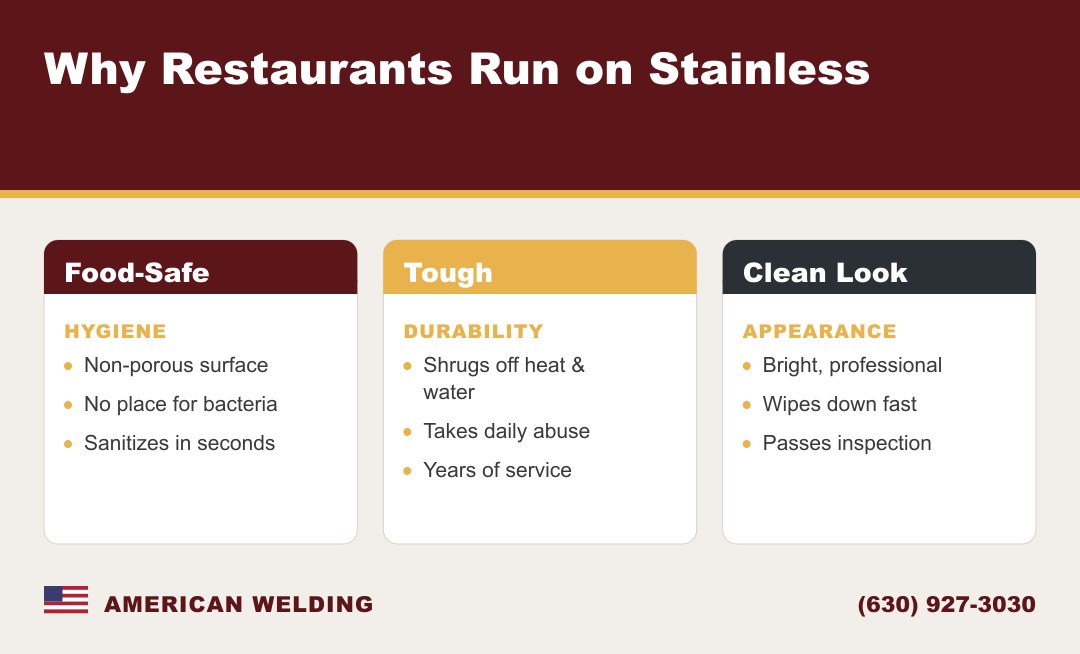
- Non-porous, so bacteria and mold have nowhere to hide.
- Shrugs off water, heat, grease, acids, and strong cleaners.
- Takes a daily beating and keeps its shape.
- Wipes clean in seconds and helps pass inspection.
- Looks clean and professional.
- Lasts for years — a smart long-term buy.
Food Safety: Non-Porous and Bacteria-Resistant
This is the big one. Stainless steel is non-porous — its surface has no tiny holes or open grain for bacteria, mold, or food residue to soak into. Wood boards, worn plastic, and cheap coated metal all have microscopic nooks where germs settle in; stainless doesn't give them the chance.
There's simple chemistry behind it. Stainless contains chromium, and when chromium meets air it forms an invisible chromium-oxide layer across the whole surface. That layer makes the metal both rust-resistant and easy to sanitize, and it heals itself the moment a scratch is exposed to air again. The same barrier that stops rust keeps bacteria from getting a foothold — which is the whole reason stainless goes on every surface that touches food.
Built to Survive a Restaurant's Daily Punishment
A busy kitchen runs hard and long — ten, twelve, sixteen hours a day, seven days a week. Stainless is built for that pace. Sheet pans get dropped on it, racks bang into it, crews scrub it with stiff pads and strong chemicals — and it doesn't dent, crack, or soften like plastic laminate would. It stays flat, solid, and food-safe.
That's why you'll still find stainless tables and sinks working fine in kitchens that opened decades ago. The metal outlasts almost everything around it, so when a weld or joint finally gives out, it's well worth repairing rather than tossing.
Heat, Water, and Corrosion Resistance
Kitchens are wet and hot at the same time, and that combination destroys most materials. Stainless handles all of it. Water beads and runs off without rusting. It sits next to open flame, hot oil, and steam without warping. And it stands up to the acids in food — tomato, citrus, vinegar — plus the strong degreasers and sanitizers used to clean up.
One honest note from the shop: stainless resists corrosion, it isn't magic. Scrub it with a brush that's touched plain carbon steel and you'll leave tiny iron particles behind that rust — making it look like the stainless failed when it didn't. Keep it clean and the corrosion resistance lasts for years.
Fast to Clean, Easy to Pass Inspection
Speed matters at the end of a shift. Because stainless is smooth and non-porous, most of it wipes down in seconds — grease and food don't bond to it the way they cling to rough surfaces. A rag, hot water, and a little sanitizer usually do the job, which saves labor every night.
It also makes health inspections easier. Inspectors want surfaces that are smooth, cleanable, and free of cracks where gunk builds up, and a well-kept stainless kitchen checks those boxes without a fight — a big reason operators specify it from the start.
The Professional Look Customers Trust
Looks count too. A gleaming stainless kitchen reads as clean. In open-kitchen restaurants and at any front counter customers can see, that bright, uniform metal sends a message before a single plate goes out: this place takes hygiene seriously. It doesn't yellow or fade with age, a quick polish brings back the shine, and that professional look protects the brand every day it's on display.
Where You'll Find Stainless in a Restaurant
Once you start noticing it, stainless is nearly everywhere behind the scenes:
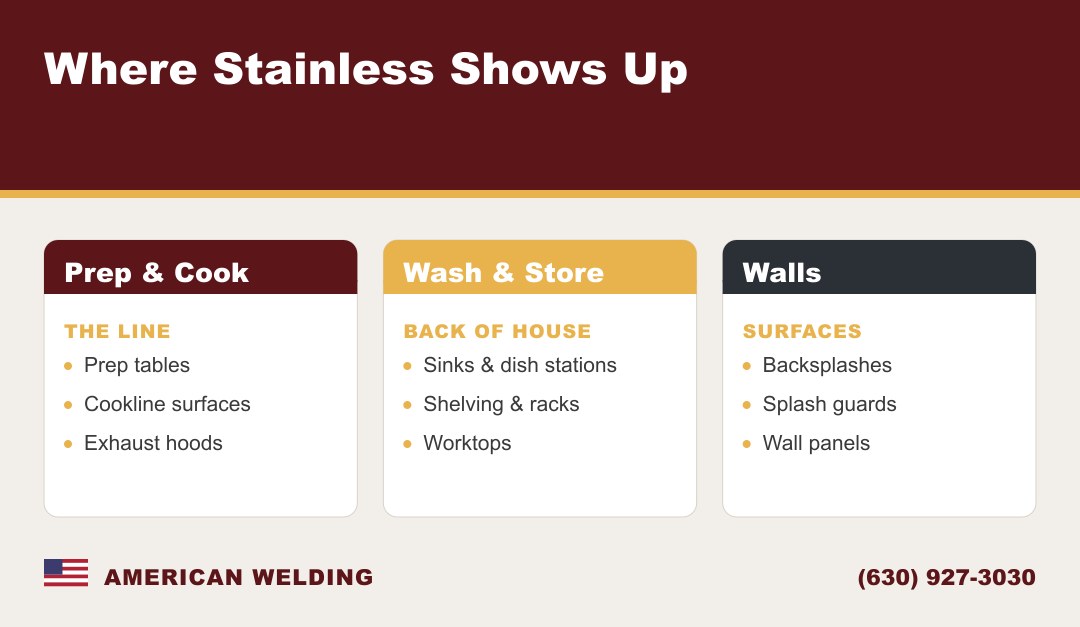
- Prep tables and worktops
- Sinks and dishwashing stations
- Exhaust hoods and ventilation
- Wall shelving and storage racks
- Backsplashes and wall panels
- Cookline surfaces and equipment stands
- Counters, cabinets, and rolling carts
Most of it is grade 304 stainless — the everyday workhorse for prep tables, sinks, hoods, and rails, with grade 316 in spots around heavy salt or brine. Either way, it all takes the same beating, and any of it can crack a weld, split a seam, or need a custom piece built to fit an odd corner.
When Restaurant Stainless Needs a Welder
Stainless lasts, but it isn't indestructible. Seams crack. Legs bend. A hood needs modifying. A prep table needs cutting down to fit a tight kitchen. That's where a welder comes in — and where restaurant stainless steel welding is a real trade, not a quick fix.
Stainless is genuinely tricky to weld well. It holds heat and expands more than regular steel, so it warps easily if the heat isn't controlled — stagger the beads, keep it cool, take your time. The filler has to match too: 304 stainless is welded with an ER308L filler, and that low-carbon filler keeps the joint from rusting later at the seam. Do it wrong and the repair looks fine but rusts within weeks.
For food-grade work, TIG welding is usually the right call — the cleanest, most precise process, leaving a smooth joint you can actually sanitize instead of a rough bead that traps food. A pro also keeps stainless-only brushes and wheels on hand so no carbon steel contaminates the metal, and finishes the weld so it resists rust.
Beyond repairs, custom fabrication is where a welder earns their spot: a shelf sized to the exact wall, a table built around the plumbing, a splash guard bent to fit. And because a kitchen can't always shut down, mobile welding brings the work right on site — American Welding does both, in the shop and out in the field across Chicago and DuPage County.
Service Areas
We handle restaurant stainless work across Chicagoland, on site or in the shop:
- DuPage County — Naperville, Wheaton, Downers Grove, Lisle, Oak Brook, Hinsdale
- Cook County — Chicago, Schaumburg
- Kane County — Aurora, St. Charles
- Will County, Kendall County, and McHenry County
Why Choose American Welding for Restaurant Stainless
American Welding is owned and run by Pete Adams, a veteran welder who has been on the torch about 37 years, in business since 1989. That's a lot of stainless, and a lot of kitchens.
We're mobile and in-shop, so we come to your restaurant when the equipment can't leave, or take the piece in when that's the better call. We know how to control heat on thin stainless so it doesn't warp, match the filler so the repair doesn't rust, and leave a smooth, sanitary weld that holds up to daily cleaning and a health inspector's eye.
Every job is fully insured, and our workmanship is guaranteed in writing. You get a clear quote before any work starts — no surprise trip fees. When it has to be done right the first time, that's the call to make.
Frequently Asked Questions
What grade of stainless steel do restaurants use?
Most restaurant equipment is grade 304 stainless — the workhorse for prep tables, sinks, hoods, and rails. Spots around heavy salt or brine sometimes use grade 316, which adds molybdenum for extra corrosion resistance. When we repair either one, we match the filler to the base metal so the joint holds up.
Is stainless steel really more sanitary than other materials?
Yes. Stainless is non-porous, so there are no holes or grain for bacteria, mold, or food to soak into. Combined with its smooth, wipe-clean surface, that's why it's trusted on food-contact surfaces and why it makes health inspections easier to pass.
Why does restaurant stainless steel sometimes rust?
Usually it isn't the stainless failing — it's contamination. A plain steel pan dragged across it, or a brush that has touched carbon steel, leaves behind tiny iron particles, and those specks rust. That's why any welding repair has to be done with stainless-only tools and finished properly.
Can you weld or repair stainless steel equipment on-site?
Yes. We offer mobile welding, so we can repair sinks, tables, hoods, and shelving right in your kitchen when the equipment can't be moved — or take the piece into the shop if that's easier. Whatever gets you back up and running faster.
How long does stainless steel equipment last in a restaurant?
Well-kept stainless lasts many years — it's common to see tables and sinks still working in kitchens that opened decades ago. When a weld cracks or a leg gives out, repairing the piece is usually smarter and cheaper than replacing the whole unit.
Is stainless steel worth the higher cost for a restaurant?
Over the life of a kitchen, yes — it lasts, stays sanitary, and saves cleaning time every night. For any repair or custom piece, we give you a clear quote before any work starts, so there are no surprises or hidden trip fees.
Why is stainless welding trickier than regular steel?
Stainless holds heat and expands more than carbon steel, so it warps easily if the heat isn't controlled, and the wrong filler can leave a joint that rusts later. That's why food-grade stainless is best handled with TIG welding by someone who does it every week.
Ready to Keep Your Restaurant Stainless in Top Shape?
If your kitchen has a cracked sink, a wobbly prep table, a hood that needs modifying, or you want a custom stainless piece built to fit, we can help. We handle restaurant stainless steel welding and custom fabrication across Chicago, DuPage County, Naperville, and the wider Chicagoland area — mobile or in-shop, guaranteed in writing.
Call or text (630) 927-3030 or email pete@americanwelding.us to walk through your project.