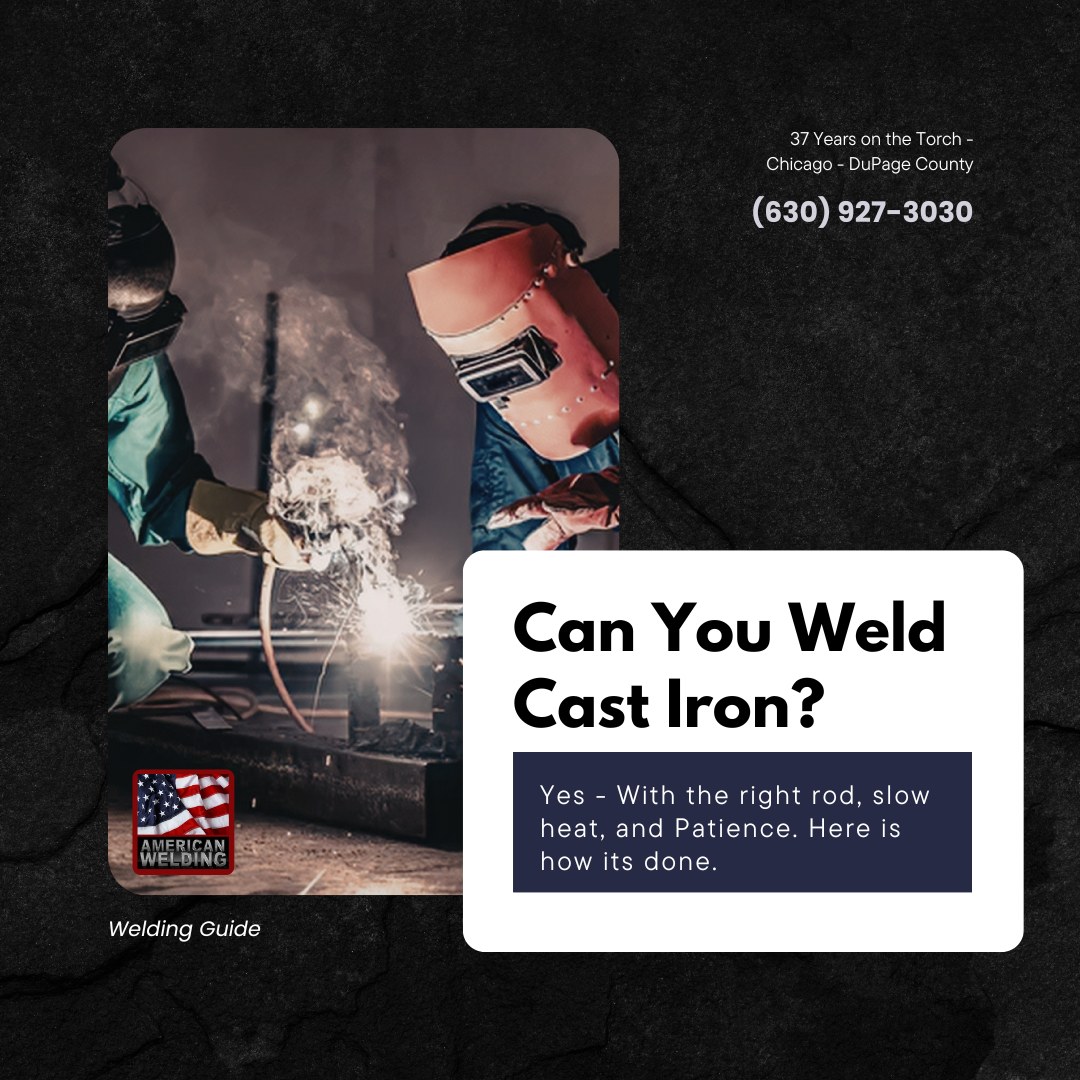
Can You Weld Cast Iron?
A crack in a cast iron part feels like the end of it — the engine block, the antique skillet, the machine base you cannot replace.
But before you throw it out, that broken casting is often worth saving.
Yes — cast iron can be welded. It cracks easily under heat, though, so it takes the right rod, careful heat control, and patience to fix the break without opening a new one.
At American Welding, cast iron is one of the metals we work every week, alongside steel, aluminum, and stainless. Owner Pete Adams has welded since 1989, and from our shop in Wayne, Illinois we see the whole range — cracked cookware to seized machine parts. Here is the honest picture on cast iron welding: why it is harder than steel, how it is actually done, and when it pays to hand it to a pro.
Why Cast Iron Is Tricky to Weld
Cast iron is not steel, and that is the whole problem. It is poured and cooled into its final shape, which leaves it hard, rigid, and full of carbon. Heat it up wrong and it fights back — the part you are trying to save can crack right next to your weld while you watch.
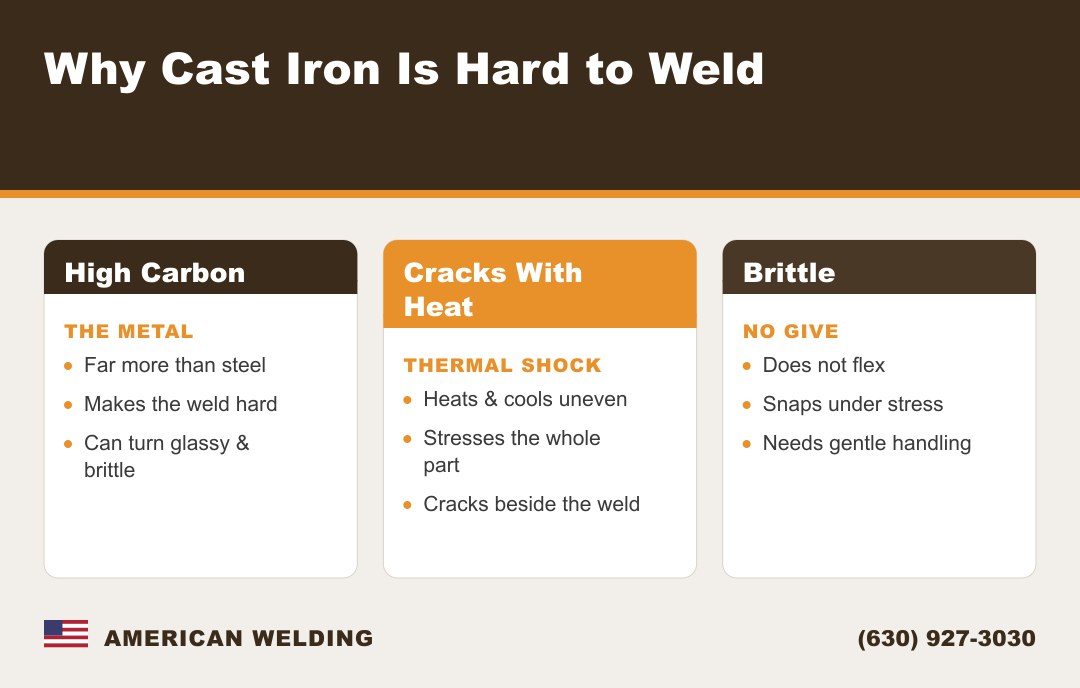
Three things make it a headache compared to welding mild steel:
- High carbon. Cast iron holds far more carbon than steel. When a weld cools too fast, that carbon turns the joint glass-hard and prone to cracking — so the fix can be more fragile than the original break.
- Cracks with heat. Cast iron hates sudden temperature swings. Blast one cold spot with an arc and the metal expands hard, then shrinks as it cools — that thermal shock pulls the casting apart and sends fresh cracks out from the weld.
- Brittle. Steel bends before it breaks; cast iron mostly just breaks. It has almost no give, so the stress a weld puts in has nowhere to go, and a rushed repair snaps the first time it is loaded.
None of this makes cast iron un-weldable — it just means the technique has to respect the metal: slow, controlled, and worked in small bites, never one long hot pass.
How Cast Iron Actually Gets Welded
A good cast iron repair is mostly about managing heat, not laying a pretty bead — adding just enough to bridge the crack while keeping the whole part warm and even. Here is the method a careful welder follows, step by step.
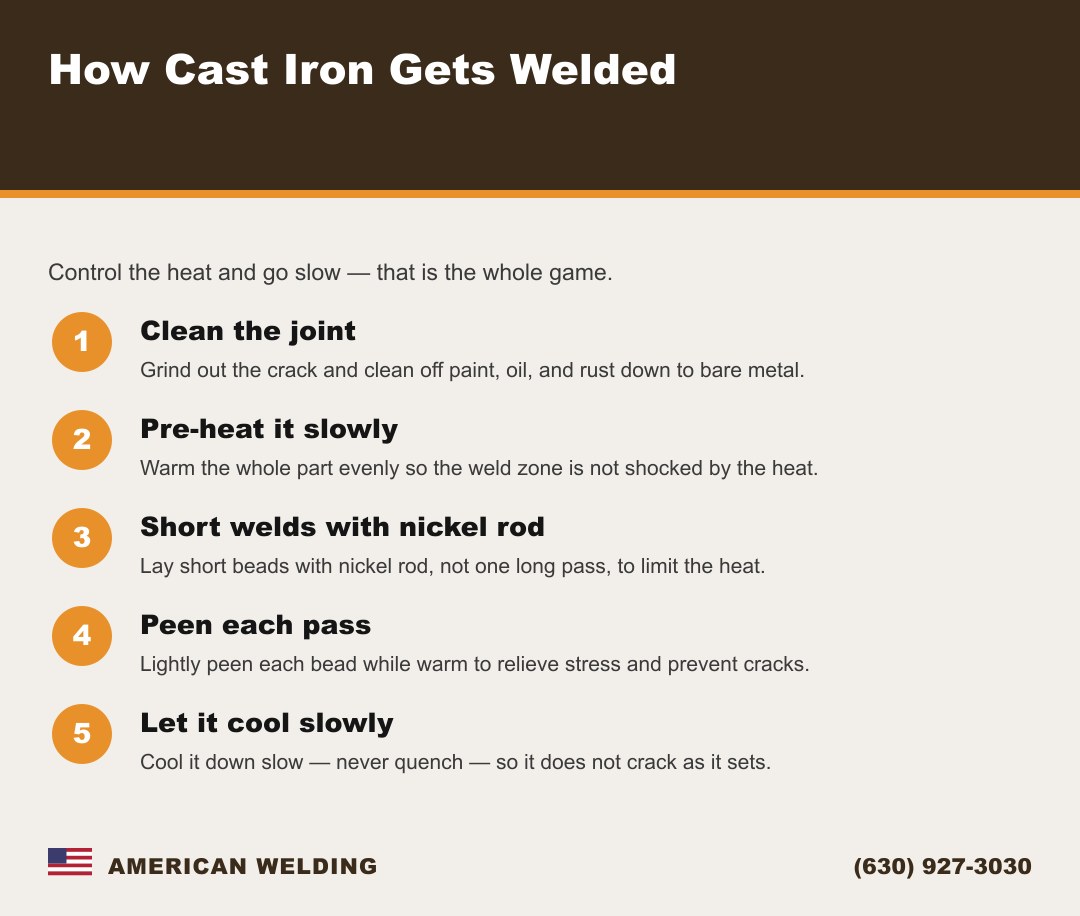
- Clean the joint. Grind out the crack and scrub away grease, paint, rust, and old oil. Cast iron soaks up oil over the years, and any left behind ruins the weld.
- Pre-heat it slowly. Warm the whole part gently and evenly before striking an arc. A warm casting welds without the violent expansion that cracks a cold one.
- Short welds with nickel rod. Run a nickel rod in short, stitched passes — an inch or two at a time — instead of one long bead. Nickel stays softer as it cools, and the short runs keep heat from building up in one place.
- Peen each pass. Lightly tap the weld with a hammer while it is still warm. Peening relieves the stress locked into the bead as it shrinks, which keeps the repair from cracking later.
- Cool it slowly. Let the part come back to room temperature on its own — buried in something insulating, never quenched. A slow cooldown is the difference between a repair that holds and one that splits overnight.
For some parts, brazing is the better call. Instead of melting the cast iron itself, brazing joins the pieces with a filler that flows in at a lower temperature — gentler on the casting, and a strong choice where the part will not see heavy heat or load. Picking the right route is half the job.
What Cast Iron Repairs We Take On
Cast iron shows up in more places than people expect, and most of it is worth fixing rather than replacing. We have welded and brazed just about every kind of casting that comes through the shop:
- Engine blocks and heads — cracks and broken bosses where a repair saves a hard-to-find or expensive replacement.
- Manifolds — exhaust and intake manifolds that have cracked from years of heat cycling.
- Cookware and skillets — cracked or broken cast iron pans, griddles, and Dutch ovens, including the old ones worth keeping.
- Machine bases and frames — cracked bases, housings, and brackets on shop and industrial equipment.
- Pulleys and wheels — broken cast iron pulleys, gears, flywheels, and hand-wheels.
- Vintage and antique parts — old stove parts, farm implements, bench vises, and heirlooms where replacement is not an option.
If your part is cast iron and it is cracked or snapped, it is worth a look — send us a photo and we will tell you straight whether it can be saved.
Should You DIY It or Call a Pro?
Plenty of guides make cast iron welding sound like a weekend job. In reality, it is the one metal where a wrong move usually makes things worse — and the damage often hides until later.
A bad cast iron weld does not just look rough. Skip the pre-heat or cool it too fast and the casting cracks alongside the repair, turning one clean break into a spider-web of new ones. Grab the wrong rod and the joint sits there hard and brittle, ready to snap under load. On an engine block or an antique you cannot replace, that mistake can cost you the whole part.
If the piece is cheap, common, and you have welded cast iron before, there is no harm in trying. But if it is valuable, hard to replace, or has to hold under load and heat, that is the moment to bring it to a welder who does this often. A proper repair almost always costs less than ruining the part twice.
Getting Cast Iron Welded in Chicagoland
Getting a cast iron part fixed is simple. Call or text Pete at (630) 927-3030, or send a photo of the break, and we will tell you whether it can be welded, brazed, or is better left alone.
Because we run mobile welding and repair rigs, we can come to you when a part cannot be moved — a machine base bolted to the floor or an engine still in the frame. Our portable welding service brings the work on-site across Chicago, DuPage County, and the wider Chicagoland area. Smaller pieces like skillets, pulleys, and antique parts are best handled by appointment at our shop, where the heat and cooldown are controlled from start to finish. Either way, you get an honest answer and workmanship that holds.
Cast Iron Welding FAQ
Can cast iron really be welded, or is it a myth?
It can genuinely be welded. It is trickier than steel because it is high in carbon and cracks under sudden heat, but with the right rod, a slow pre-heat, short passes, and a slow cooldown, a broken casting comes back solid.
Why does cast iron crack when you weld it?
Because it hates fast temperature changes. A cold casting expands hard where the arc hits, then shrinks as it cools, and that thermal shock pulls the brittle metal apart. Keeping the whole part warm and cooling it slowly is what prevents the cracks.
What kind of rod is used to weld cast iron?
A nickel rod is the usual choice. Nickel stays softer and more forgiving as the weld cools, so it resists the hard, brittle zone that forms when cast iron is welded with the wrong filler. It is run in short, stitched passes rather than one long bead.
Is brazing better than welding for cast iron?
Sometimes. Brazing joins the pieces with a filler that flows in at a lower temperature instead of melting the casting, so it is gentler on the part and a strong option where the piece will not face heavy heat or load. Which one fits is a call we make when we see it.
Can you weld a cracked cast iron engine block?
Often, yes. Cracked blocks and manifolds are among the most common repairs we take on, and a proper weld can save an expensive or hard-to-find replacement. Send a photo of the crack and we will tell you whether it is a good candidate.
Can a cracked cast iron skillet be saved?
Many can. Old cast iron cookware is worth keeping, and a careful repair can bring a cracked pan or Dutch oven back to use. Bring it by our Wayne, Illinois shop by appointment so the heat and cooldown are controlled properly.
Got a Cracked Cast Iron Part?
Do not toss that engine block, skillet, or heirloom just because it cracked. Cast iron can usually be saved when it is welded the right way, and Pete has been doing exactly this since 1989. Whether your part comes to our Wayne, Illinois shop or we bring the rig to you across Chicago and DuPage County, you will get an honest answer and a repair that holds.
Call or text (630) 927-3030 or email pete@americanwelding.us and send a photo of the break.