Gas vs Gasless MIG Welding
Standing in the aisle trying to choose between gas and gasless MIG? You are not alone — this one trips up plenty of people.
Both run a spool of wire, both lay down a strong bead, so the real difference is easy to miss until you are mid-job.
Here is the short answer: gas MIG gives the cleanest welds indoors on thin metal, while gasless MIG runs flux-cored wire with no tank and wins outdoors, in the wind, and on thick steel.
At American Welding, owner Pete Adams has welded since 1989 — around 37 years on the torch — and from our shop in Wayne, Illinois we run both setups every week on mobile rigs across Chicago and DuPage County. They are not rivals so much as two tools for two different jobs. Once you know what each one is actually doing, the choice gets simple. Here is the plain-English breakdown, plus how the two stack up on the kind of work people in Chicagoland actually bring us.
What Gas MIG Welding Is
Gas MIG is the classic setup most people picture when they think of MIG welding. A solid wire feeds through the gun, and at the same time a tank of shielding gas flows out of the nozzle and blankets the molten puddle. That gas curtain keeps the open air off the weld while it cools, which is the whole trick.
What you get for the extra hardware is a weld that looks and runs clean. The bead comes out smooth and bright, there is very little spatter to grind off, and the arc is forgiving on thin material like auto-body panels and sheet steel. The catch is that tank. It has to come with you, it costs money to fill, and a stiff breeze will pull the shielding gas right off the puddle — which is exactly why gas MIG is a shop-and-garage process, happiest indoors and out of the wind.
What Gasless MIG Welding Is
Gasless MIG — more properly called flux-cored welding — does the same job with a clever twist. Instead of solid wire fed next to a gas tank, the wire itself is a hollow tube packed with flux. As the arc burns that flux, it throws off its own shielding gas and lays a layer of slag over the cooling bead. In other words, the wire shields itself, so there is no tank to haul and nothing to blow away.
That makes gasless MIG the go-anywhere option. It runs great outdoors and in a breeze, it bites through thicker steel with good penetration, and it is more tolerant of rust, mill scale, and less-than-perfect prep on a rough piece. The trade-off is cosmetic and a little more cleanup: flux-cored welds throw more spatter, leave slag you have to chip off, and finish rougher than a clean gas bead. For structural and field work, though, that is a fair price for never chasing a gas bottle.
Gas vs Gasless — Side by Side
Put the two next to each other and the pattern is clear: gas trades portability for a clean, tidy weld, and gasless trades looks for the freedom to work anywhere. Here is how they compare on the things that matter most on a real job.
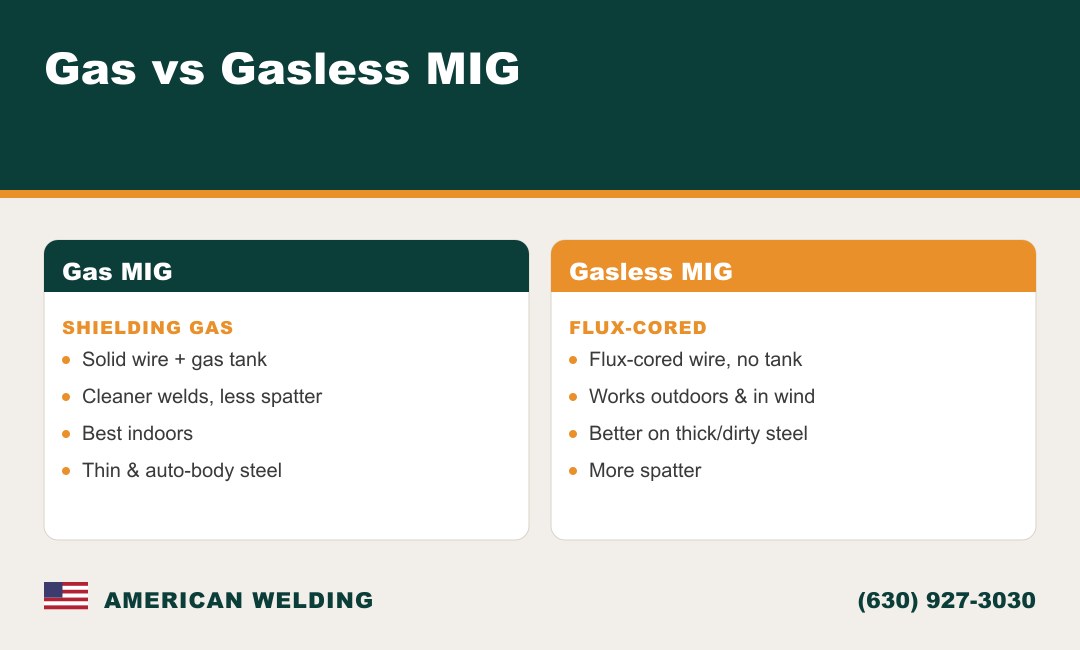
- Gas MIG: solid wire plus a shielding-gas tank, cleaner welds, far less spatter, and the best choice indoors on thin or auto-body steel.
- Gasless MIG: self-shielding flux-cored wire, no tank to carry, works outdoors and in the wind, stronger on thick or dirty steel — at the cost of more spatter and slag to clean up.
Which Should You Use?
Forget which process is "better" in the abstract — ask what the job in front of you needs. The weld only has to suit the metal, the setting, and the look you are after. Match the process to those three and you will pick right almost every time.
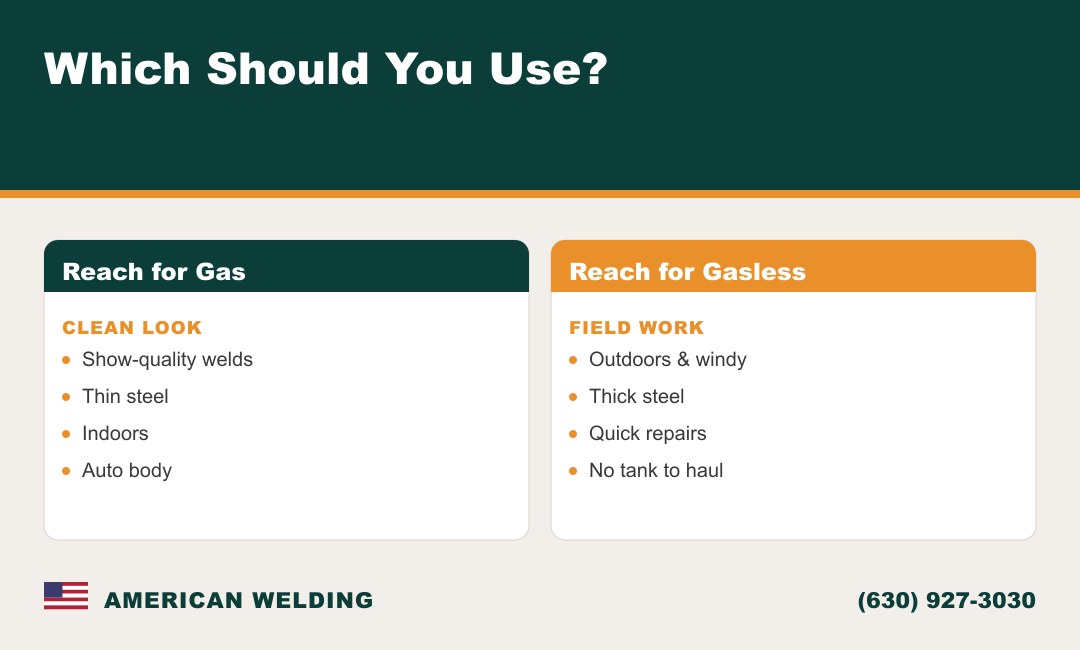
Reach for gas MIG when you want a clean, show-quality look, when you are welding thin steel, when you are indoors, or when you are doing auto-body work where the bead has to look as good as it holds. Reach for gasless MIG when you are outdoors, on a windy site, working thick steel, or knocking out a quick field repair where dragging a gas bottle makes no sense. If a job needs the clean precision of neither — say, polished stainless or thin aluminum — that is usually a sign it belongs to a different process entirely, which is the heart of the MIG vs TIG welding question.
What American Welding Runs
For most people this whole debate is beside the point — you do not need to own a machine, you need the weld done right. That is where we come in. Because our work is mobile, we bring the correct setup to you and match it to the job on the spot, rather than forcing one process onto a piece it does not suit.
Fixing a thin bracket or auto-body panel in a clean spot? We will run gas MIG for the tidy, strong finish. Welding a heavy gate, a trailer, or a structural repair out in a customer's yard with the wind up? Gasless flux-cored earns its keep, no tank required. When a piece calls for more finesse than either MIG can give, we switch to TIG welding for stainless, aluminum, and precision work. Our mobile welding rigs and portable welding gear mean we carry the right process to your site across Chicago, DuPage County, and the wider Chicagoland area — so the method fits the metal, not the other way around.
Not sure which your project needs? You do not have to. Send Pete a photo or call, tell us the metal and where it sits, and we will tell you straight which process is right and give you a free quote before any work starts.
Gas vs Gasless MIG FAQ
Is gas or gasless MIG better for beginners?
Gasless flux-cored is often the easier start — there is no tank or gas flow to set, and it is forgiving outdoors and on thicker steel. Gas MIG is just as beginner-friendly for clean indoor work on thin metal, but it adds the tank and the wind sensitivity. Pick based on where and what you will weld.
Can you use gasless flux-cored wire outdoors?
Yes — that is its biggest advantage. Because flux-cored wire makes its own shielding as it burns, there is no gas curtain for the wind to blow away. It is the standard choice for field repairs, outdoor jobs, and anywhere a breeze would ruin a gas-shielded weld.
Does gasless MIG weld thin metal?
It can, but it is not its strong suit. Flux-cored wire runs hot and penetrates deep, so on thin sheet or auto-body panels it is easy to burn through. For thin steel where the look matters, gas MIG is the cleaner, more controllable choice.
Why does gasless MIG produce more spatter?
The flux that shields the weld also burns off as slag and throws more sparks and spatter than a clean gas arc. That means a little more grinding and chipping afterward. It is a cosmetic trade-off, not a strength problem — the weld underneath is still solid.
Can one MIG machine run both gas and gasless?
Many MIG welders do both — you swap the wire, change the drive roller to suit, and flip the polarity. Not every machine is set up for gas, so check the unit first. For us it simply means carrying the right wire and setup to each job and picking the one the work calls for.
Which is stronger, gas or gasless MIG welds?
Done right, both make strong welds — strength comes from proper technique and heat, not the shielding method. Gasless flux-cored tends to penetrate deeper on thick steel, which is why it is favored for heavy and structural work, while gas MIG gives a cleaner bead on thinner material.
Not Sure Which MIG Your Job Needs?
You do not have to guess between gas and gasless, or own a machine at all. Tell us the metal and where it sits, and we will bring the right process to you — gas MIG for the clean indoor work, flux-cored for thick steel and windy field repairs, TIG when it calls for finesse.
We run mobile across Chicago, DuPage County, and Chicagoland from our shop in Wayne, Illinois, fully insured on every job, with the workmanship guaranteed in writing.
Call or text (630) 927-3030 or email pete@americanwelding.us to walk through your project.