MIG vs TIG Welding
Staring at two welders and not sure which one the job needs? You are asking exactly the right question.
Pick the wrong process and you can waste an afternoon or blow a hole clean through a thin panel.
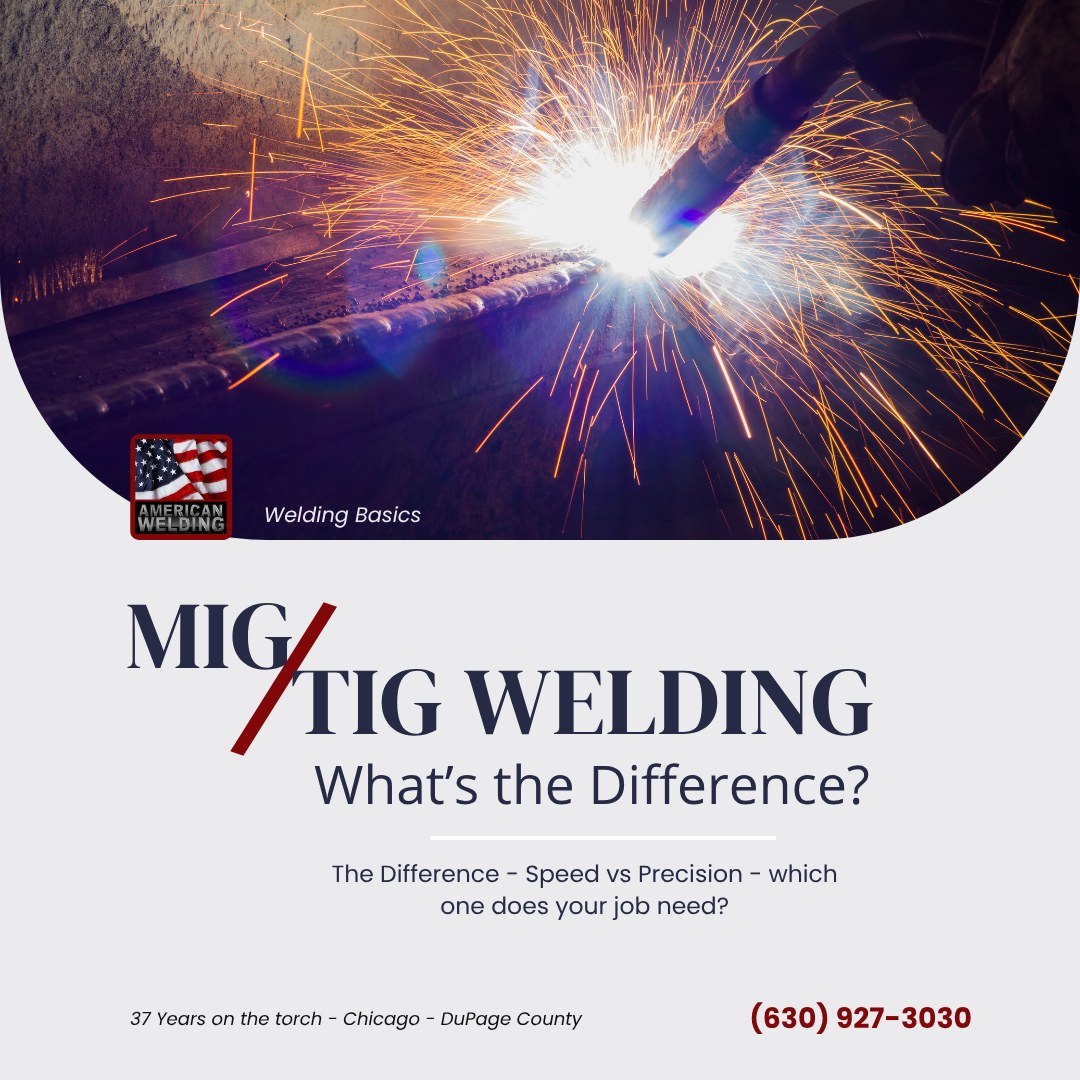
Here is the short version: MIG is faster and easier and handles thick steel with no fuss, while TIG is slower but cleaner and far better for thin metal, aluminum, and stainless.
At American Welding, we run all three main processes — ARC, MIG, and TIG — and choose whichever one fits the metal in front of us. Owner Pete Adams has welded since 1989, and from our shop in Wayne, Illinois we bring mobile rigs to jobs all over Chicagoland. If you want the full lay of the land first, our guide to the types of welding walks through every process; below we focus on the two that people mix up most — MIG and TIG — and how to tell them apart.
What MIG Welding Is
MIG welding is the wire-fed process, and it is the one most people picture when they think of welding. A spool of thin wire feeds automatically through the gun, a shielding gas flows out around it to keep the weld clean, and you simply pull the trigger and move the gun along the joint. The machine does the feeding; you steer.
That is why MIG is fast and forgiving. Because the wire never stops coming, you can lay down a long bead in a hurry and cover a lot of ground on a big job. It runs with one hand, tolerates a little rust or paint better than the alternatives, and it is the easiest process to pick up — a beginner can get a decent weld on their first day. For thick steel, gates, frames, trailers, and structural repair, MIG is usually the right call.
What TIG Welding Is
TIG welding works in a completely different way. There is no wire feeding through the torch — instead you hold a filler rod in one hand and feed it in by hand, dab by dab, while the other hand guides the torch and a foot pedal controls the heat. It is a three-limb job, and it takes real practice to do well.
What you get for that effort is control. TIG lays down the cleanest, most precise weld of any process — little to no spatter, a neat row of stacked-dime beads, and a joint that often needs no cleanup at all. That precision is why TIG is the go-to for thin metal, and it is the process that truly shines on aluminum welding and stainless. When the piece is delicate, visible, or made of a tricky metal, our TIG welding service is what handles it.
MIG vs TIG — The Real Differences
Strip away the jargon and the two processes really differ on four things: how the filler gets there, how fast you can go, how clean the weld looks, and how hard it is to learn.
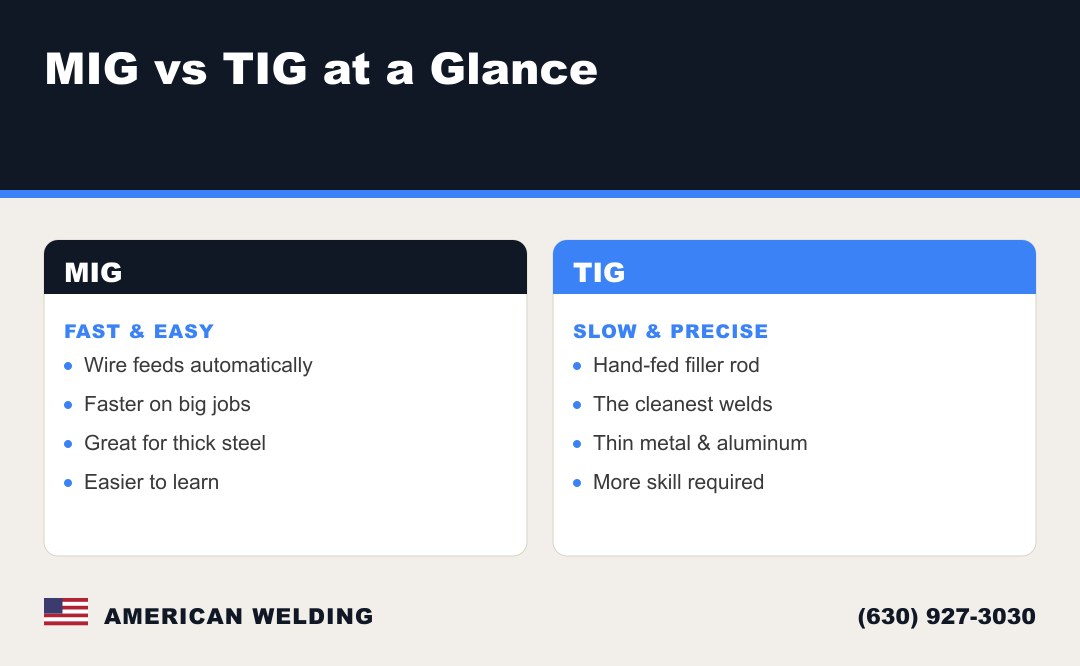
MIG feeds its wire automatically, which is what makes it quick and beginner-friendly and ideal for thick steel and long runs. TIG hands the filler control to the welder, which is slower and demands more skill but produces the cleanest weld on the finest work. Neither is "better" in a vacuum — they are built for different jobs:
- Speed. MIG wins on pace — the wire never stops, so big jobs move fast. TIG is deliberate and slow by design.
- Metal thickness. MIG loves thick steel and pours heat into it. TIG is the safe choice for thin sheet and small parts, where too much heat means a burn-through.
- Appearance. A MIG weld is strong but rougher and usually needs grinding to look clean. A TIG weld comes out show-quality straight off the torch.
- Learning curve. MIG is the easiest process to learn. TIG takes the longest to master because both hands and a foot are all working at once.
Which Should You Use?
The honest answer is that it depends on the metal, the thickness, and how the finished weld has to look. But there are clear cases where one process is obviously the right tool, and knowing them saves everyone time.
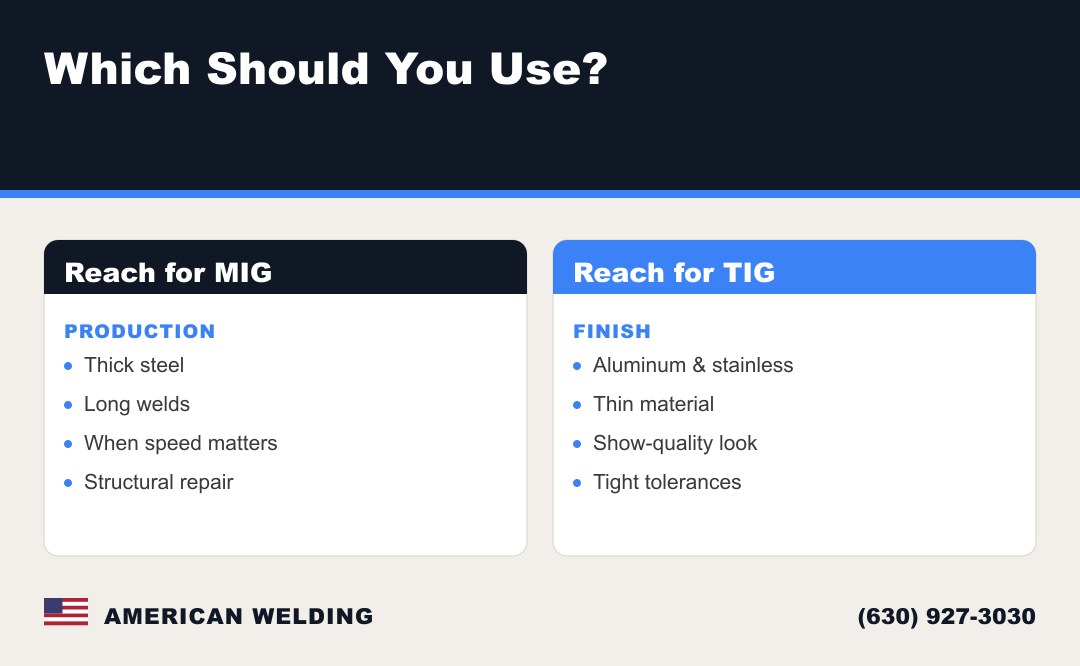
Reach for MIG when you are working thick steel, running long welds, need speed, or handling a structural repair where strength matters more than a flawless finish — think gates, frames, railings, and trailers. Reach for TIG when you are joining aluminum or stainless, working thin material that would burn through under a MIG gun, chasing a show-quality look, or holding to tight tolerances where every millimeter counts.
And if you are still not sure? That is exactly what we are here for. Send us a photo of the piece and we will tell you which process it needs — no guesswork on your end.
What American Welding Runs
You do not have to pick the process yourself. American Welding runs all three — ARC, MIG, and TIG — and part of doing the job right is choosing the one that suits the metal and the repair. A thick steel bracket gets MIG; a cracked aluminum housing gets TIG; a heavy outdoor job might get ARC. Pete looks at the piece and matches the process to it.
Because we are a mobile welding outfit, we bring the right machine to you across Chicago, DuPage County, and the wider Chicagoland area, rather than making you haul a broken part across town. Curious how the heavy-duty processes compare on rougher work? Our breakdown of arc welding vs stick welding covers that side of the shop, and when the job calls for the clean, precise finish only the torch delivers, our TIG welding service takes over. Whatever the metal, we have the process for it — and the honest advice to match.
MIG vs TIG Welding FAQ
Is MIG or TIG welding stronger?
Done properly, both make a weld stronger than the metal around it, so "stronger" usually comes down to the right process for the material. MIG puts down heat fast and suits thick steel; TIG gives tighter control on thin metal and alloys. The strongest weld is the one matched to the job, not one process over the other.
Which is easier to learn, MIG or TIG?
MIG, by a wide margin. The wire feeds automatically and you steer with one hand, so a beginner can lay a decent bead quickly. TIG asks you to feed filler by hand, guide the torch, and work a foot pedal all at once, which takes far more practice to master.
Can you weld aluminum with MIG?
You can, with the right setup, but TIG is the process most welders reach for on aluminum. It gives the control and clean result aluminum needs, especially on thinner pieces. For anything visible or delicate, TIG is the safer choice — which is why we lean on it for aluminum and stainless work.
Is TIG welding slower than MIG?
Yes, and that is by design. TIG is deliberate — you feed the filler rod one dab at a time — so it takes longer than MIG on the same joint. You trade speed for a cleaner, more precise weld, which is exactly the trade you want on fine or visible work.
Which is better for thin metal?
TIG, without question. Its fine heat control — dialed in with a foot pedal — lets you join thin sheet without burning straight through it. MIG pours in more heat and is harder to hold back, so it is easy to blow a hole in a light panel. Thin material calls for TIG.
How do I know which process my job needs?
The quickest way is to let us look at it. Snap a photo of the piece and call or text Pete at (630) 927-3030, and we will tell you whether it is a MIG, TIG, or ARC job — and give you a free quote. Matching the process to the metal is our job, not yours.
Not Sure Which Process Your Job Needs?
You do not have to know the difference between MIG and TIG — that is our job. Whether it is thick steel that needs a fast, strong weld or thin aluminum that needs a clean, precise one, we run the right process for the metal in front of us.
We bring mobile welding rigs to jobs across Chicago, DuPage County, and all of Chicagoland from our home base in Wayne, Illinois — and every quote is free.
Send a photo and call or text (630) 927-3030, or email pete@americanwelding.us for your free quote.