What Are the 4 Types of Welding? How to Pick the Right One for Your Job
If you've been looking into welding for a repair, a home project, or a business job, you've probably run into the same four names: MIG, TIG, Stick, and Flux-Cored.
Each welding type has its own strengths. Each has the right job. And using the wrong one is the most common reason welds crack, rust, or break under load.
This guide walks through what each type actually is, how it works, what metals it handles, when to use it, and when to skip it. Straight talk from decades of hands-on welding work across Chicago.
The Four Main Welding Types at a Glance
Here's the short answer first, then we go deep on each one:
- MIG welding: fast, common, easy to learn, works best on flat, clean metal
- TIG welding: slow, precise, cleanest finish, best for visible or delicate work
- Stick welding: tough and rugged, handles outdoor and dirty jobs
- Flux-Cored welding: MIG-style speed built for windy or messy sites
The right pick always comes down to three things: the metal being welded, the job's setting, and what the finished weld has to do.
1. MIG Welding — The Everyday Workhorse
MIG stands for Metal Inert Gas. It's also called wire welding.
A MIG welder is a machine with a spool of thin welding wire inside. The welder holds a gun connected to that machine. Pull the trigger, and the wire feeds out on its own while a protective gas puffs around it to keep the weld clean.
It's fast, it's steady, and it's the type most beginners start with.
What MIG welding handles well:
- Regular steel
- Stainless steel (with the right wire and gas)
- Aluminum (with a special setup)
- Thin to medium-thickness metal
- Long, straight welds
Real-world jobs where MIG is the top pick:
- Fixing a bent bumper on a car
- Building a steel storage rack for a shop
- Welding a metal fence together
- Repairing a stainless steel food prep table indoors
- Assembling a trailer body
Why welders reach for MIG:
- Very fast: a job that takes an hour with TIG might take 15 minutes with MIG
- Beginner-friendly: the machine does a lot of the work
- Cleaner run than stick welding
- Great for repeat welds that all look the same
Where MIG welding falls short:
- Windy outdoor jobs blow the gas away and leave weak welds
- Rusty, painted, or dirty metal keeps the weld from bonding
- Very thick steel needs a bigger, deeper weld than MIG can easily give
- Very thin sheet metal can warp under MIG heat
2. TIG Welding — The Precision Specialist
TIG stands for Tungsten Inert Gas.
A TIG welder holds two things at once. In one hand, a small hand tool with a sharp, pointed tip, the tungsten part. In the other, a welding rod. A foot pedal controls the heat. A protective gas keeps the weld clean.
The result is the slowest, most controlled, and cleanest-lookingweld of the four types. On a polished stainless bar top or a decorative iron gate, TIG is the only real choice.
What TIG welding handles well:
- Stainless steel (all grades)
- Aluminum
- Copper, brass, and other soft metals
- Thin sheet metal
- Small, delicate parts
Real-world jobs where TIG is the top pick:
- Welding a restaurant kitchen sink or a hood
- Repairing a broken bicycle frame
- Fixing a cracked aluminum boat hull
- Building a display stand or handrail that has to look clean
- Welding food-service equipment
Why welders reach for TIG:
- The cleanest finished weld of the four types
- Full control over heat and speed with the foot pedal
- Works on almost any metal
- Very little cleanup afterward
Where TIG welding falls short:
- Slow; not the pick for a long production run
- Thick, heavy structural steel isn't its strength
- Needs a very clean surface; grease, paint, or rust ruins the weld
- Not portable enough for windy outdoor jobs
For more details, see our TIG Welding Service page.
3. Stick Welding — The Rugged Field Choice
Stick welding uses a coated welding rod that melts during welding. The coating on the rod burns off and forms a protective gas around the weld. No separate gas tank needed.
That built-in gas is what makes stick welding useful outdoors; wind, rain, and dust don't stop it. Farmers, ranchers, construction crews, and field repair welders lean on stick welding for a reason.
What stick welding handles well:
- Regular steel
- Cast iron (with the right rod)
- Thick steel plates and beams
- Rusty, painted, or dirty metal
- Outdoor jobs in bad weather
Real-world jobs where stick is the top pick:
- Fixing a cracked steel gate at a job site
- Repairing a broken trailer axle on the road
- Welding a heavy-duty dumpster gate
- Patching a rusted farm implement
- Field welding on a construction site
Why welders reach for stick:
- Works outdoors without a gas tank
- Handles dirty metal better than MIG or TIG
- Cheap and rugged setup
- Portable, easy to load on a truck for mobile work
Where stick welding falls short:
- Messier than MIG or TIG, more cleanup after
- Not as clean-looking a finish
- Not the right pick for thin sheet metal
- Steeper learning curve than MIG
4. Flux-Cored Welding — The Outdoor Speed Option
Flux-cored welding works much like MIG. A machine feeds welding wire into the joint. The trigger runs the weld steadily.
The difference is what's inside the wire. Instead of needing a gas tank, the wire has a powder inside. That powder makes its own protective gas as it burns. That means all the speed of MIG welding without the wind-blown gas problem.
What flux-cored welding handles well:
- Regular steel
- Thick structural steel
- Outdoor field jobs
- Dirty or painted metal
- Construction and heavy repair work
Real-world jobs where flux-cored is the top pick:
- Welding a heavy steel beam on a windy construction site
- Repairing a cracked trailer frame outdoors
- Building a heavy-duty gate or fence in the field
- Patching farm equipment out in the open
- Any thick-metal job where stick welding would be too slow
Why welders reach for flux-cored:
- MIG-style speed on outdoor jobs
- No gas tank to haul around
- Handles thick metal well
- Deals with dirty metal better than MIG
Where flux-cored welding falls short:
- More smoke than MIG
- Rougher finish than TIG
- Not the right pick for thin metal or decorative work
- Not the cleanest look for visible welds
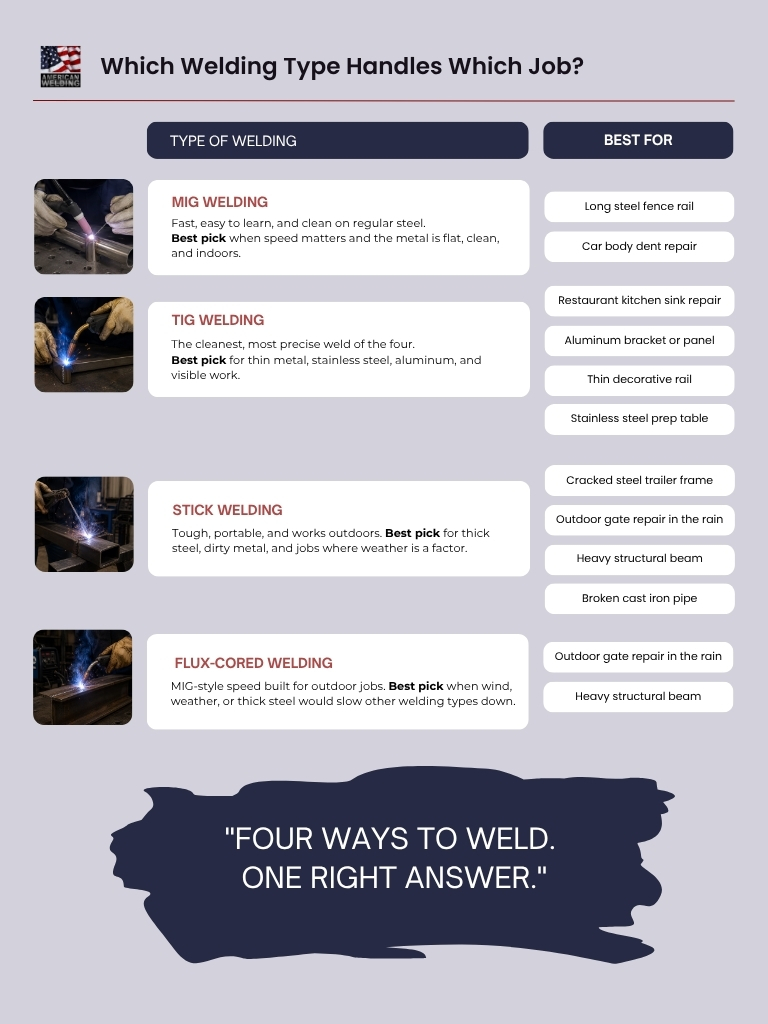
Which Welding Type Handles Which Job
Here's a quick side-by-side to make the choice clear:
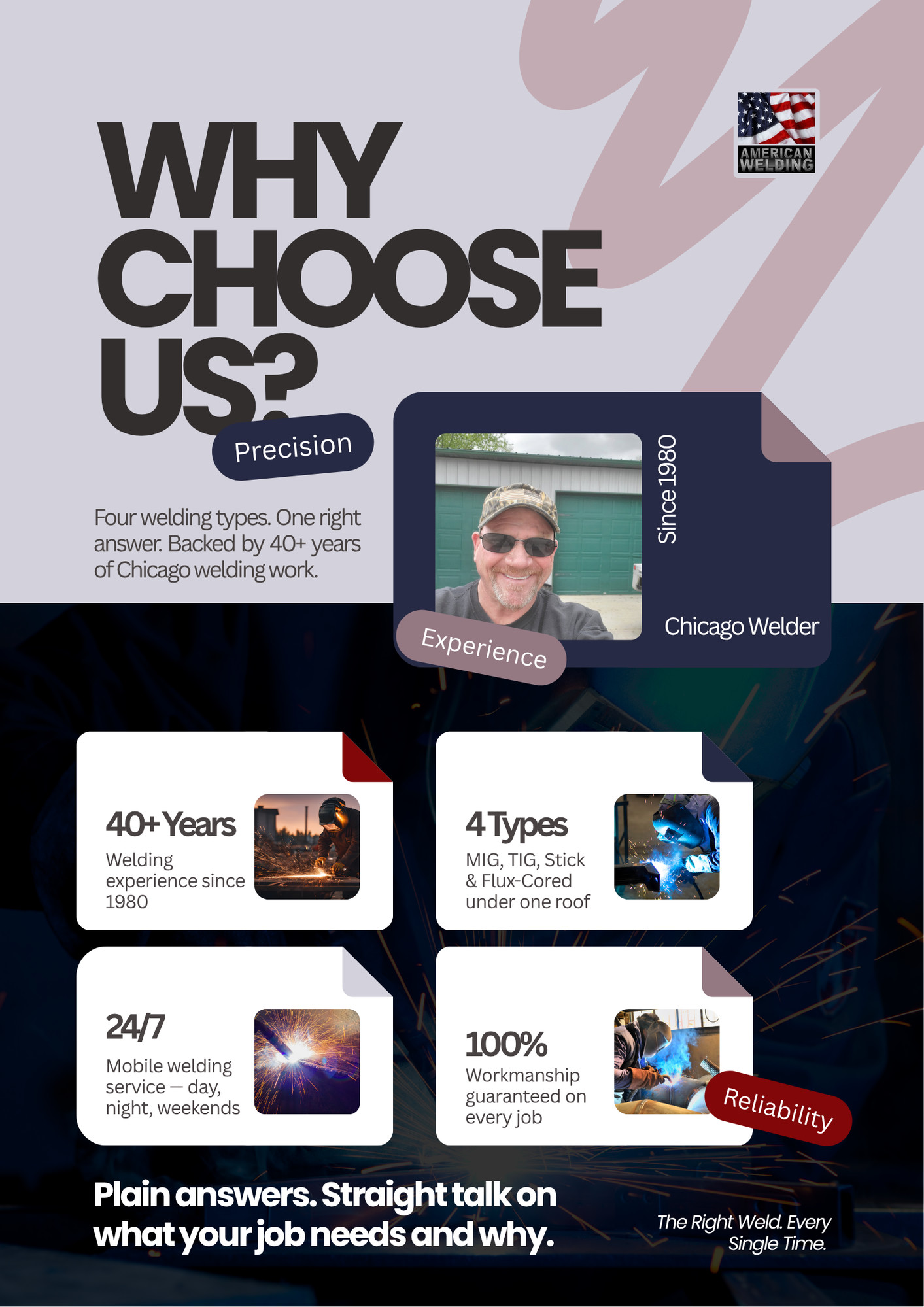
Pete has been welding since 1980, and all four types of welding have crossed his workbench in a single day. The choice isn't about a favorite tool. It's about matching the process to the job. Workmanship is guaranteed either way.
How to Pick the Right Welding Type for Your Job
A simple three-question test that gets you to the right welding type most of the time:
Question 1: What kind of metal is it, and how thick?
- Thin stainless or aluminum → TIG
- Regular steel, medium thickness → MIG
- Thick steel or cast iron → Stick or Flux-Cored
Question 2: Where is the job — indoors or outdoors?
- Indoors with clean metal → MIG or TIG
- Outdoors or windy → Stick or Flux-Cored
- Mobile site → Stick or Flux-Cored (portable)
Question 3: Does the finished weld need to look clean?
- Yes — visible, decorative, or food-service → TIG
- Yes — but speed matters more than a mirror finish → MIG
- Not important — hidden, structural, or rough repair → Stick or Flux-Cored
Answer those three questions, and you'll almost always land on the right type of welding.
When People Pick the Wrong One
Most welding failures we see when jobs come in for repair trace back to the wrong type used on the wrong job. Here are the ones that show up most:
- MIG welding outdoors. The wind blows the protective gas away. The weld ends up full of tiny air pockets. It looks fine on day one and breaks under load a month later.
- Stick welding on thin sheet metal. Too much heat for the metal. The rod burns right through the sheet before a bead can form.
- MIG welding on aluminum without the right setup. Aluminum needs a special machine and wire. Standard MIG will not hold.
- Flux-Cored welding on decorative work. The weld itself holds. The finish looks rough and unfinished, a bad look on a visible rail or a customer-facing job.
- TIG welding on dirty metal. TIG needs a clean surface. Grease, paint, or rust will contaminate the weld and cause it to crack.
- Any welding type on a metal that it wasn't built for. Trying to weld cast iron with a standard MIG wire, or trying to weld thick steel with a small TIG setup, is a common shortcuts that fail.
The fix in almost every case is the same. Grind out the failed weld and redo it using the appropriate welding method for the job.
What a Welding Setup Actually Looks Like
Each welding type uses a different setup on the shop floor and in the truck:
- MIG setup: A machine with a wire spool inside, a gas tank next to it, and a gun connected by a cable. Common in indoor shops.
- TIG setup: A machine, a gas tank, a hand-held tool, a foot pedal, and a supply of welding rods. Almost always shop-based.
- Stick setup: A small machine and a supply of coated rods. Very portable — fits on the back of a truck or in a corner of a shop.
- Flux-Cored setup: Looks like a MIG setup, but no gas tank. Common on mobile welding trucks and construction sites.
A full-service welding shop keeps all four setups ready to go. That way, the right type is on hand no matter what job walks in the door.
How American Welding Takes Care of Every Job
Every welding job that comes into American Welding gets a full size-up before any welding starts. The process is the same for a small repair or a big fabrication project — steady, careful, and matched to the job.
Here's how it works from first look to finished weld:
- Size up the metal. What kind is it? How thick? How clean is the surface?
- Read the setting. Indoor shop or outdoor job site? Windy? Wet? Tight space?
- Understand the weld's job. Hold weight? Look clean? Handle food contact? Take the weather?
- Match the welding type. MIG, TIG, Stick, or Flux-Cored. Sometimes two of them are on the same job.
- Prep the metal. Clean it to the level required by the chosen welding type.
- Dial in the machine. Match wire speed, heat, gas, and pedal settings to the job.
- Run the weld. Steady and controlled. No rushing.
- Check the finish. Every job gets looked over before it leaves the shop or the site.
Right type. Right job. Artistry guaranteed.
Cost and Effort — Which Welding Type Costs More?
Not all types of welding cost the same. Here's the plain breakdown:
- Stick welding is usually the cheapest: the setup is basic, and the rods are affordable
- MIG welding is in the middle: the machine costs more, but the wire is cheap, and jobs run fast
- Flux-Cored welding is close to MIG in cost: the wire is a bit pricier, but no gas is needed
- TIG welding is usually the most expensive: the machine costs more, the process is slow, and skilled TIG welders are harder to find.
For a customer, that usually means a TIG weld on a stainless kitchen part costs more than a stick weld on a steel gate. The tradeoff is finish, precision, and the metal being welded.
Service Areas
American Welding serves Chicago and the surrounding suburbs:
- DuPage County — Naperville, Wheaton, Downers Grove, Lisle, Oak Brook, Hinsdale
- Cook County — Elk Grove Village, Schaumburg, Hoffman Estates, Bartlett
- Will County — Bolingbrook, Joliet, Plainfield
- Kane County — St. Charles, Geneva, Batavia, Aurora
- Kendall County — Oswego, Yorkville
- McHenry County and DeKalb County
- Milwaukee to Illinois corridor and NW Indiana for larger jobs
All Four Types of Welding in Bolingbrook
Bolingbrook is a working mix of warehouses, restaurants, retail centers, and neighborhoods. Every setting calls for a different type of welding.
A warehouse loading dock might need stick welding to fix a cracked steel plate. A restaurant on Boughton Road might need TIG welding for a stainless prep table. A homeowner near Hidden Lakes might need MIG welding on a bent iron fence. A construction crew on a Bolingbrook expansion might need flux-cored on a windy site.
All four welding types are scheduled for the same week. The right one gets picked before the truck leaves. Workmanship guaranteed.
Why Choose American Welding
More on specific welding types and services:
- TIG Welding Service
- Aluminum Welding Service
- Restaurant Stainless Steel Welding Repair
- Mobile Welding & Repair
- Cast Iron Welding Service
- The Laser Welding Process Explained
FAQs About the 4 Types of Welding
Q: Which type of welding is the strongest?
Strength depends on the metal, the joint, and the setup, not the type. A stick weld on thick steel and a TIG weld on thin stainless steel can be equally strong for their respective jobs. The wrong type for any job is always weaker.
Q: Which welding type is best for beginners?
MIG is usually the easiest. The wire feeds by itself, and the weld runs steady with a simple trigger pull. That's why most welding schools start beginners on MIG.
Q: What is the difference between MIG and TIG welding?
MIG is faster and uses a self-fed wire. TIG is slower, uses a hand-held rod, and gives a much cleaner finish. MIG is for speed. TIG is for finish and precision.
Q: Can you MIG weld outside?
Yes, but with limits. Wind blows away the protective gas MIG needs. For a windy or open-area job, stick or flux-cored welding is a better choice.
Q: Which welding type is best for stainless steel?
TIG welding gives the cleanest, best-looking stainless welds. MIG works too, especially for faster jobs on thicker stainless. Stick and flux-cored are usually skipped on stainless.
Q: What is the best welding type for aluminum?
TIG is the top choice for clean, strong aluminum welds. MIG can weld aluminum too, but only with a special machine and setup. Stick and flux-cored do not weld aluminum well.
Q: What welding type is best for cast iron?
Stick welding with a specialty rod is the most common pick for cast iron cracks. Cast iron is a tricky metal, so the wrong type of rod will lead to more cracks.
Q: Which welding type is used for cars?
MIG is the most common for car body work: fast, clean, and works well on thin steel panels. TIG is used for specialty repairs or high-end restoration.
Q: Are there more than 4 types of welding?
Yes, laser welding, spot welding, plasma welding, oxy-fuel welding, and others exist. MIG, TIG, Stick, and Flux-Cored are the four most common types for repair, fabrication, and building work.
Q: What welding type does American Welding use?
All four, plus laser and spot welding when the job calls for it. Pete picks the right type for each project, not the same one every time.
Q: Which welding type is best for outdoor jobs?
Stick and flux-cored are the two best choices for outdoor welding. Both work in wind and weather. MIG and TIG usually stay in the shop.
Not Sure Which Welding Type Your Job Needs?
That's the easiest call of all. Describe the job. Pete picks the right type.
Mobile welding service across Chicago and the surrounding counties. Every type of welding is on hand, ready to go.
Call (630) 927-3030 or email pete@americanwelding.us to walk through your project. Workmanship guaranteed.