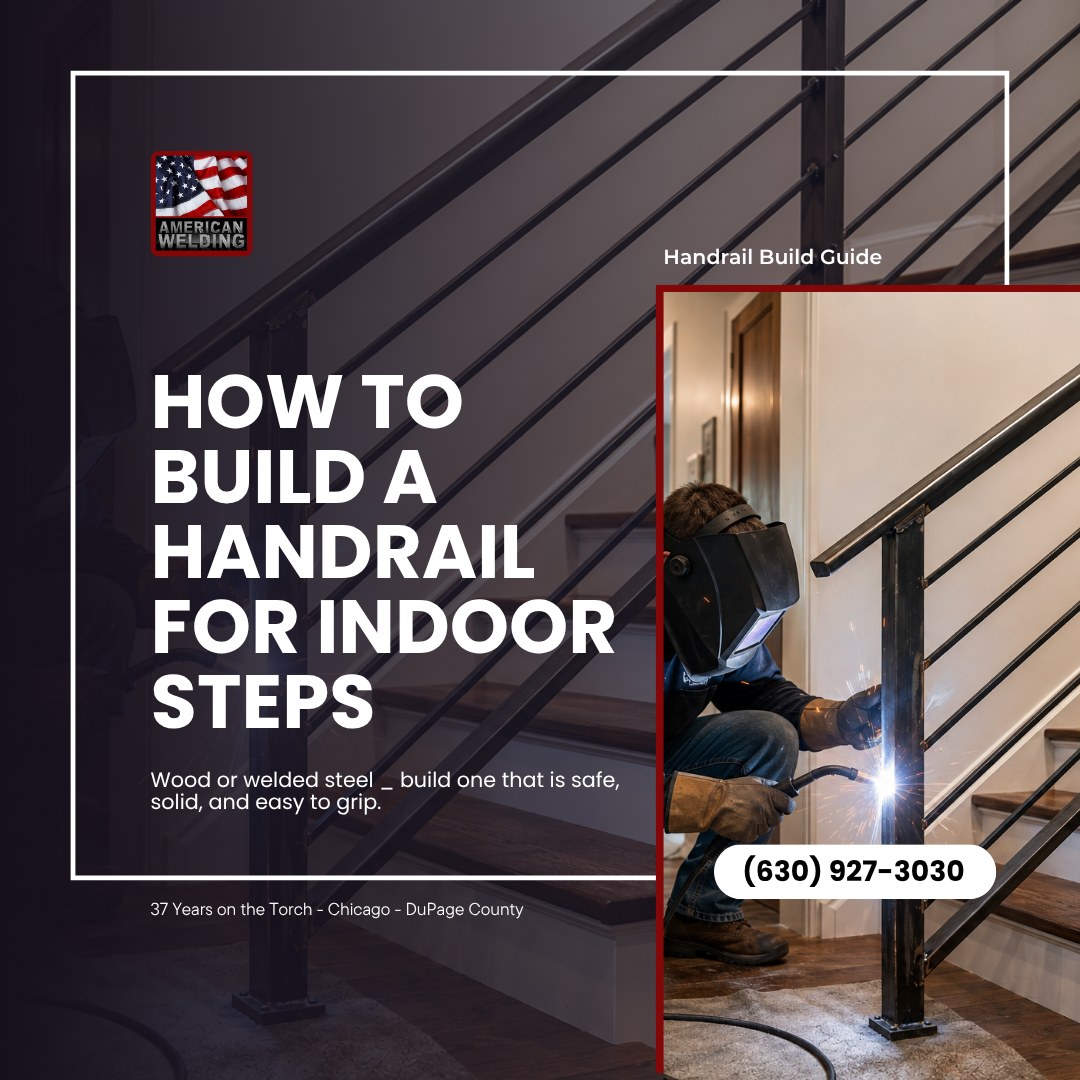
How to Build a Handrail for Indoor Steps
A handrail has one job.
It catches you when your foot doesn't.
So it can't wobble, and it can't be hard to grab.
When you build a handrail for indoor steps, you're really building two things: a rail your hand can slide along without letting go, and anchors strong enough to take your full weight in a fall. Get both right and the stairs feel safer the second you touch the rail. Get either one wrong and you've built a decoration, not a safety device.
This guide walks the job the way I'd explain it at your kitchen table after 37 years on the torch — picking the rail, building it, mounting it so it holds. Wood or a welded metal handrail, the fundamentals are the same. And if you'd rather not chase studs and cut miters yourself, a solid stair railing is a quick job for a shop that does custom fabrication every day.
The Short Answer: What Building a Handrail Takes
You need a graspable rail, brackets or posts to hold it, and solid framing to screw into. The rail runs parallel to the slope of the stairs, sits about 34 to 38 inches above the tread nosings — 36 is the sweet spot — and mounts into the wall studs, not just the drywall.
The order is simple: snap a slope line, cut the rail, add returns on the ends, lay out brackets every four feet or so, mount into framing, set the rail, then sand and finish. A weekend job if the wall cooperates — longer for a continuous welded metal rail with returns, which is where a pro earns their keep.
Wood vs Metal: Choosing the Rail
Both work. They just fit different homes and budgets.
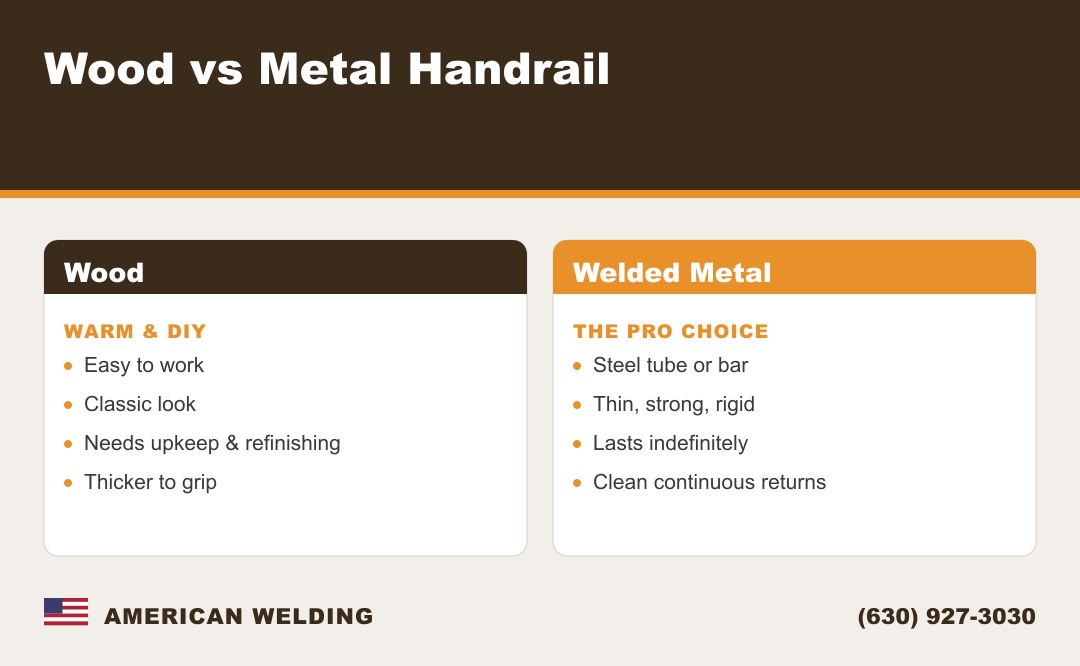
Wood is warm and DIY-friendly. Oak, maple, and poplar come pre-milled with a graspable profile already routed in, and it feels good under the hand. The trade-off: wood can split at screw holes, it dents, and a thin rail flexes over a long run unless every bracket is dead solid.
A welded metal handrail — steel tube or round bar — is stronger and longer-lasting. It's thinner for the same strength, so it looks cleaner on a tight staircase, and a properly welded rail with returns is one continuous piece with no joints to loosen. Finished right, it lasts indefinitely. The catch is the cutting, welding, and grinding — which is why most folks call a shop. For a continuous rail that wraps a corner or returns into the wall, metal wins.
Tools and Materials You'll Need
For a basic wood build:
- Pre-milled handrail stock in a graspable profile
- Brackets rated for handrail use, or newel posts for an open side
- Stud finder, tape measure, level, and pencil
- Drill/driver and screws long enough to reach the studs
- Miter saw or hand saw for the returns
- Sandpaper and your finish — stain, poly, or paint
For a metal build, add a chop saw or angle grinder, a welder (TIG welding gives the cleanest joints on tube and bar), clamps, and a flap disc for dressing welds smooth. That's where a home shop and a pro shop part ways — good welds on thin-wall tube take a steady machine and a steadier hand.
How to Build a Handrail for Indoor Steps, Step by Step
Here's the order I follow on the job.
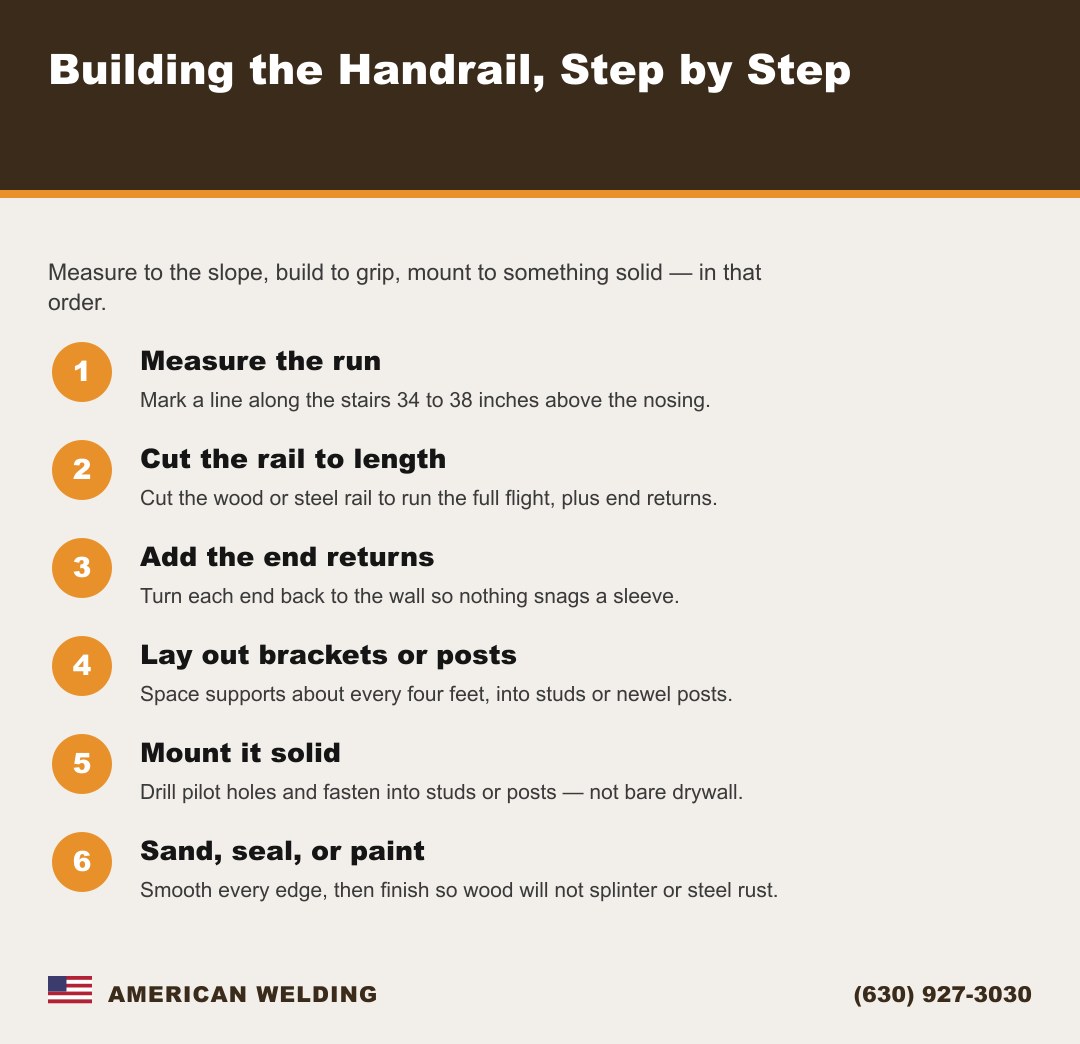
- Measure the run and mark the slope line. Hold a level along the stairs and mark a line on the wall parallel to the slope at your target height. This is your reference for everything else.
- Cut the rail to length. Measure along the slope line and cut to cover the full flight, leaving extra at each end for returns.
- Add end returns. Cut the ends so the rail turns back to the wall instead of stopping in open air — a mitered piece on wood, a bent or welded return on metal.
- Lay out the brackets or posts. Mark bracket spots every four feet or so, each on a stud. On an open side, plan your newel posts instead.
- Drill and mount into studs or posts. Pilot-drill and screw each bracket into solid framing. Never trust drywall anchors alone — they pull out under a real fall.
- Set and secure the rail. Drop it onto the brackets, check it against your slope line, and lock it down. It shouldn't move when you lean hard.
- Sand and deburr. Knock down every sharp edge. On metal, dress the welds smooth so nothing catches.
- Seal or paint. Finish the rail so wood won't splinter and steel won't rust.
Getting the Height and Angle Right
Measure from the nosing of each tread — the front edge you step on — straight up to the top of the rail. Most building codes put that between 34 and 38 inches, and 36 is the number I aim for because it fits the widest range of hands.
The rail has to stay parallel to the slope of the stairs, not level. Set every bracket to that slope line and the rail follows the stairs at a constant, comfortable height. If you're wondering where the rail should begin and end relative to the first and last step, our guide Where Should a Stair Railing Start covers it.
Mounting to the Wall or the Stairs
This separates a safe rail from a scary one. A handrail can see a sudden, sharp load — a grown adult catching a fall — so the anchors have to reach real structure.
On a closed wall, that means studs. Find them, mark them, and drive your bracket screws into solid framing. Drywall anchors, even heavy-duty ones, aren't enough on their own — fine for a picture, not for your safety. If your spacing misses the studs, add blocking behind the drywall or move the bracket. On an open side, the rail rides on newel posts bolted through the treads or into the stair framing. For the full closed-wall method, see How to Install Stair Railing to Wall.
Making It Easy to Grip
A rail you can't wrap your hand around isn't doing its job. Aim for a graspable diameter of roughly 1.25 to 2 inches — round or gently rounded so your fingers close around it. A big flat decorative plank looks nice, but you can't grab it when you slip, and that's the moment it's supposed to work.
Keep the whole run smooth and continuous — no sharp corners, no rough welds, no gaps where your hand has to let go and re-grab. On metal, grind every joint flush; on wood, sand the profile satin. Your hand should travel from the bottom step to the top without a hitch.
Finishing: Sand, Seal, or Paint
Finishing isn't just looks — it's protection. Bare wood splinters and soaks up grime from a thousand hands, and bare steel rusts wherever it stays a little damp.
On wood, sand smooth, then stain and topcoat with a durable polyurethane, or prime and paint. On steel, clean it, prime it, and finish with a good enamel or powder coat so it never surfaces rust. Either way, let each coat cure before people start grabbing it.
Common Mistakes to Avoid
After decades of fixing other people's rails, the same mistakes come up again and again:
- A rail too thick to grip. If your hand can't close around it, it's a shelf, not a handrail.
- Mounting only into drywall. The number one failure — it holds until the day someone actually needs it.
- No end returns. An open end catches sleeves, straps, and pockets, and that snag is how people fall.
- Skipping the finish. Raw metal rusts and raw wood splinters, and both get worse every month.
- Losing the slope line. Set brackets by eye and the rail waves up and down, feeling wrong under the hand.
When a Welded Metal Handrail Is Worth It
Sometimes wood is plenty. But a welded metal handrail earns its cost when you want one continuous rail with no seams, when it has to wrap a landing or corner, or when it'll take hard daily use for decades. Steel gives you a thin, strong profile and returns that flow into the wall as one clean piece.
That's where custom fabrication comes in. We measure your exact staircase, build the rail to fit, and anchor it into real structure. Because we also do mobile welding, we fabricate and mount right at your home across Chicago and DuPage County — no hauling parts back and forth. TIG welding keeps the joints clean and strong, and every rail leaves smooth enough to slide a bare hand along.
Service Areas
We build and install handrails on-site across Chicagoland and the wider Midwest, mobile and in-shop:
- DuPage County — Naperville, Wheaton, Downers Grove, Lisle, Oak Brook, Hinsdale
- Cook County — Chicago, Schaumburg
- Kane County — Aurora, St. Charles
- Will County, Kendall County, and McHenry County
Why Choose American Welding for Handrails
American Welding is owned and run by Pete Adams, a veteran welder on the torch since 1989 — about 37 years of building things that have to hold. We handle stair railings and handrails from measurement to mounting, in steel cut, welded, and finished to fit your exact staircase.
We show up when we say we will, set the work area up carefully, and we're fully insured on every job. Our workmanship is guaranteed in writing, because a handrail is a safety device and we treat it like one. When it has to be done right the first time, that's the call to make.
Frequently Asked Questions
How high should a handrail be for indoor stairs?
Measure from the nosing of the tread straight up to the top of the rail. Most building codes land between 34 and 38 inches, and 36 is the sweet spot that fits the widest range of hands.
Can I mount a handrail into drywall without hitting studs?
No. Drywall anchors won't hold under a real fall. A handrail has to anchor into wall studs, into solid blocking behind the drywall, or into newel posts on an open side.
What's the best diameter for a handrail so it's easy to grip?
A graspable diameter of roughly 1.25 to 2 inches, round or gently rounded, lets your fingers close all the way around it. Anything much wider or flatter is hard to grab when you slip.
Do I really need returns on the ends of the rail?
Yes. An open rail end sticks out and catches sleeves, straps, and pockets — a real snag hazard. A return turns the end back to the wall so nothing catches. Skipping it is a common mistake.
Is a wood or metal handrail better?
Wood is warm and DIY-friendly but can split and flex. A welded metal handrail is thinner, stronger, and lasts indefinitely — better for a continuous rail, a corner, or heavy daily use. It just takes cutting and welding, which is why most people have it fabricated.
Do you come to my home to install it?
Yes. We offer mobile welding across Chicago and DuPage County, so we fabricate and mount your rail right on-site — no shipping parts back and forth.
What does a custom handrail cost?
It depends on the length, material, and your staircase. We give a clear quote before any work starts, with no surprise trip fees, so you know the number up front.
Ready for a Handrail Built to Last?
A good handrail should feel solid the first time you touch it and stay that way for decades. If you'd rather have yours measured, built, and mounted right — warm wood or clean welded steel — we'll handle the whole job and guarantee the work in writing.
Serving Chicago, Naperville, and all of DuPage County, mobile and in-shop.
Call or text (630) 927-3030 or email pete@americanwelding.us to walk through your project.