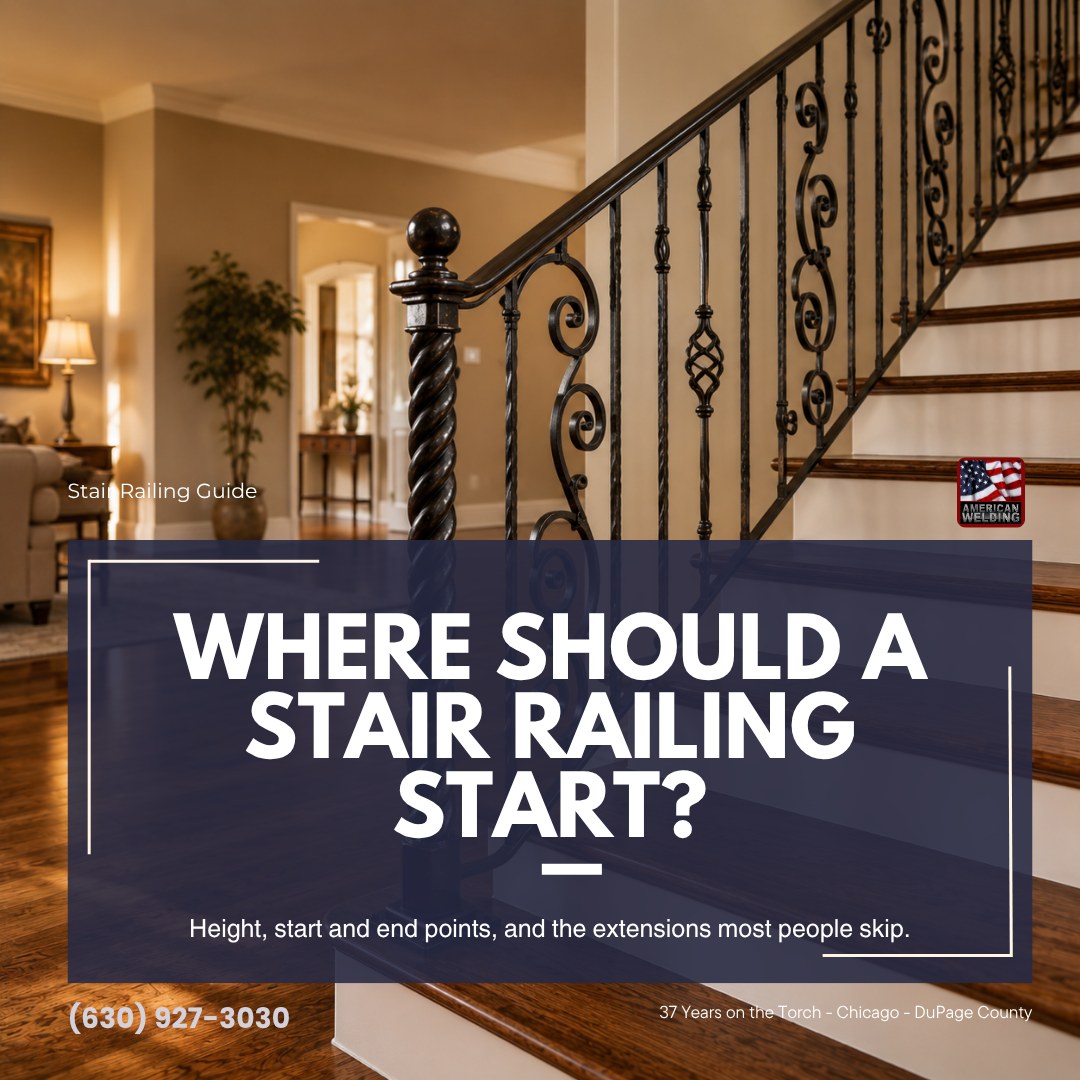
Where Should a Stair Railing Start?
Ask most people where should a stair railing start and they point at the first step.
That is the number one mistake.
A railing that starts and stops with the stairs leaves you reaching for air at the exact moment you need something to hold.
The start and end points are where a stair railing earns its keep. Get them right and the rail catches you before you are on the stairs and keeps you steady after you are off them. I have been welding rails around Chicago and DuPage County since 1989, and this detail separates a rail that just passes a glance from one that keeps a person on their feet. Here is how the positioning really works, top to bottom.
The Short Answer: Where a Stair Railing Should Start
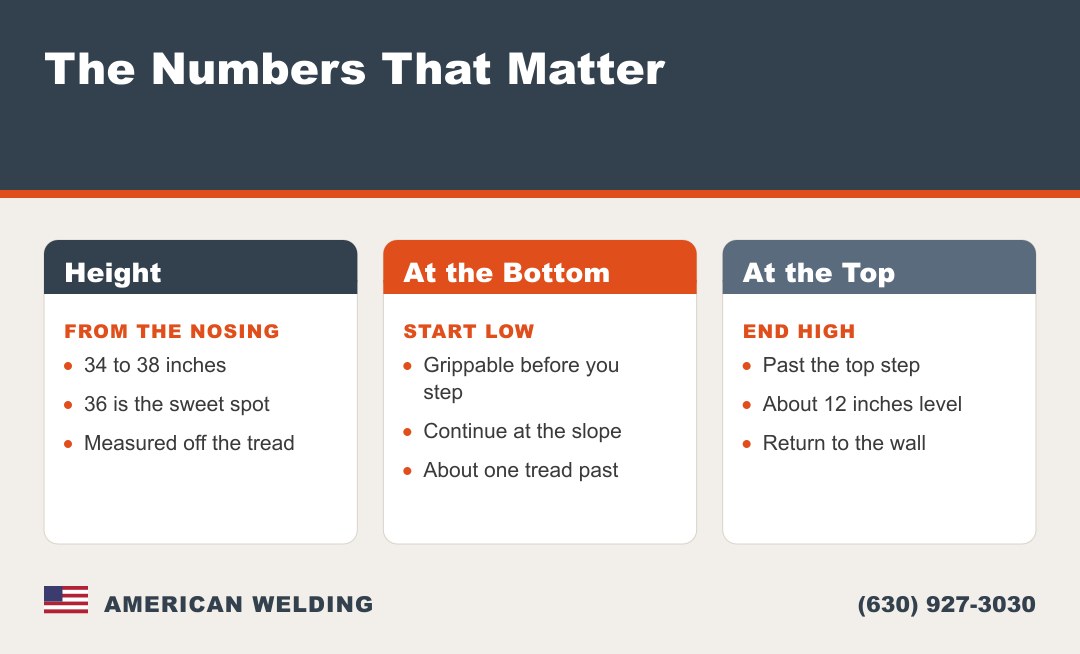
A stair railing should start before the first step and end after the last one. Going up, the graspable handrail should begin about one tread depth ahead of the bottom step and extend roughly 12 inches horizontally past the top step onto the landing. In plain terms: your hand should already be wrapped around the rail before your foot leaves solid floor, and stay wrapped until you are fully clear of the stairs. Everything else, the height, the material, the mounting, comes second to that.
Why the Start and End Points Matter Most
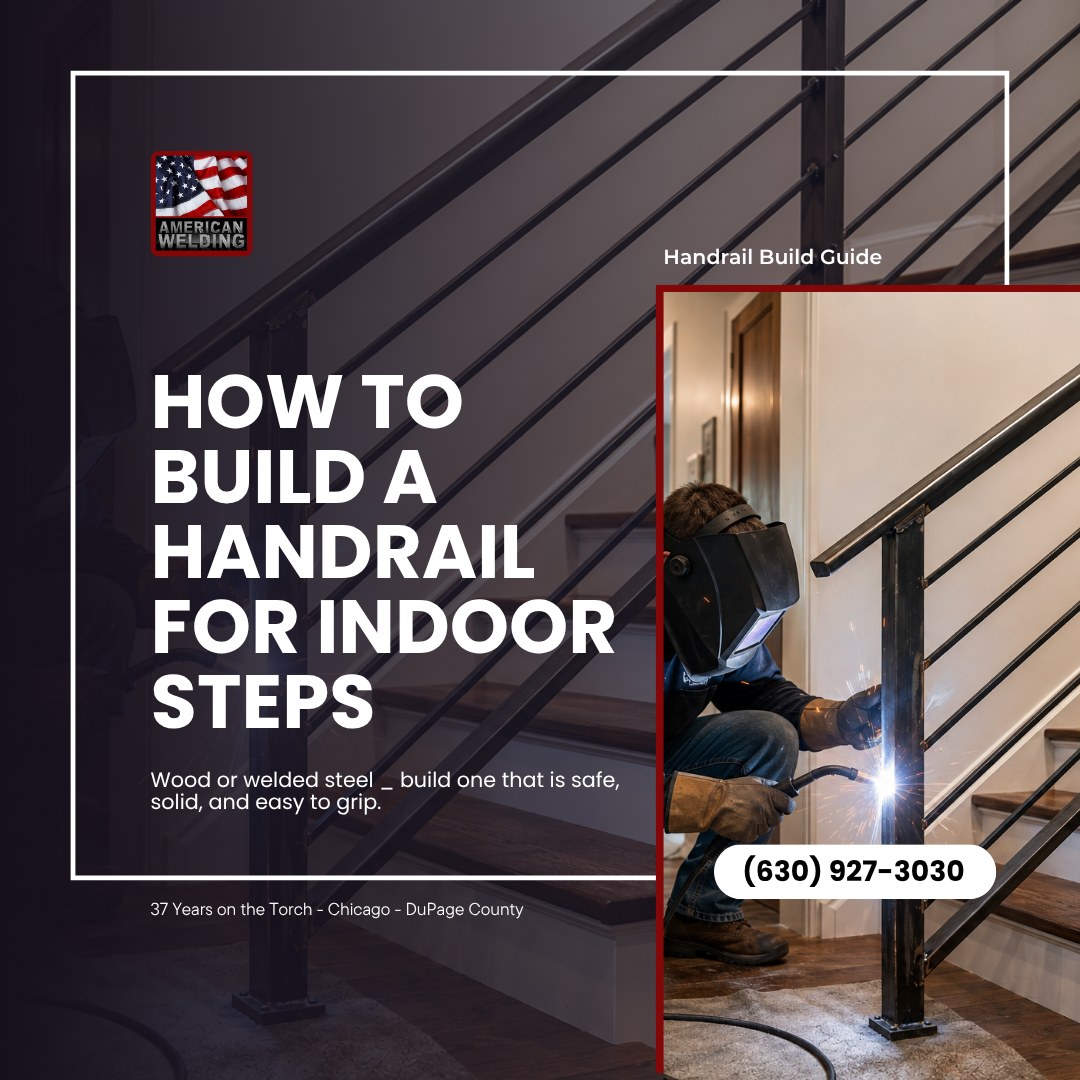
Think about when you actually grab a railing hard. Not in the middle of the flight. It is the moment your weight shifts onto the first step going down, or the moment you crest the top going up. That is where balance is most unsettled, and it is where most stair falls happen: at the very top and the very bottom. So the rail has to be there, ready to grab, before the stairs begin and past where they end. A rail that only spans the steps gives you nothing to hold during the two most dangerous moments of the trip, the same principle we cover in How to Build a Handrail for Indoor Steps.
How High Should the Railing Be?
Height is measured from the nosing of the stair tread, the front edge of each step where your foot lands, straight up to the top of the handrail. Most building codes put that between 34 and 38 inches, and after 37 years on the torch I will tell you 36 inches is the sweet spot. It suits the widest range of adults and lets your hand slide along without hunching or reaching. Just as important, the height stays consistent: you measure from each tread nosing so the rail runs parallel to the stairs, and it carries that same height through the flat extensions at each end with no sudden dip or climb.
Where the Railing Starts at the Bottom
At the bottom, the handrail should keep running at the stair slope for about one tread depth past the last step, rather than ending where the bottom step meets the floor. Coming down, your hand trails behind your feet, so if the rail quits the instant you reach the floor your support disappears while your body is still committing to that last step. Carrying it one tread depth further keeps your hand loaded through the finish, and going up it gives you something to grab before you climb. From there it typically returns to the wall or a newel post, so there is no open end to snag a sleeve or a child's arm.
Where the Railing Ends at the Top
At the top, the rule changes shape. Instead of following the slope, the handrail should run horizontally about 12 inches past the top step across the landing. Picture walking up: your feet reach the landing but your balance is still catching up, and for a stride or two you are on level ground carrying momentum from the climb. That horizontal extension gives your hand somewhere to stay planted while your feet and balance sort themselves out. Coming down, it is the piece you reach for before you ever tip onto the first descending step. Like the bottom, it normally returns to the wall or a post so the end is closed off and out of the walking path.
Handrail Extensions: The Part People Skip
Those two runs past the steps, the sloped overrun at the bottom and the horizontal foot at the top, are the extensions, and they are the most skipped part of a stair railing. Builders leave them off because they take a little more material and a clean return back to the wall or post. It is fussier to fabricate. But this is the whole reason a rail works at the dangerous ends of the stairs. When we build a stair railing, the extensions are drawn in from the start, not tacked on as an afterthought. If your current rail stops dead at the top and bottom steps, that is the first thing worth fixing.
Keeping the Grip Continuous
A handrail only helps if you can hold it the whole way without letting go, so the graspable surface has to be continuous, with no gaps, from the bottom extension to the top one. No spot where a bracket forces your hand off. No break where two sections meet at a post. No newel cap that interrupts the run. Continuity is where good custom fabrication earns its money: a rail welded as one flowing line, with the transitions from slope to horizontal smoothed into gentle bends and brackets set to clear your knuckles, lets you keep a steady hold from first step to last. Where the rail meets the wall, this is the same care we describe in How to Install Stair Railing to Wall, mounts strong enough to lean on and set far enough off the wall that your fingers wrap all the way around.
Homes vs Public Stairs: What's Different
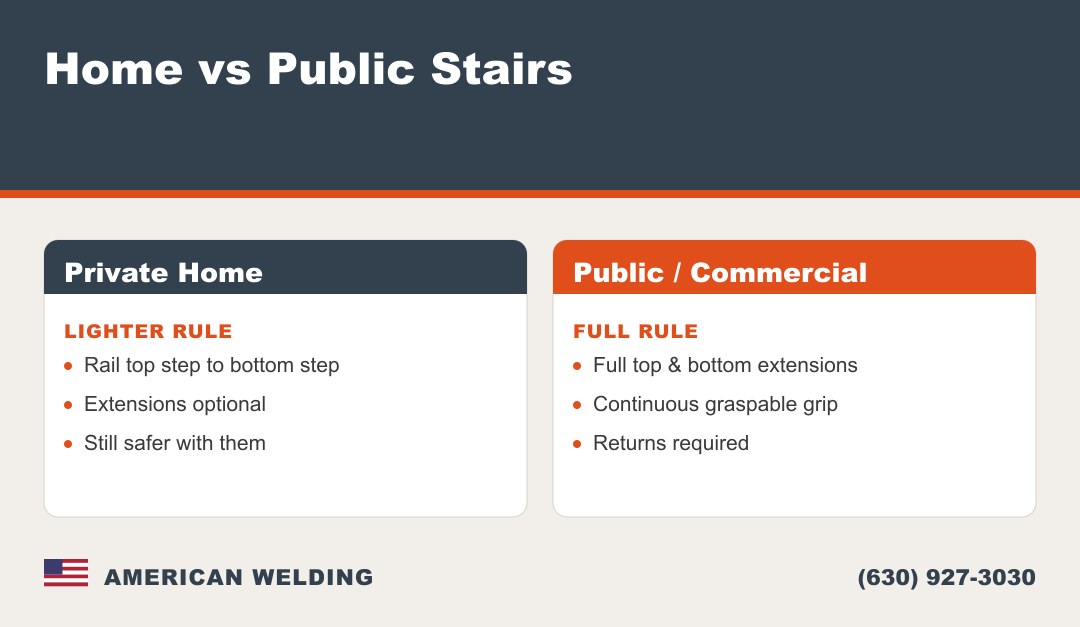
The standard is not identical everywhere. Private homes are often held to a lighter rule: the handrail only has to run from the top step to the bottom step, without the full extensions past each end. Public and commercial stairs typically require the complete package, the sloped overrun at the bottom and the horizontal 12 inches at the top. My honest take after decades of both is that the lighter home standard is the minimum, not the goal. Physics does not care whether you fall at home or at a storefront in Chicago. The extensions are safer everywhere, and they matter most in exactly the homes where people assume they can skip them, houses with kids, older parents, or anyone unsteady on the stairs.
Getting It Right: Measure, Mark, Mount
When we lay out a stair railing, the sequence is simple and never changes:
- Measure the slope and the ends. We find the rail line off the tread nosings at a consistent height, then mark where the bottom extension reaches one tread depth past the last step and where the top extension lands 12 inches onto the landing.
- Mark the mounts and returns. Brackets and posts are located so the grip stays continuous and both ends return cleanly to a wall or post, with nothing left open.
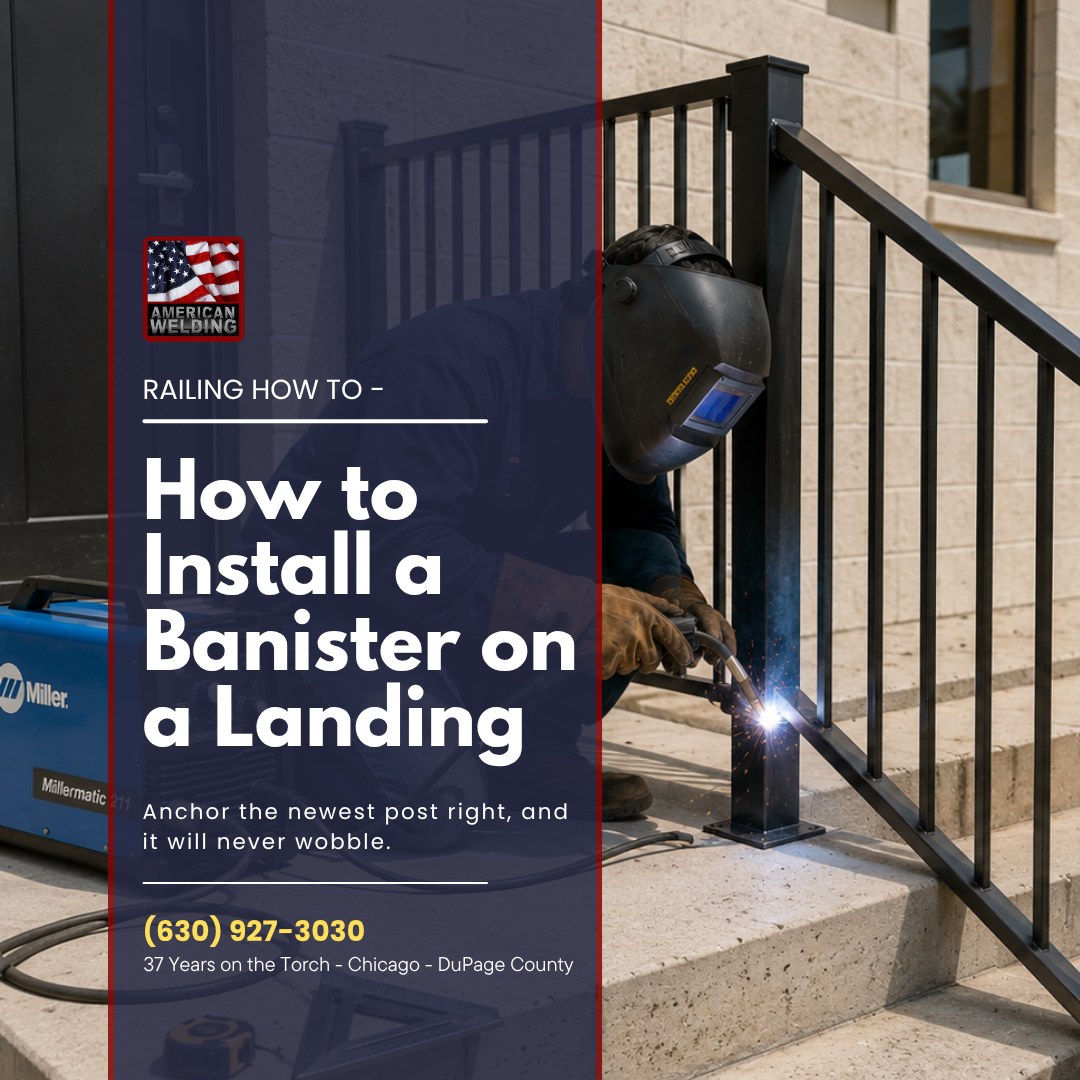
- Mount it solid. The rail is fastened into framing or set on anchored posts, because a rail that flexes when you lean on it is a rail you cannot trust.
Most rails are built with TIG welding for clean, strong joints, then finished to match the space. Because we run a mobile welding rig, a lot of this happens right at your stairs, measured, fitted, and welded on site so the extensions and returns line up with your actual landing instead of a drawing.
Service Areas
We build and install stair railings on site and in the shop across Chicagoland and the wider Midwest:
- DuPage County — Naperville, Wheaton, Downers Grove, Lisle, Oak Brook, Hinsdale
- Cook County — Chicago, Schaumburg
- Kane County — Aurora, St. Charles
- Will County, Kendall County, and McHenry County
Why Choose American Welding for Stair Railings
American Welding is Pete Adams, a veteran welder with about 37 years on the torch and in business since 1989. I have built and repaired more stair railings around DuPage County and greater Chicago than I can count, and I still lay out every one the same careful way, because the extensions and the continuous grip are what keep people safe. You get honest work from someone who does it himself, custom fabrication fitted to your exact stairs, and workmanship guaranteed in writing. We are fully insured on every job, and you get a clear quote before any work starts, with no surprise trip fees. When it has to be done right the first time, that is the call to make.
Frequently Asked Questions
Where should a stair railing start at the bottom?
Before the first step, not on it. The graspable rail continues at the stair slope about one tread depth past the last step, so your hand is holding on before your foot commits to the stairs and stays supported as you step off onto the floor.
How far should a handrail extend past the top step?
About 12 inches, run horizontally across the landing. That flat extension gives your hand something to hold while you crest the stairs and your balance catches up, which is one of the two spots where most stair falls happen.
What is the right height for a stair railing?
Measured from the front edge (the nosing) of each stair tread, most building codes call for 34 to 38 inches. In my experience 36 inches is the sweet spot, and the height should stay consistent the whole way, including through the extensions.
Does a home stair railing need the extensions?
Often not by the letter. Private homes are frequently held to a lighter standard where the rail just has to run from the top step to the bottom step, while public and commercial stairs require the full extensions. Even so, the extensions are safer everywhere, so I recommend them either way.
Why does the grip need to be continuous?
Because a railing only helps if you can hold it the whole way without letting go. Gaps at posts, brackets that push your hand off, or caps that interrupt the run all force you to release at the wrong moment. A continuous grip catches you when you are not expecting to fall.
Can you add extensions to my existing railing?
Usually yes. If your current rail stops dead at the top and bottom steps, adding the sloped bottom overrun and the horizontal top extension is one of the most worthwhile safety upgrades you can make, and we match the new work so it reads as one continuous piece.
Ready for a Stair Railing Done Right?
A stair railing lives or dies on where it starts and where it ends. If yours stops short at the steps, or you are planning a new one and want the extensions, height, and continuous grip done properly from day one, let's talk it through. I will look at your stairs, tell you honestly what they need, and build you a rail you can trust.
Call or text (630) 927-3030 or email pete@americanwelding.us to walk through your project.