How to Weld Sheet Metal Without Warping
Few things are more maddening than laying a clean bead on a thin panel and watching it pull, ripple, and oil-can as it cools.
Sheet metal is unforgiving — there is almost no mass to soak up the heat you pour into it.
The short version: sheet metal warps from too much heat in one spot, so the whole game is keeping heat low and spread out — tack, stitch, and skip around the panel instead of running one long bead.
If you have ever tried to patch a rusty fender or join two thin panels and ended up with a wavy, bowed mess, you are not alone — thin-gauge work trips up plenty of experienced welders too. At American Welding, owner Pete Adams has welded since 1989, and from our shop in Wayne, Illinois we handle thin-metal and auto-body TIG welding across Chicago and DuPage County every week. The techniques below are the same ones we use, and most cost you nothing but patience.
Why Sheet Metal Warps
Warping is not bad luck — it is physics. When you heat steel it expands, and when it cools it shrinks and pulls on everything around it. On a thick part, the surrounding mass holds that movement in check. On thin sheet, there is nothing to resist the pull, so the panel buckles, waves, and bows toward the weld. Three habits cause almost all of it.
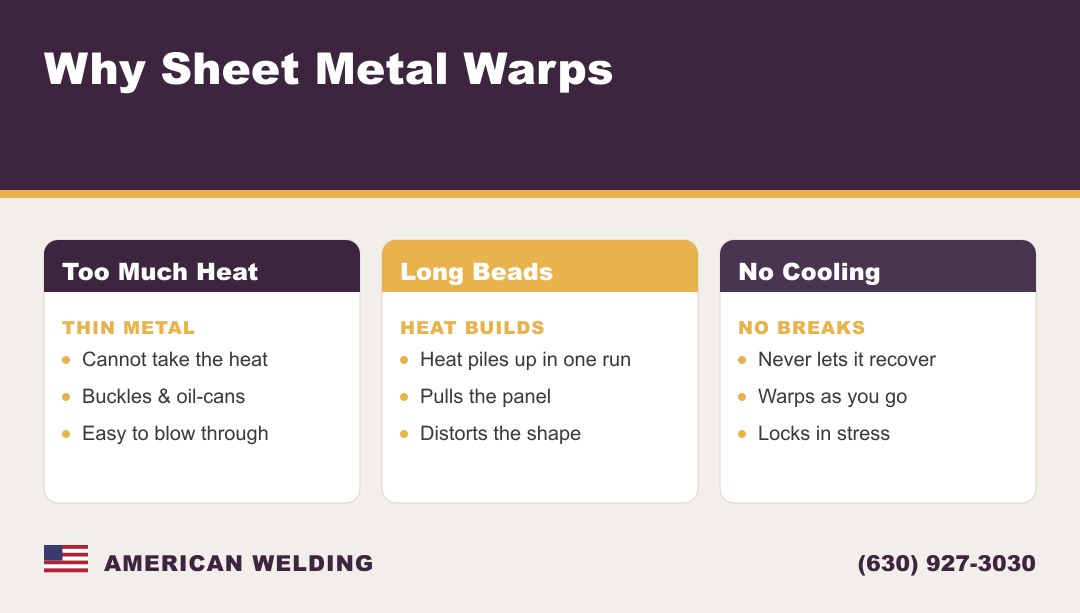
- Too much heat. Thin metal simply cannot take the amperage you would use on a bracket or a gate. Turn it up and the panel buckles before the bead is even finished.
- Long beads. Run one continuous weld across a panel and the heat builds up in that line, concentrating all the expansion and shrinkage in one place. That is a guaranteed bow.
- No cooling breaks. Weld steadily without letting the panel recover and the heat has nowhere to go but outward through the metal, warping a wider and wider area as you work.
Fix those three things and you have solved most of the problem before you strike an arc. Everything that follows is really just a way to keep heat low, keep it moving, and give the panel time to breathe.
The Right Process and Settings
Before technique, get the process and the settings right — on sheet metal they matter more than anything. The goal is always the same: the lowest heat that still fuses the two pieces together, and not one bit more.
For the thinnest panels, TIG welding is the top choice. It gives you fine control over the heat with a foot pedal, so you can feed in just enough amperage to fuse and back off the instant the puddle forms. That control is exactly what thin steel, stainless, and aluminum body panels need.
MIG works well too, as long as you keep the heat down. Run the smallest wire you can — thin wire needs less current to melt, which means less heat in the panel — and set your voltage and wire speed low. Test on a scrap of the same gauge first and aim for a small, quiet puddle. If the metal is blowing through, you are too hot. Whichever process you use, a clean, tight fit-up matters, because gaps force you to add heat to bridge them, and heat is the enemy.
How to Weld Sheet Metal Without Warping
With the right settings dialed in, the method itself is simple — it is all about spreading the heat out so no single spot ever gets hot enough to pull the panel. Follow this sequence and a flat panel stays flat.
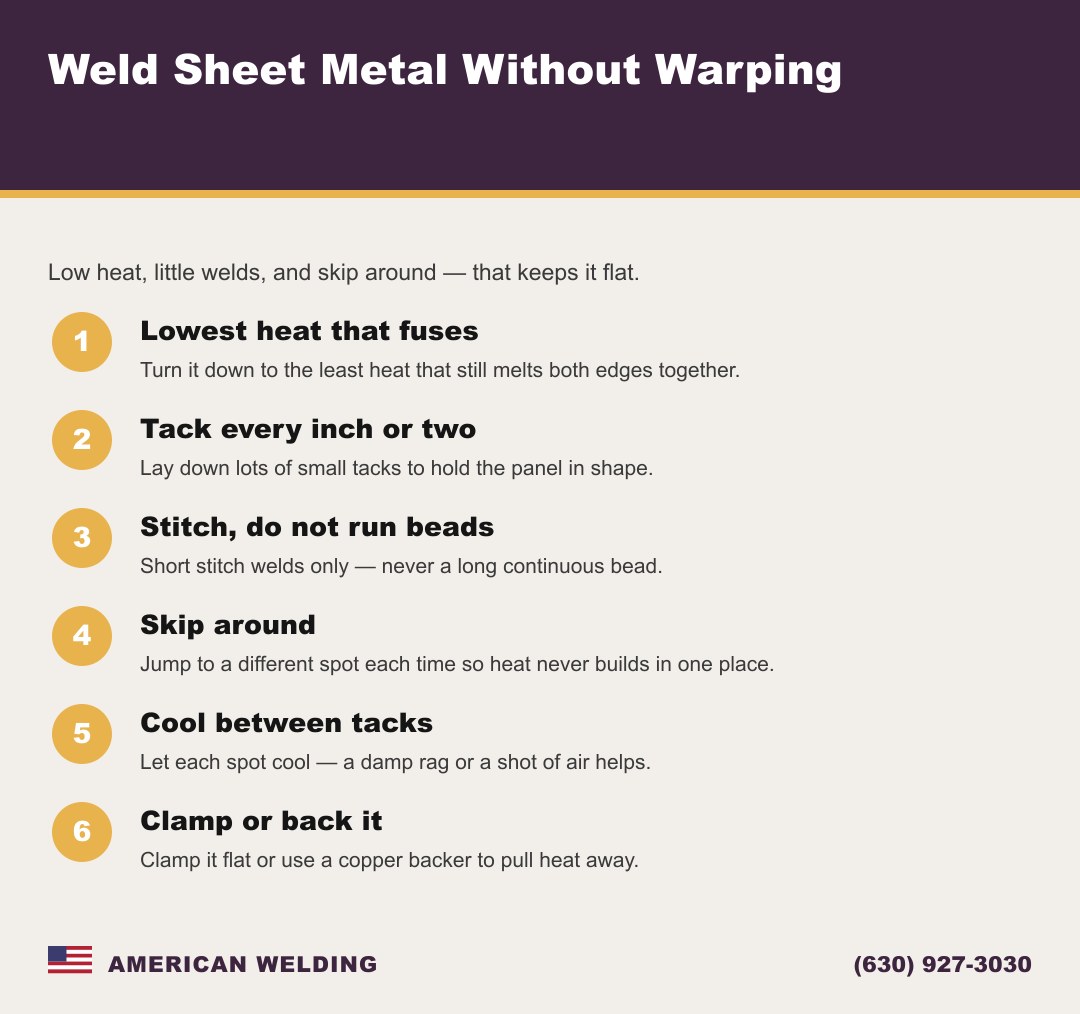
- Use the lowest heat that fuses. Start cool and only nudge the settings up until the two pieces join. More heat than that is wasted straight into warping the panel.
- Tack every inch or two. Lay down a line of small tack welds along the joint first. They lock the panels in position and keep the gap from opening or closing as the metal moves.
- Stitch weld — do not run long beads. Fill between the tacks with short bursts, maybe half an inch at a time. Each little weld adds almost no heat compared with one long run.
- Skip around — do not weld in order. Jump from one end to the other, then the middle, then back. Spreading the welds keeps heat from piling up in any one zone.
- Let it cool between tacks. Give the panel a few seconds — or a wipe with a damp rag near, not on, the weld — so it never gets hot to the touch across a wide area. Patience here is what saves the panel.
- Clamp it or use a copper backer. Clamps hold the panel flat while it cools, and a copper or brass bar behind the joint pulls heat away and keeps thin metal from blowing through. Both make a real difference.
Work through those steps in order and the heat never gets ahead of you. It is slower than running one bead and walking away — but a slow panel that stays flat beats a fast one you have to hammer back into shape.
Fixing a Panel That Already Warped
If the damage is already done, do not grab a bigger hammer and start flattening — that usually stretches the metal and makes the bulge worse. A warped panel has too much metal in one area, and the fix is to shrink it back, not pound it down.
Shrinking is the main tool. A small, controlled spot of heat on the high point, cooled quickly, draws the metal back in on itself and pulls the bulge flat. It takes a light touch, so it is worth practicing on scrap first. Planishing — gently working the metal between a hammer and a shaped dolly — smooths out the small waves once the big distortion is gone. Done right, the two together bring a wavy panel back to true without filler. Done wrong, you stretch the metal further, so a panel you cannot afford to ruin is worth handing off.
When to Let a Pro Handle It
Thin sheet metal is one of the hardest things to weld well, and auto-body panels are the toughest of all — the metal is light, the fit has to be clean, and a warped finish shows under paint forever. If the panel is visible, structural, or made of aluminum or stainless, the margin for error gets small fast.
That is where it pays to call someone who does it daily. American Welding has run thin-metal and body work since 1989, and our TIG welding service is built for exactly this kind of precision — low heat, tight control, flat results. Because we are mobile welding specialists, Pete brings the rig to you anywhere across Chicagoland and DuPage County, so a panel that cannot travel does not have to. Send a photo or call for a free quote, and we will tell you straight whether it is a quick fix or a bigger job.
Sheet Metal Welding FAQ
Can you weld sheet metal with a MIG welder?
Yes. MIG works well on sheet metal as long as you keep the heat down — use the smallest wire you can, set the voltage and wire speed low, and stitch weld in short bursts rather than one long bead. Test on a scrap of the same gauge first.
Why does my sheet metal warp when I weld it?
Because thin metal has no mass to absorb the heat. When you weld, the metal expands, and when it cools it shrinks and pulls the panel toward the weld. Too much amperage, long continuous beads, and no cooling breaks all concentrate that heat and make the panel buckle.
Is TIG or MIG better for thin sheet metal?
TIG gives you the finest heat control, which makes it the best choice for the thinnest panels and for aluminum or stainless body work. MIG is faster and perfectly capable on sheet steel if you keep the settings low and stitch weld. For visible auto-body work where a flat finish matters most, TIG usually wins.
How do you fix a panel that already warped?
Do not hammer it flat — that stretches the metal. Warping means there is too much metal in one area, so you shrink it back with a small, controlled spot of heat cooled quickly, then planish the remaining ripples smooth between a hammer and dolly. It takes practice, so try it on scrap first or hand it to a pro.
Does a copper backer really help?
It does. A copper or brass bar held behind the joint pulls heat away from the weld and keeps thin metal from blowing through, because the weld will not stick to copper. It is one of the simplest tricks for welding gaps and edges on sheet metal without burning holes.
Can you weld auto body sheet metal without replacing the panel?
Often, yes — a rust-out, tear, or crack can be patched rather than replacing the whole panel, as long as there is enough solid metal to work with. The key is low-heat, flat-finish welding so the repair disappears under paint. Send us a photo and we will tell you whether a patch will hold or a replacement makes more sense.
Got a Thin Panel That Keeps Warping?
Sheet metal and auto-body work is precision welding — low heat, tight control, and a flat finish that holds up under paint. It is exactly what we have done since 1989, out of our shop in Wayne, Illinois.
Whether it is a fender patch, a stainless panel, or a bowed piece that needs shrinking back to true, we come to you anywhere across Chicago, DuPage County, and the wider Chicagoland area — and the workmanship is guaranteed.
Call or text (630) 927-3030 or email pete@americanwelding.us for a free quote — send a photo and we will take a look.