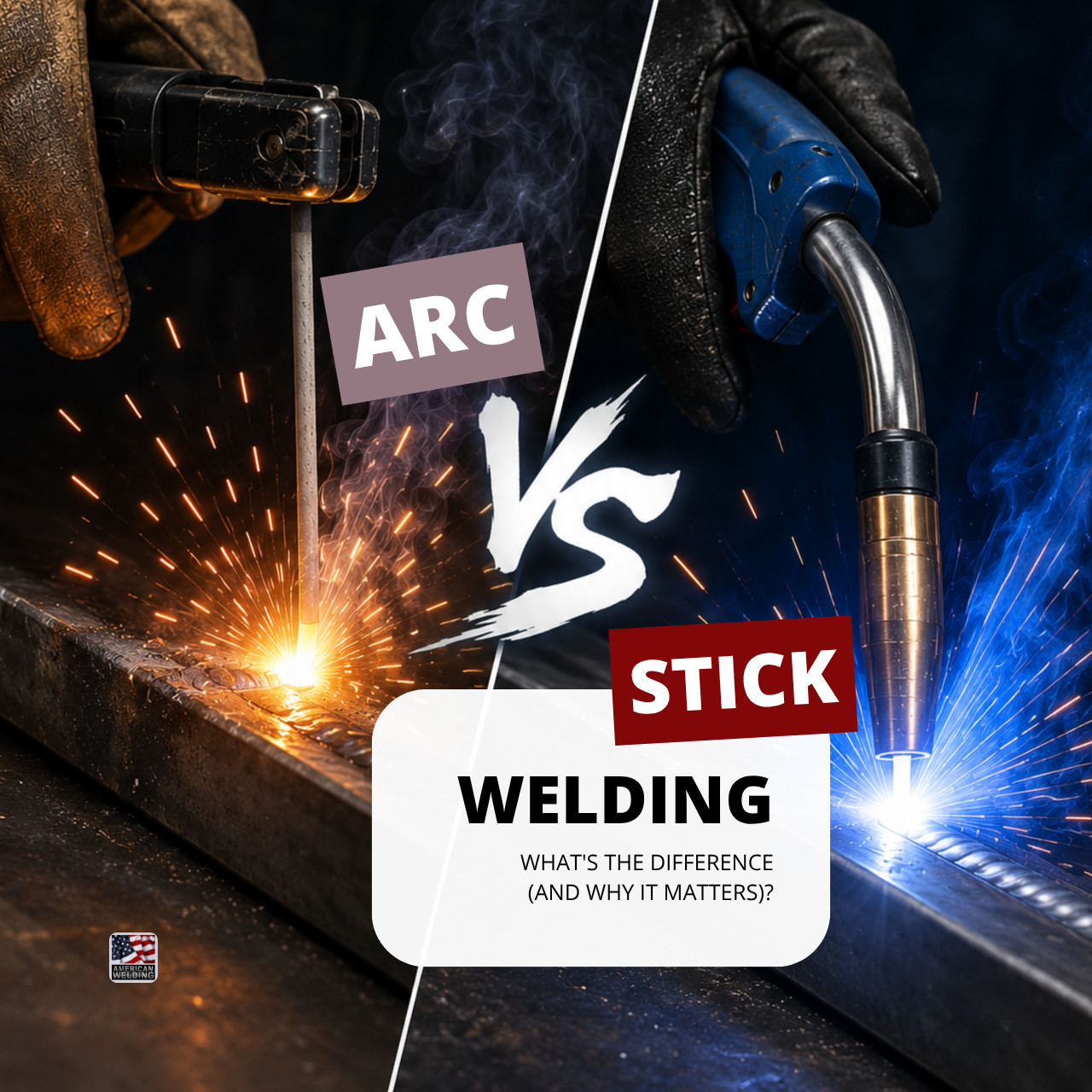
Arc Welding vs Stick Welding: What's the Difference (And Why It Matters)?
Ask ten welders about "arc welding vs stick welding," and you'll hear two different answers. That's because the question itself has a hidden problem; one that trips up first-time welders and confused clients all the time.
Here's the truth in one sentence: stick welding IS a type of arc welding.
But when most people say "arc welding," they mean something different than stick. This guide clears up the confusion, then runs the comparison the way clients actually mean it—plain talk. Real jobs. Decades of Chicago welding behind every point.
The Quick Answer
Arc welding is an umbrella term. It covers every welding type that uses an electric spark- an arc to melt metal together. That includes MIG, TIG, Stick, and Flux-Cored welding. Stick welding is one specific type of arc welding. It uses a coated welding rod; no gas tank, no wire feed, just a rod and a machine.
Most clients who ask about "arc welding vs stick welding" really mean wire-fed arc welding vs stick welding. That's the comparison this guide covers.
What Is Arc Welding?
Arc welding is the whole family of welding types that use an electric spark to join metal. Turn on the machine, touch the rod or wire to the metal, and a bright spark jumps across the gap. That spark is hot enough to melt the metal into one solid piece.
The four main arc welding types are:
- MIG welding — wire feeds from a machine, gas protects the weld
- TIG welding — hand-held rod, foot pedal control, gas protection
- Stick welding — coated rod, no gas needed
- Flux-Cored welding — wire with powder inside, no gas needed
Each type uses an arc. Each has a right job. The difference is how the metal, the rod, and the gas work together.
What Is Stick Welding?
Stick welding is the oldest and simplest form of arc welding. A welder holds a coated welding rod in one hand, touches it to the metal, and the arc starts.
The coating on the outside of the rod burns as the weld runs. That burning coating makes its own protective cloud around the weld. No separate gas tank needed. That's why stick welding is called "self-shielding"; the rod protects the weld all by itself.
Wait — Isn't Stick Just a Type of Arc?
Yes. And that's the whole confusion. Stick welding is one branch of the arc welding family, but it's the most recognizable branch; the bright spark, the mask, the smoke.
When a customer asks "arc welding vs stick welding," here's what they usually mean:
- "Arc welding" in their head = the newer, faster wire-fed welding (MIG, or sometimes flux-cored)
- "Stick welding" in their head = the older, hand-held rod version
That's the comparison this guide runs; the wire-fed way vs the rod-based way. The rest of the article uses "arc welding" the way clients usually mean it.
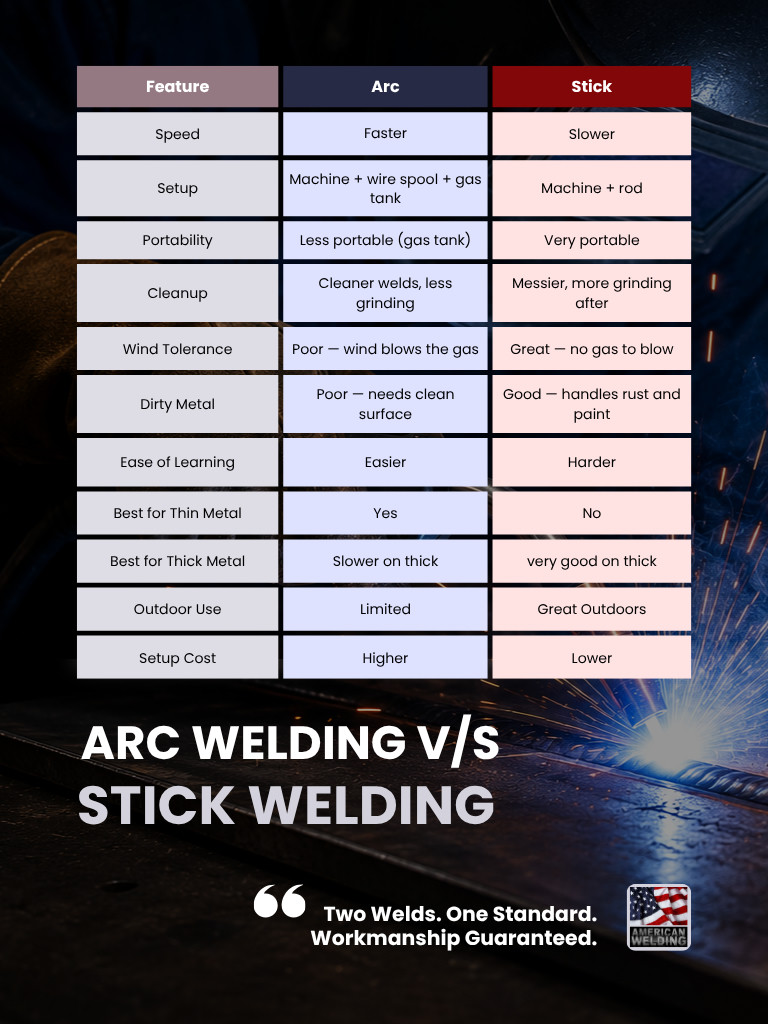
Arc (Wire-Fed) Welding vs Stick Welding — Side by Side
Here's the practical comparison most clients want:
Which Metals Each One Handles
Arc welding (wire-fed) and stick welding work with different metals in different ways:
Arc welding (MIG or flux-cored) works well on:
- Regular steel; most everyday jobs
- Stainless steel (with the right wire)
- Aluminum (with a special setup)
- Thin to medium-thickness metal
- Sheet metal for car body work
Stick welding works well on:
- Regular steel; the classic pick
- Cast iron (with a specialty rod)
- Thick steel plates and beams
- Rusty, painted, or dirty metal
- Structural steel for frames and trailers
Neither one is the top pick for thin sheet metal jobs where finish matters; that's TIG territory. Neither is the top pick for polished stainless kitchen work; TIG again.
When to Choose Arc Welding
Arc welding (the wire-fed kind) is usually the right pick when:
- The metal is clean and flat. Wire-fed welding wants a smooth surface.
- Speed matters. MIG welding runs much faster than stick welding.
- The job is indoors. No wind to blow away the protective gas.
- The welder is new to welding. Wire-fed is easier to learn.
- The finish should look clean. Wire welds are smoother with less cleanup.
Real jobs where arc welding usually wins:
- Building a steel storage rack in a shop
- Repairing a bent car body panel
- Fabricating a set of matching steel brackets
- Welding a long fence rail
- Assembling a trailer body indoors.
When to Choose Stick Welding
Stick welding is usually the right pick when:
- The metal is thick. Stick handles heavy steel better than most wire welding.
- The metal is rusty, painted, or dirty. Stick punches through where wire welding fails.
- The job is outdoors. Wind doesn't stop stick welding.
- Portability matters. A stick setup fits on the back of a truck.
- The setup budget is low. Stick machines and rods are cheap.
Real jobs where stick welding usually wins:
- Fixing a cracked steel trailer frame on the road
- Welding a heavy-duty gate outdoors
- Patching a rusty farm implement in a field
- Repairing structural beams on a construction site
- Fixing a broken cast iron pipe with a specialty rod
When People Ask for the Wrong One
The most common mistakes clients make when requesting the wrong welding type:
- Asking for wire welding on a rusty gate. The gas needs a clean surface. Rust ruins the weld.
- Asking for stick welding on thin car body sheet metal. Stick puts too much heat in. It burns right through the panel.
- Asking for wire welding outdoors in the wind. The gas blows away. The weld fails.
- Asking for stick welding on aluminum. Standard stick rods don't hold on aluminum. Wrong tool for the metal.
- Asking for wire welding on painted or dirty metal. The paint or dirt keeps the weld from bonding.
Every one of these calls comes back into the shop eventually as a re-weld. Redoing them with the right welding type usually fixes the problem for good.
How Every Weld Gets Called at American Welding
Every welding job gets the same three-step call before any spark is struck:
- Look at the metal. What kind? How thick? How clean is the surface?
- Look at the setting. Indoor shop or outdoor site? Windy? Wet? Tight space?
- Match the welding type. Sometimes arc. Sometimes stick. Sometimes both on the same project.
Pete picked up the torch in 1980 and never put it down. In four decades of welding, one lesson has held: the right welding type saves the job, and the wrong one costs the customer twice. Workmanship guaranteed either way.
Service Areas
American Welding serves Chicago and the surrounding suburbs:
- DuPage County — Naperville, Wheaton, Downers Grove, Lisle, Oak Brook, Hinsdale, Wayne
- Cook County — Elk Grove Village, Schaumburg, Hoffman Estates, Bartlett
- Will County — Bolingbrook, Joliet, Plainfield
- Kane County — St. Charles, Geneva, Batavia, Aurora
- Kendall County — Oswego, Yorkville
- McHenry County and DeKalb County
- Milwaukee to Illinois corridor and NW Indiana for larger jobs
Two Calls, Two Welding Types — A Day in DuPage County
Last week, two calls came in from DuPage County on the same afternoon.
The first call was from a homeowner in Wayne. A steel garden gate had rusted at the hinge and needed a hard repair on outdoor metal that had seen years of weather. That job called for stick welding; a rod that could push through rust, with no gas to worry about in the open wind.
The second call was from a fabrication shop building matching steel brackets for a client. Fast, clean, indoors, and repeatable. That job called for wire arc welding; smooth, quick, and consistent from bracket to bracket.
Same afternoon. Same county. Two welding types on the schedule. Workmanship guaranteed on both.
Why Choose American Welding
- All welding types under one roof—Arc, stick, TIG, flux-cored, and laser. No sending you to another shop.
- The right pick every time. Not the fastest. Not the cheapest. The right one for the job.
- Decades of hands-on welding. Every welding type has its own habits. Time on the job is the only teacher.
- Plain answers. Straight talk on what your job needs and why.
- Full mobile welding service. Repairs come to you when the job can't come to the shop.
- Workmanship guaranteed on every job.
More on specific welding types and services:
- What Are the 4 Types of Welding?
- TIG Welding Service
- Mobile Welding & Repair
- Aluminum Welding Service
- Cast Iron Welding Service
- Restaurant Stainless Steel Welding Repair
FAQs About Arc Welding vs Stick Welding
Q: Is stick welding a type of arc welding?
Yes. Stick welding is one of the four main types of arc welding, along with MIG, TIG, and Flux-Cored. Arc welding is the whole family that uses an electric spark to join metal.
Q: Which is stronger: arc welding or stick welding?
Both can make equally strong welds when used on the right job. Strength depends on the metal, the joint, the setup, and the welder, not the type. The wrong type on any job is always weaker.
Q: Is arc welding easier than stick welding?
When people say "arc welding," they usually mean MIG welding, and yes, MIG is easier to learn than stick. Stick welding takes more practice to get a clean weld.
Q: Can you stick weld outdoors?
Yes. Stick welding is one of the best types for outdoor jobs. It doesn't rely on a gas tank, so wind and weather don't stop it.
Q: Can arc welding (MIG) be done outdoors?
Yes, but with limits. Wind blows away the protective gas MIG uses. For outdoor jobs, stick or flux-cored welding usually works better.
Q: What's cheaper: arc welding or stick welding equipment?
Stick welding equipment is usually cheaper. A stick machine and a supply of rods is a low-cost setup. MIG welding needs a machine, a wire spool, and a gas tank.
Q: Is arc welding safer than stick welding?
Both types are safe when done with proper setup. Both give off heat, sparks, and fumes. The safe practice is the same for both: careful setup, fire precautions, and clean shutdown.
Q: Which welding type is best for beginners?
MIG welding (a form of arc welding) is usually the easiest to learn. Stick welding takes longer to get right but teaches core welding skills.
Q: What is the difference between arc welding and MIG welding?
MIG welding IS a type of arc welding. So are TIG, stick, and flux-cored. When people compare "arc welding vs stick," they usually mean MIG vs stick.
Q: Can stick welding handle stainless steel?
Yes, but MIG or TIG usually gives a cleaner stainless finish. Stick is used on stainless when the job is thick or when a wire welder isn't available.
Q: What welding type does American Welding use?
All four main arc welding types: MIG, TIG, Stick, and Flux-Cored; plus laser and spot welding when the job calls for it. The right one gets picked for each project.
Not Sure Which Welding Type Your Job Needs?
That's the easiest call to make. Describe the job. American Welding picks the right welding type.
Mobile welding service across Chicago and the surrounding counties. Workmanship guaranteed.
Call (630) 927-3030 or email pete@americanwelding.us to walk through your project.