The Arc Welding Process Explained Simply
Everyone has seen the bright flash of an arc welder; the sudden white spark, the smoke, the shower of orange dots on the ground.
But almost nobody knows what's actually happening inside that spark. What is the arc? Why does it melt metal? And how does a welder turn a bright flash into a strong joint that holds a car frame, a steel gate, or a stainless kitchen table together?
This guide walks through the arc welding process step by step, as simply as possible. No trade jargon. No science-class talk. Just real explanations from decades of Chicago welding work.
The Quick Answer
The arc welding process uses electricity to make a small, controlled lightning spark between a welding rod (or wire) and the metal being welded. That spark is hot enough- around 6,500 degrees Fahrenheit- to melt both the rod and the metal at the same time.
As the two melted metals cool, they harden into a single solid piece. That's the whole process, boiled down.
Everything else is about controlling the spark so it welds cleanly and holds strong.
How the Arc Actually Forms
An arc welder uses an electric current, the same kind that runs a light switch, but much stronger.
One cable connects the machine to the metal being welded. The other cable connects the machine to the welding rod or wire. When the rod touches the metal and pulls back a tiny bit, electricity jumps across the gap. That jump is the arc.
Think of it like a very small, very controlled bolt of lightning. Hot, bright, and focused right where the welder wants it.
What Happens to the Metal
When the arc hits the metal, three things happen at the same time:
- The metal melts. The heat softens the metal into a small pool.
- The welding rod or wire melts. It drips into the pool, adding new material.
- The two mix and cool. As they cool, they harden into one solid piece.
That mixing and cooling is what makes an arc weld strong. The two pieces of metal are no longer just touching; they're now one continuous piece.
Different arc welding types (MIG, TIG, Stick, Flux-Cored) all use this same basic idea. What changes is HOW the rod or wire is fed in, and HOW the weld is protected while it cools.
The Full Arc Welding Process — Step by Step
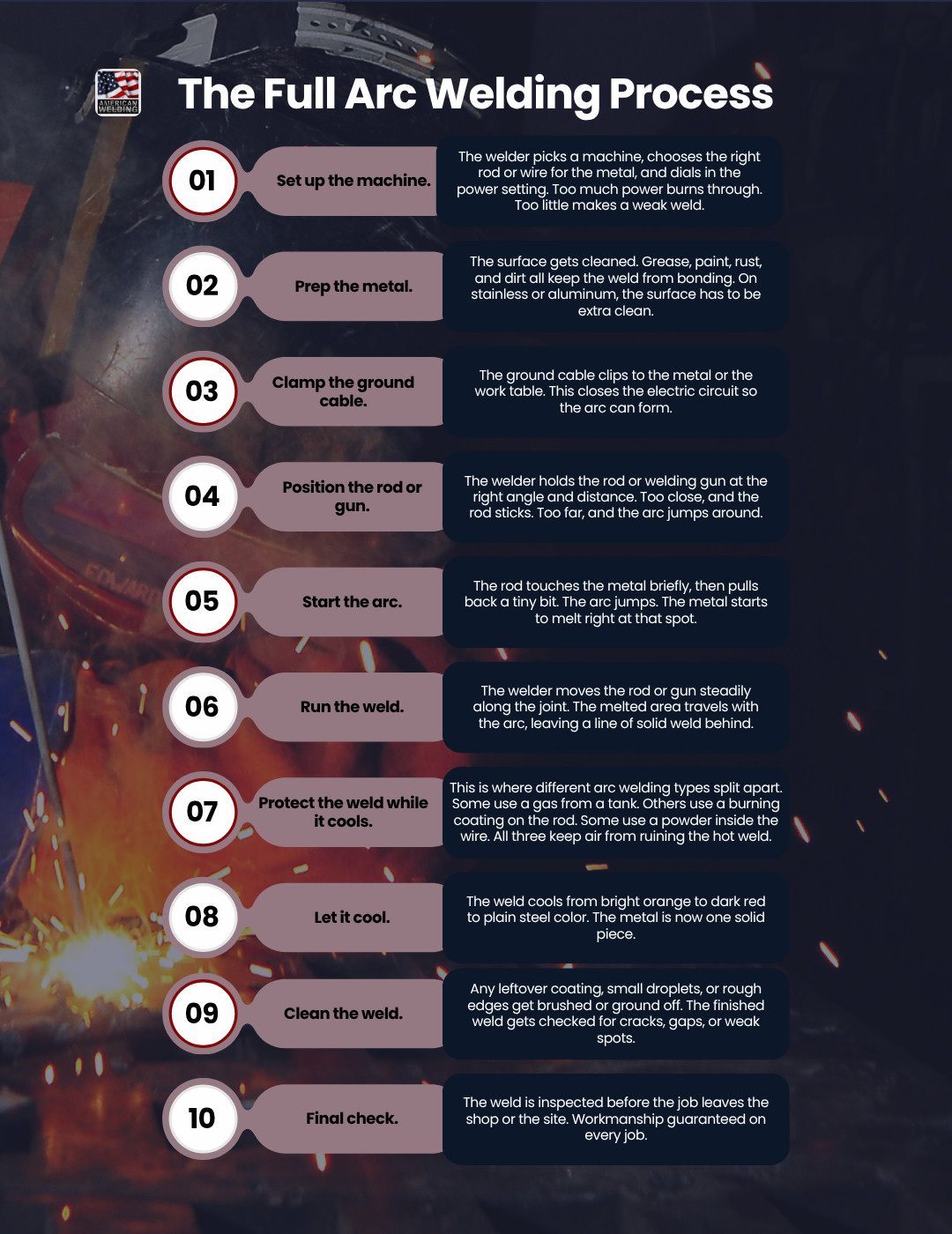
Every arc welding job, no matter the type, goes through the same basic steps:
The Four Ways to Run an Arc
The arc welding process comes in four main flavors. Each one runs the same basic steps above, but uses a different way to feed the rod or wire, and a different way to protect the weld:
- MIG welding — a wire feeds from a machine, and a gas tank supplies protection
- TIG welding — a hand-held rod, foot pedal control, and gas protection
- Stick welding — a coated rod that makes its own protection as it burns
- Flux-Cored welding — a wire with powder inside that makes its own protection
For a full breakdown of each one, see our guide: What Are the 4 Types of Welding?
What the Arc Needs to Work
Four things have to come together for a good arc weld:
1. Clean metal.
Rust, paint, grease, and dirt all mess with the arc. Cleaner metal means a cleaner weld.
2. The right power setting.
Every metal and thickness needs a specific power level. Too high burns through. Too low won't melt right.
3. Protection for the hot weld.
Whether that comes from a gas tank, a burning rod coating, or a powder inside the wire — the melted metal has to stay away from the air until it cools.
4. A steady hand.
The welder controls the speed, angle, and distance of the arc. That control is what separates a strong weld from a weak one.
Any one of these four missing, and the weld will fail; sometimes right away, sometimes months later.
Where the Arc Welding Process Goes Wrong
Even with the right setup, the arc welding process can go sideways. Here are the most common problems:
- Weak welds from dirty metal. The arc can't bond through rust or paint. The weld looks fine but breaks under load.
- Burn-through on thin metal. Too much power melts a hole instead of a bead. Common on car body panels or thin sheet steel.
- Cracked welds from cooling too fast. Some metals need to cool slowly. When they cool too quickly, cracks form as they shrink.
- Weld full of tiny air pockets. When the protective gas or coating fails, air gets into the melted metal and leaves gaps.
- Warped metal from too much heat. Thin sheet metal bends and twists when heat spreads too far.
- Poor bond on painted or coated metal. The coating burns off wrong and stops the weld from taking.
Every one of these calls comes into the shop eventually as a re-weld. Redoing them with the right setup usually solves the problem for good.
Metals the Arc Melts
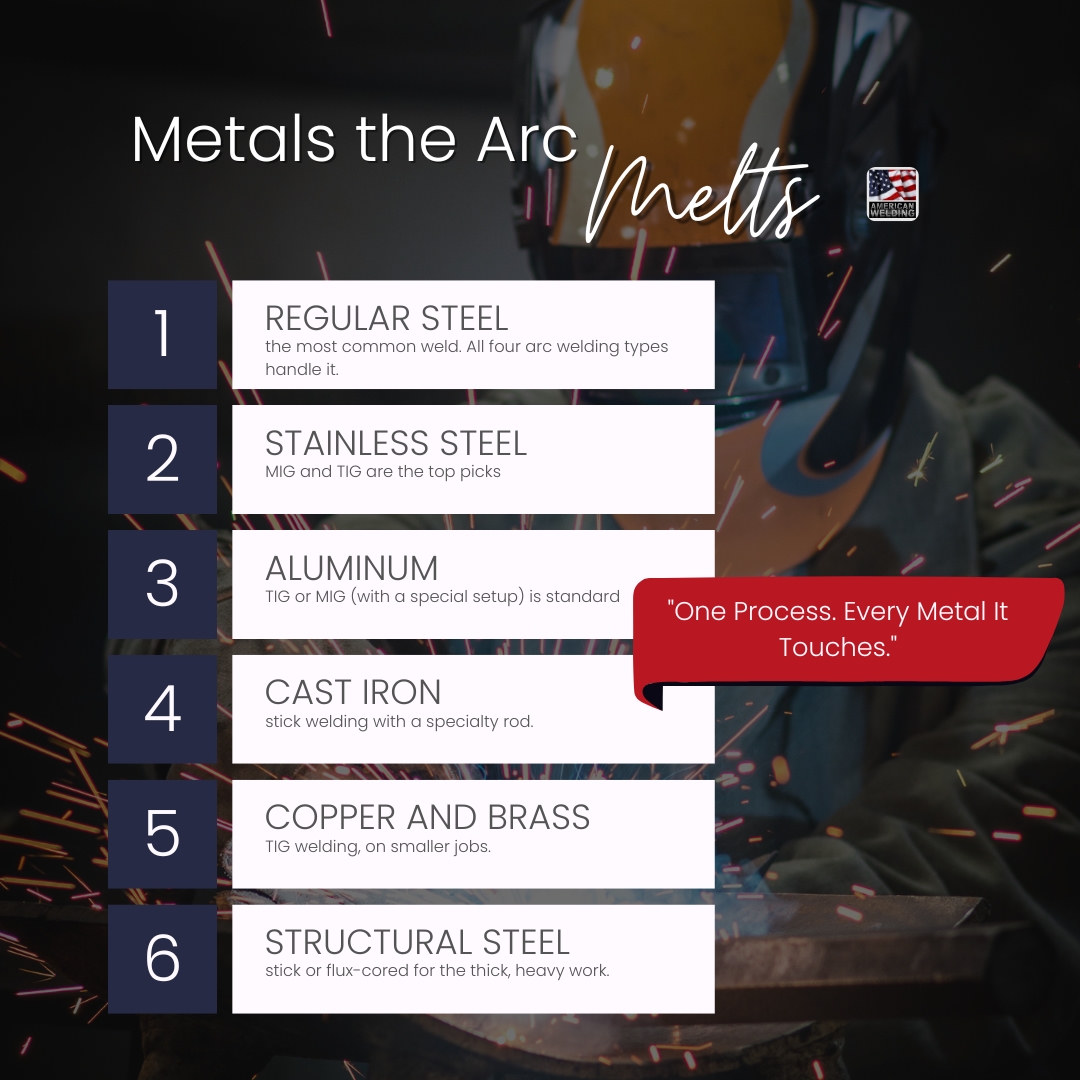
The arc welding process works on almost every metal used in construction and repair:
Some metals need extra care. Cast iron cracks easily. Aluminum reflects heat oddly. Stainless can warp or lose its rust protection if welded wrong.
That's why matching the right arc welding type to the job matters.
Inside the Arc Welding Process at American Welding
At American Welding, every arc welding job runs through the same careful process; no shortcuts, no rushed setups.
Here's what happens on a typical job:
- Take the call. Understand the metal, the setting, and what the finished weld has to do.
- Pick the right arc welding type. MIG, TIG, Stick, or Flux-Cored; matched to the job.
- Prep and set up. Clean the metal, position the piece, dial in the machine.
- Run the weld: steady speed, right angle, controlled arc.
- Cool and clean. Let the weld cool, then brush or grind clean.
- Check the finish. Every weld gets a full look-over before the job leaves.
Four decades of repair work have shown one clear pattern: the difference between a weld that lasts and one that fails is almost always in the process, not the equipment. Workmanship guaranteed on every arc weld.
Service Areas
American Welding serves Chicago and the surrounding suburbs:
- DuPage County — Naperville, Wheaton, Downers Grove, Lisle, Oak Brook, Hinsdale, Wayne
- Cook County — Elk Grove Village, Schaumburg, Hoffman Estates, Bartlett
- Will County — Joliet, Bolingbrook, Plainfield
- Kane County — St. Charles, Geneva, Batavia, Aurora
- Kendall County — Oswego, Yorkville
- McHenry County and DeKalb County
- Milwaukee to Illinois corridor and NW Indiana for larger jobs
The Arc Welding Process at Work Across DuPage County
Arc welding shows up in nearly every corner of DuPage County, but the reason behind the call changes from one town to the next.
In Oak Brook, corporate campuses need arc welding for stainless kitchen equipment and back-of-house repairs. In Naperville, it goes to home projects, garage builds, and outdoor gates. In Wheaton, it handles school building repairs and light manufacturing work. In Lisle and Downers Grove, industrial parks bring in pallet racks, forklift arms, and machinery frames.
Same arc welding process every time. Different reason behind every call. Workmanship guaranteed on jobs across the county.
Why Choose American Welding for Arc Welding
- All four arc welding types under one roof. MIG, TIG, Stick, and Flux-Cored; matched to your job, not to what's fastest.
- The right process every time. Every step gets the same care. No skipped prep. No rushed cool-down.
- Decades of hands-on arc welding. Every weld type has its own habits. Time on the job is the only teacher.
- Plain answers. Straight talk on what your job needs and why.
- Full mobile welding service. Arc welding at the job site when the job can't come to the shop.
- Workmanship guaranteed on every arc welding job.
More on welding types and services:
- What Are the 4 Types of Welding?
- Arc Welding vs Stick Welding: What's the Difference?
- TIG Welding Service
- Aluminum Welding Service
- Mobile Welding & Repair
- Cast Iron Welding Service
FAQs About the Arc Welding Process
Q: What is the arc welding process in simple terms?
Arc welding uses an electric spark to melt two pieces of metal so they cool into one solid piece. The spark comes from a machine pushing electricity through a rod or wire onto the metal.
Q: How hot is the arc in arc welding?
The arc reaches about 6,500 degrees Fahrenheit. That's hot enough to melt almost every common metal in seconds.
Q: What are the main steps in the arc welding process?
Set up the machine, clean the metal, clamp the ground, position the rod, start the arc, run the weld, protect the cooling weld, let it cool, clean the weld, and check the finish. Every arc welding job follows this pattern.
Q: Why does the arc welding process need protection for the weld?
Molten metal reacts badly with the air. Oxygen and nitrogen in the air cause the weld to weaken and form small holes. Arc welding uses gas, a rod coating, or a powder inside the wire to keep air away until the weld cools.
Q: Can the arc welding process be used on any metal?
Most common metals: regular steel, stainless steel, aluminum, cast iron, copper, and brass. Some need special rods, wires, or setups. A few very reactive metals need other welding methods.
Q: What is the difference between the arc welding process and gas welding?
Arc welding uses electricity to make the heat. Gas welding uses a flame from a torch fed by fuel gas and oxygen. Arc welding is faster, hotter, and stronger for most modern jobs.
Q: How long does the arc welding process take?
A short repair weld can take a few minutes. A long fabrication job can take hours. The arc welding process itself is fast; most of the time on a job is prep, setup, and finish work.
Q: Is the arc welding process dangerous?
It gives off heat, bright light, sparks, and fumes. With proper setup, fire precautions, and clean shutdown, it's a safe process handled by trained welders every day.
Q: What arc welding process is easiest to learn?
MIG welding is usually the easiest. The wire feeds by itself, and the weld runs steady with a simple trigger pull. Stick and TIG take more practice.
Q: What arc welding process is strongest?
All arc welding types can make strong welds when used on the right job. Strength comes from the metal, the process match, and the welder, not the type alone.
Ready for Arc Welding Done Right?
Whether it's a repair, a fabrication project, or a mobile call, American Welding runs the arc welding process the same careful way every time.
Mobile welding service across Chicago and the surrounding counties. Workmanship guaranteed.
Call (630) 927-3030 or email pete@americanwelding.us to walk through your project.