Welding vs Brazing vs Soldering
If you are trying to tell welding, brazing, and soldering apart, the whole thing comes down to one question: does the metal you are joining actually melt, or not?
Welding melts the base metals together into one solid piece. Brazing and soldering never melt the base metal at all — they glue the parts with a separate melted filler.
The strength follows the heat: welding is the strongest, brazing sits in the middle, and soldering is the weakest.
At American Welding, owner Pete Adams has welded since 1989 — about 37 years on the torch — and from our shop in Wayne, Illinois we run mobile rigs out to jobs across Chicago and DuPage County every week. People ask us all the time whether a repair needs welding, brazing, or soldering. Here is how to tell the three apart, and how to pick the right one for what is in front of you.
What Welding Is
Welding is the only one of the three that melts the base metals themselves. You bring the edges of two pieces up to their melting point, they flow together, and as they cool they freeze into a single continuous piece of metal. A filler is usually added to the joint, but the key difference is that the parent metal becomes liquid and fuses — there is no separate glue holding anything together.
That takes the most heat by far. Steel does not soften until you are well past 2,500°F, so welding needs a serious heat source — an electric arc or a hot flame. In return you get the strongest joint of the three: a sound weld is typically as strong as the metal around it, which is why anything that carries weight, takes a load, or has to survive real abuse gets welded. The common methods — ARC, MIG, and TIG — are all forms of this same fuse-the-base-metal idea, and we break them down in our guide to the types of welding.
What Brazing Is
Brazing joins metal without melting it. You heat the two parts up, then flow in a filler rod that melts at a fairly high temperature — but still below the melting point of the base metal. The parts stay solid the whole time; only the filler turns liquid. Drawn into the tight gap between the pieces, it bonds to both surfaces and locks them together as it cools.
Because the base metal never melts, brazing has two big advantages. It is gentle on thin or delicate parts that a full weld would blow through or warp, and it happily joins metals that are hard to weld to each other, like steel to brass or copper fittings in a run of pipe. A good brazed joint is strong and leak-tight — not quite weld strength, but far beyond soldering, and plenty for plumbing, HVAC, and tooling.
What Soldering Is
Soldering works the same way as brazing — a melted filler bonds the parts while the base metal stays solid — but at a much lower heat. The solder melts at a few hundred degrees, cool enough to handle with a simple iron or a small torch, which is exactly why it is the method for delicate work.
That low heat is also why soldering makes the weakest joint of the three. It is built for sealing and for carrying an electrical signal, not for holding a load — which is why you find it on circuit boards and electronics, in jewelry, and on thin copper pipe and tubing. Ask a soldered joint to take real force and it will let go, which is the whole reason the stronger methods exist.
The Real Differences
Strip away the detail and the three methods line up on two scales: how much heat they use, and how strong the joint is. Welding sits at the top of both, soldering at the bottom, and brazing right in the middle.
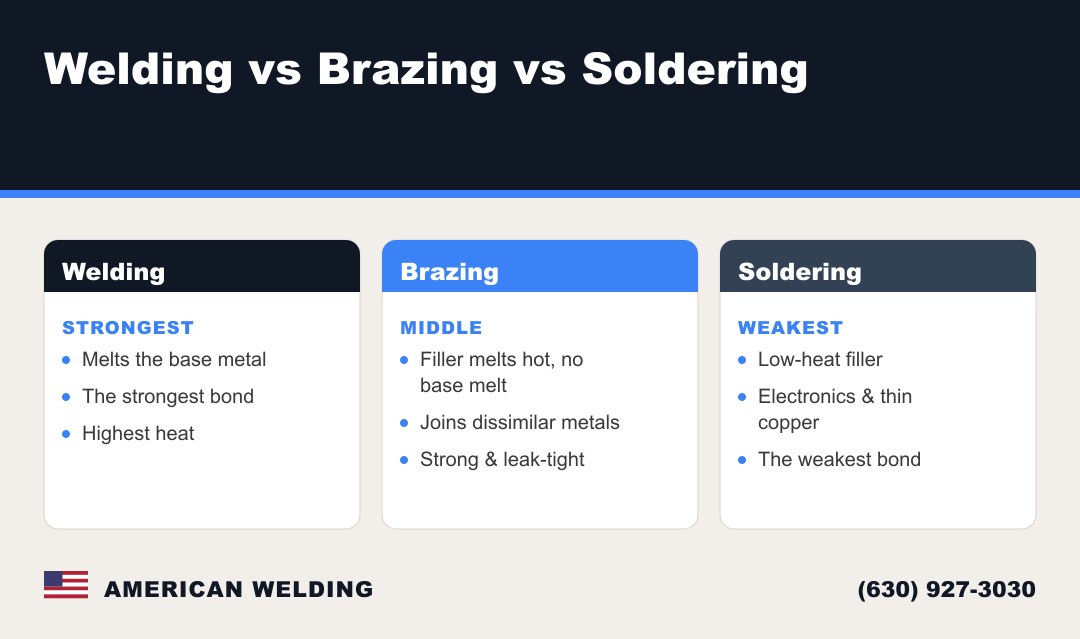
- Welding — melts the base metal so the parts become one piece. Highest heat, strongest bond. This is the only method that truly fuses the parent metal.
- Brazing — a filler melts at a high heat but the base metal never melts. Strong and leak-tight, and happy to join dissimilar metals like steel and brass.
- Soldering — a low-heat filler, cool enough for a handheld iron. Best for electronics and thin copper, and the weakest of the three.
Which Should You Use?
The right method is almost always decided for you by the job: what the parts are made of, how much strength the joint needs, and how much heat the parts can take. Match those three things and the choice is usually obvious.
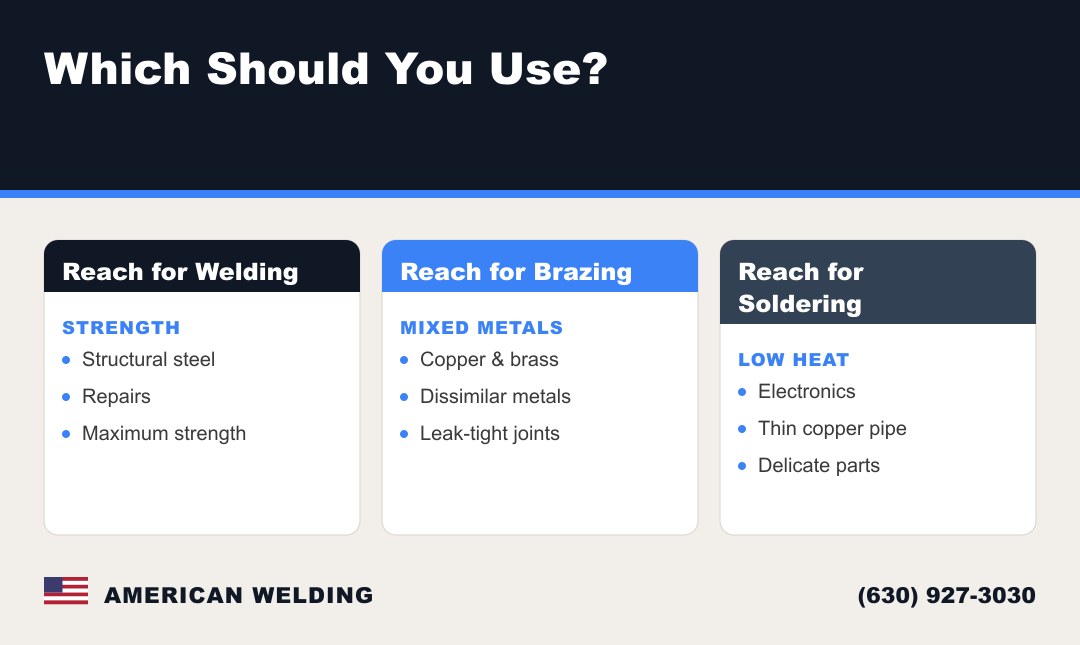
- Reach for welding when strength is the point — structural steel, gates and railings, trailer and equipment repairs, anything that carries a load or has to survive hard use.
- Reach for brazing when you are joining dissimilar metals, working with copper and brass, or need a strong, leak-tight joint without melting a thin or delicate part.
- Reach for soldering for electronics and circuit work, thin copper pipe, and anything fragile that only needs a sealed or electrical connection at low heat.
When in doubt, ask what happens if the joint fails. If the answer is "something falls, bends, or breaks," you want a weld. If it is "a wire loses contact" or "a pipe weeps," brazing or soldering will do.
What American Welding Does
We are a welding shop, and welding is where we live — fusing the base metal for maximum strength on the jobs that have to hold. Pete runs ARC, MIG, and TIG depending on the metal and the repair, and we work in steel, aluminum, stainless, and cast iron. If a part carries weight or has to survive real abuse, that is a weld, not a glued-on filler.
The best part is that we come to you. Our mobile welding and repair rigs bring the shop to your driveway, shop floor, or job site across Chicagoland, so heavy or awkward pieces never have to be hauled anywhere. For clean, precise work on thinner stainless and aluminum we turn to TIG welding, and for those tricky old engine blocks, cookware, and machine bases we handle cast iron welding, one of the fussiest metals there is. Not sure which method your project needs? Snap a photo of the broken part and send it over, or call Pete and talk it through — the quote is free either way.
Welding vs Brazing vs Soldering FAQ
Is brazing as strong as welding?
No. A sound weld fuses the base metal and is usually about as strong as the metal around it, while a brazed joint relies on a filler bonded to the surface. Brazing is genuinely strong and leak-tight — far beyond soldering — but for anything structural or load-bearing, welding is the stronger choice.
What is the difference between brazing and soldering?
Both flow a melted filler into the joint without melting the base metal — the only real difference is heat. Brazing uses a higher-temperature filler and makes a stronger joint, while soldering melts at a few hundred degrees and makes a weaker one. Braze hot, solder cool.
Can you braze or solder steel instead of welding it?
You can braze steel, and it is a good option for thin steel or for joining it to another metal like brass. But for a repair that has to carry weight or take abuse, welding is the right call — it fuses the steel itself rather than bonding a filler to the surface. Soldering is not suited to structural steel at all.
Which method is best for joining two different metals?
Brazing usually wins here. Because the base metals never melt, it can bond two different metals — like steel and brass, or copper fittings — that are difficult to weld together. The filler keys to both surfaces and leaves a strong, leak-tight joint.
Do I need welding or brazing for a structural repair?
Welding. Anything that holds weight, takes a load, or has to survive real use should be welded so the base metal fuses into one piece. If you are not certain whether your part is structural, send us a photo and we will tell you straight.
Does American Welding handle this kind of work?
We are a welding shop first and foremost — ARC, MIG, and TIG on steel, aluminum, stainless, and cast iron, built for strength and backed in writing. We are mobile across Chicago, DuPage County, and the wider Chicagoland area. Tell us what you are trying to join and we will point you to the right method and give you a free quote.
Need It Joined to Hold? Call Pete.
Welding, brazing, and soldering each have their place — but when a part has to carry weight and survive real use, you want it welded. Pete has been fusing steel, aluminum, stainless, and cast iron since 1989, and our mobile rigs bring that work straight to you.
From our shop in Wayne, Illinois we cover Chicago, DuPage County, and all of Chicagoland. Send a photo of the broken part for a fast, free quote.
Call or text (630) 927-3030 or email pete@americanwelding.us to talk through your project.