What Is Flux-Cored Welding?
If you have ever watched a welder lay a clean bead outside in a stiff wind, odds are you were watching flux-cored welding.
It looks almost exactly like MIG, runs off a spool of wire, and feeds the same way.
The whole difference is hidden inside the wire itself.
Flux-cored welding is like MIG, but the wire is hollow and packed with flux — so self-shielded flux-cored needs no gas tank, and it works great outdoors and on thick or dirty steel.
At American Welding, owner Pete Adams has welded since 1980 and built his mobile shop in Wayne, Illinois back in 1989. Flux-cored wire is one of the tools our rigs carry to jobs across Chicago and DuPage County, because so much real welding happens outside, on heavy steel, or on metal nowhere near shop-clean. Here is what it is, how it differs from regular MIG, and when it is the right call.
How Flux-Cored Welding Works
Regular MIG welding feeds a solid metal wire and blankets the weld with shielding gas piped in from a tank. Flux-cored welding swaps that solid wire for a tube — a hollow wire with a core of flux packed down the center, a little like the lead inside a pencil.
When the arc melts the wire, it melts the flux at the same time. That flux burns and does the one job that keeps a weld sound: it shields the molten puddle from the oxygen in the air. Here is the sequence at the tip of the gun.
- The arc melts the tubular wire and the flux packed inside it in the same instant.
- The burning flux releases a cloud of shielding gas that pushes the air — and its oxygen — away from the molten metal.
- A thin crust of slag forms over the cooling bead and keeps the air out until the metal is solid.
- You chip or brush the slag away once it cools, and the finished weld is right underneath.
Because the shield is built into the wire instead of sprayed from a tank, there is far less for the wind to blow away. That one fact is why flux-cored is the go-to for outdoor and job-site welding.
Self-Shielded vs Gas-Shielded Flux-Cored
Not all flux-cored wire works the same way. There are two families, and the split comes down to one question: do you still run a gas tank, or not?
- Self-shielded flux-cored — the flux alone does all the shielding. No gas tank, no hoses, nothing for the wind to steal. This is the portable, outdoor-friendly type most people picture when they hear "flux-cored."
- Gas-shielded flux-cored (dual-shield) — uses the flux and a shielding gas together. The added gas gives a cleaner, smoother bead and is a favorite for heavy fabrication under a roof, but it ties you back to a tank.
For mobile work run out of a truck, self-shielded is usually the winner. The whole setup rides along with no gas bottle to haul, swap, or shelter from a breeze — which matters when the job is on a windy lot somewhere across Chicagoland rather than inside a shop.
Flux-Cored vs Solid-Wire MIG
The quickest way to understand flux-cored is to set it right beside the solid-wire MIG it resembles. They share a gun and a wire feeder, and from across the shop they look identical — but each has a job it does best.
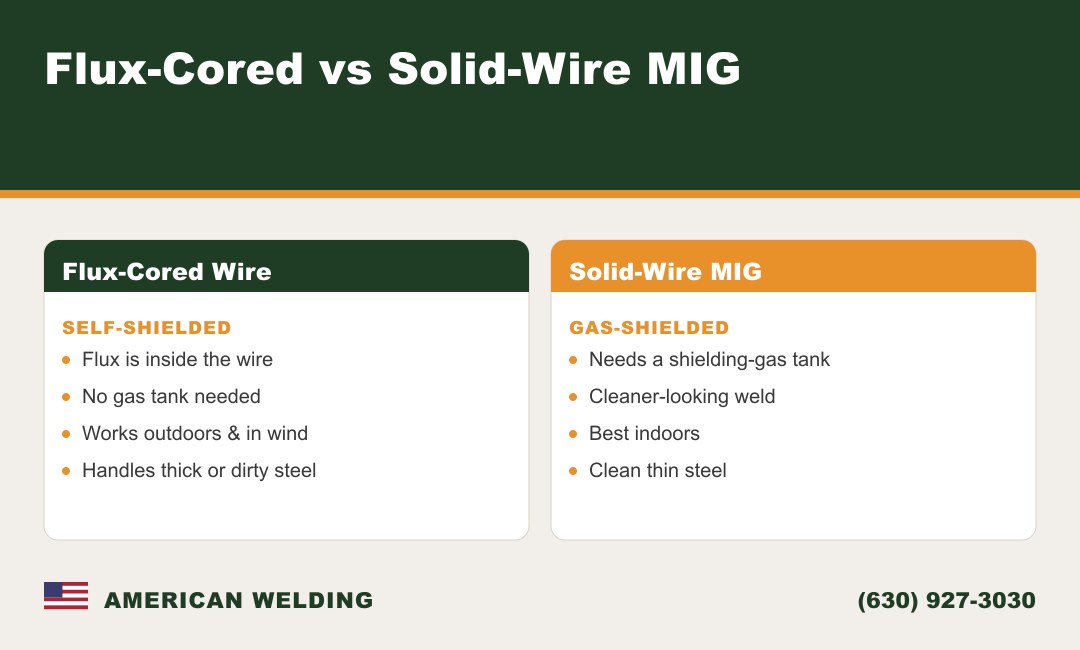
Flux-cored wire carries its shielding on the inside. Self-shielded versions need no gas tank at all, so the wind cannot rob the weld, and the process bites through thicker and dirtier steel without a fuss. That is what makes it the outdoor and heavy-repair workhorse.
Solid-wire MIG leans on a shielding-gas tank to protect the puddle, which is a liability outside but a strength indoors. The payoff is a cleaner, better-looking weld with little to no slag to chip, which is why MIG shines on clean, thin steel in a controlled space. Neither is better across the board — they are simply built for different conditions.
Where Flux-Cored Wins
Flux-cored is not the right pick for every weld, but there are a handful of situations where it flat-out beats solid-wire MIG. These are the jobs our crews reach for it most.
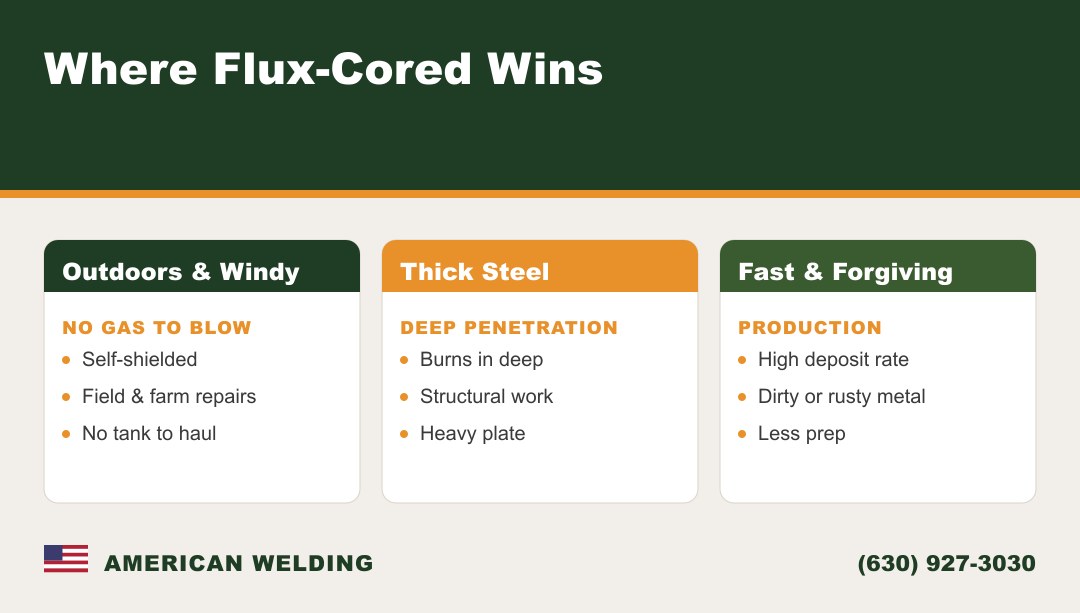
- Outdoors and in the wind. Self-shielded flux-cored carries its own shield, so there is no gas cloud to blow away. On an open job site it keeps laying sound welds when MIG would be fighting the breeze.
- Thick steel. Flux-cored runs hot and digs in, so it gets deep penetration and strong fusion on heavy plate and structural metal in fewer passes.
- Fast production. It lays down metal quickly — a high deposit rate — which means more finished weld per hour when there is a lot of ground to cover.
- Dirty or rusty metal. Flux-cored is simply more forgiving. It tolerates a bit of mill scale, surface rust, and grime far better than solid-wire MIG, which wants clean, bright steel to behave.
When a job calls instead for a show-quality bead on thin, stainless, or decorative metal, we switch processes entirely — see our TIG welding service, or our rundown of MIG vs TIG welding for how the clean-finish processes stack up.
When American Welding Reaches for It
A lot of the welding we do never happens inside a shop. A gate hinge tears loose, a trailer frame cracks, a railing rusts through, or a piece of structural steel needs reinforcing right where it stands. For that kind of on-site, outdoor, heavy-steel work, flux-cored is often the tool that gets it done without dragging a gas bottle into a windy parking lot or alley.
Because Pete built the business around coming to you, our mobile welding rigs show up with flux-cored ready to run on dirty, weathered, or thick steel just as we find it. Whether it is a single outdoor repair or ongoing structural work, our portable welding service brings the right process to the metal instead of asking you to haul the metal to a shop — covering Chicago, DuPage County, and the wider Chicagoland area.
Flux-Cored Welding FAQ
Is flux-cored welding the same as MIG?
They are close cousins. Both feed a wire through the same kind of gun and feeder, so the motion feels identical. The difference is the wire: MIG uses a solid wire with shielding gas from a tank, while flux-cored uses a hollow wire packed with flux that shields the weld from the inside. Self-shielded flux-cored needs no gas tank at all.
Do you need gas for flux-cored welding?
It depends on the wire. Self-shielded flux-cored needs no gas — the flux inside the wire does all the shielding, which is what makes it so handy outdoors. Gas-shielded flux-cored, also called dual-shield, does run a gas tank alongside the flux for a cleaner bead, and it is used mostly for heavy fabrication indoors.
Is flux-cored welding strong enough for structural work?
Yes. Flux-cored runs hot and penetrates deep, so it produces strong, well-fused welds on thick plate and structural steel — one reason it is common on heavy outdoor and construction work. As with any process, the strength comes from the right wire, the right settings, and an experienced hand welding it to spec.
Can you flux-cored weld outside in the wind?
That is where it shines. Self-shielded flux-cored carries its shield inside the wire, so there is no gas cloud for the wind to scatter. Solid-wire MIG struggles outdoors because a breeze blows the shielding gas off the puddle, but flux-cored keeps laying sound welds on an open, windy site.
Does flux-cored welding work on rusty or dirty metal?
It is more forgiving than MIG. Flux-cored tolerates a bit of surface rust, mill scale, and grime far better than solid wire, which wants clean, bright steel. We still knock off loose rust and scale for the best result, but flux-cored is the practical choice for weathered, real-world metal in the field.
Flux-cored or MIG — which should I use?
Match the tool to the job. For outdoor repairs, thick steel, or dirty metal, flux-cored usually wins. For a clean, good-looking weld on thin steel in a sheltered spot, solid-wire MIG is hard to beat. If you are not sure what your project needs, send Pete a photo and he will tell you the right process for a free quote.
Need Outdoor or Heavy-Steel Welding Done Right?
Flux-cored is built for the jobs that scare off a shop setup — windy lots, thick structural steel, and weathered metal that needs fixing where it sits. We bring the right process to your site instead of asking you to haul the work to us.
Pete Adams has welded since 1980 and run this mobile shop out of Wayne, Illinois since 1989, serving Chicago, DuPage County, and all of Chicagoland. Send a photo of your project and get a free quote — no surprise trip fees.
Call or text (630) 927-3030 or email pete@americanwelding.us to talk through your job.