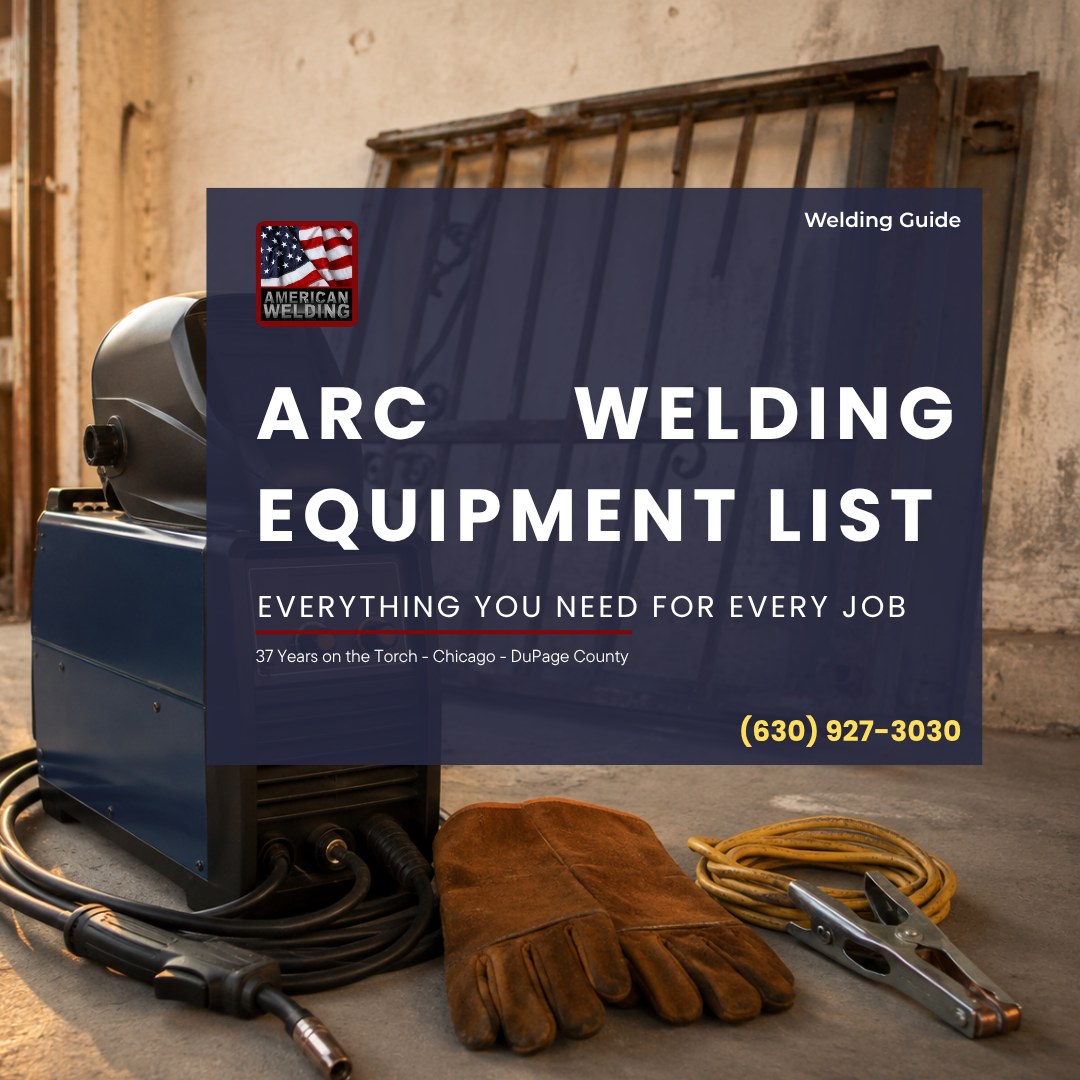
Arc Welding Equipment List: Everything You Need for Every Job
Before any welder strikes an arc, you need a set of equipment: the machine, the cables, the rod or wire, the safety gear, and a handful of tools that make the job possible.
Miss one piece, and the weld either won't happen or won't hold. That's why every serious welder, beginner or pro, starts with a full equipment list before starting a job.
This guide walks through the complete arc welding equipment list, piece by piece. It covers what each item does, why it matters, and how the whole setup fits together. So you know exactly what you're looking at before you buy or hire.
The Quick Answer — The Core Arc Welding Equipment List
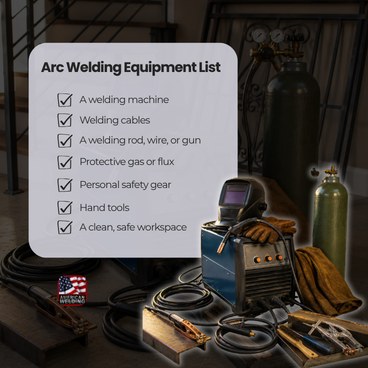
At a minimum, every arc welding setup needs:
Every arc welding type- MIG, TIG, Stick, Flux-Cored uses this same basic list, with small changes for each process.
1. The Welding Machine (Power Source)
The machine is the heart of every arc welding setup. It takes wall electricity and turns it into welding electricity: a low-pressure, high-flow current that can melt metal.
Two main machine types:
- Transformer welders: heavy, rugged, long-lasting
- Inverter welders: lighter, more portable, more features
The machine has to match the welding type (MIG, TIG, Stick, or Flux-Cored) and the metal being welded. A stick machine can't run TIG. A small home welder can't handle thick industrial steel.
2. Welding Cables and Ground Clamp
Every arc welding machine needs two heavy cables:
- The rod or wire cable: carries electricity from the machine to the welding rod, wire, or gun
- The ground cable: clips onto the metal or the work table to close the electric circuit
Without both cables in place, no arc can form.
The ground clamp is a strong metal clip at the end of the ground cable—usually copper-plated to maintain strong electrical flow. Damaged or thin cables lose electrical flow. Loose ground clamps cause weak, jumpy arcs. Both commonly cause bad welds.
3. The Welding Rod, Wire, or Gun
This is what feeds new metal into the weld. Which one depends on the welding type:
- Stick welding: a coated welding rod held by hand
- MIG welding: a welding gun that feeds thin wire from a spool
- TIG welding: a hand-held tool paired with a separate welding rod
- Flux-Cored welding: a welding gun with wire that has powder inside
The rod or wire has to match the metal being welded. Stainless steel needs a stainless rod or wire. Cast iron needs a specialty rod. Regular steel uses standard rods or wires.
Not sure whether MIG or TIG is right for your job? Our guide on MIG vs TIG Welding: What's the Difference? breaks it down. For a full breakdown of the types, see What Are the 4 Types of Welding?
4. Protective Gas or Flux
The arc melts metal so hot that even the surrounding air can cause problems. Air pockets can get into the weld and weaken it.
Every arc welding type has a way to protect the weld:
- MIG welding uses a gas tank (usually a mix of argon and carbon dioxide)
- TIG welding uses a gas tank (usually pure argon)
- Stick welding uses a burning rod coating that makes its own gas
- Flux-Cored welding uses powder inside the wire that makes its own gas
For MIG and TIG, the equipment list also includes:
- A gas tank (also called a cylinder)
- A gas regulator (controls how fast the gas flows)
- Gas hoses (connect the tank to the machine)
Stick and Flux-Cored don't need any of these; the protection is built into the rod or wire.
5. Personal Safety Gear
Welding gives off heat, bright light, sparks, and fumes. Safety gear is standard equipment on every job.
The common categories include:
- Face and eye protection (usually an auto-darkening welding helmet)
- Heat-resistant hand protection
- Protective clothing to cover skin from sparks and heat
- Sturdy footwear to protect from falling metal
- Hearing protection for louder jobs
- Fume protection when working in tight or unventilated spaces
The exact gear varies by the job, the metal, and the setting. Every American Welding job gets its work area set up carefully before the first arc is struck.
6. Hand Tools and Accessories
Beyond the machine and safety gear, every welder keeps a set of hand tools within reach:
- Chipping hammer knocks off leftover coating after a stick or flux-cored weld
- Wire brush cleans metal before welding and cleans finished welds
- Metal file smooths rough edges and cleans up finished welds
- Angle grinder cuts, grinds, and cleans metal on bigger jobs
- Welding clamps hold pieces of metal together during the weld
- C-clamps or vise grips provide extra holding power for tricky joints
- Measuring tape and marker for laying out cuts and joints
- Sturdy work table: a metal surface built to take heat and sparks
None of these are optional. Missing one of them slows the job down or causes bad welds.
7. Cleanup and Finishing Equipment
After the weld runs, there's still work to do.
Standard finishing gear includes:
- Wire brush (again used for cleanup too)
- Angle grinder with grinding disc smooths welds down flat
- Angle grinder with flap disc for a finer finish
- Sandpaper or polishing pad for the final smooth surface
- Rust preventer or paint for outdoor jobs or bare steel
- Cleaning cloth and degreaser for stainless jobs
A weld isn't finished until it's cleaned, checked, and (if needed) painted or coated. The finishing gear makes that last step possible.
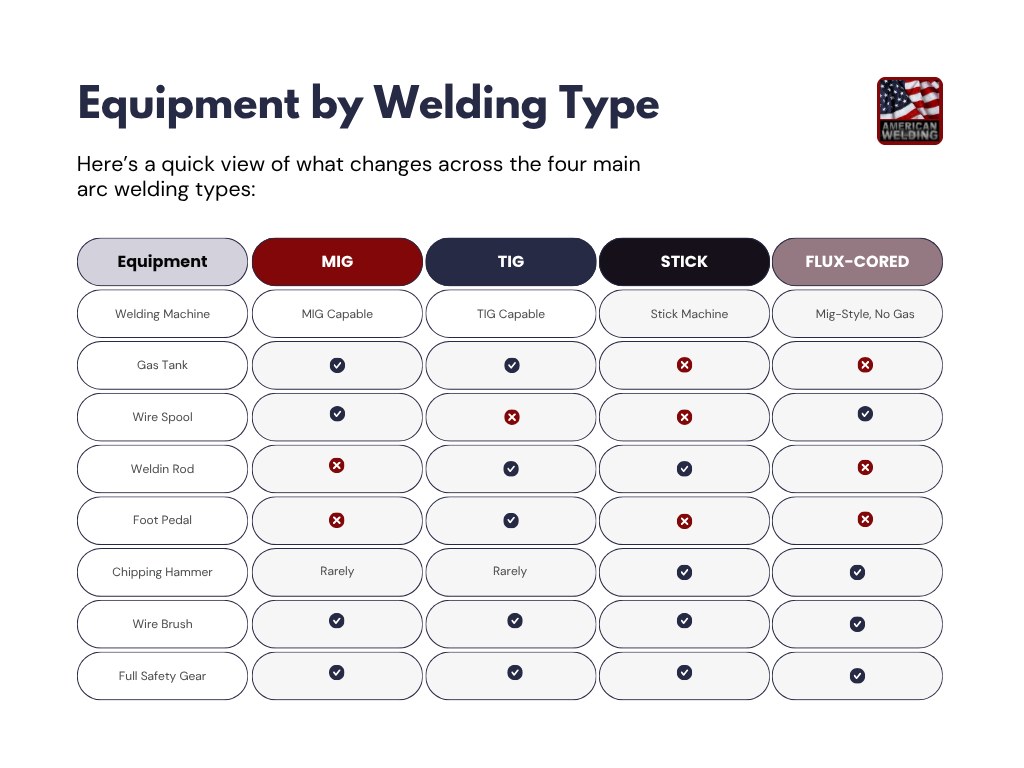
Equipment by Welding Type
MIG and Flux-Cored share the most equipment. TIG needs the most specialized parts. Stick has the shortest equipment list; one reason it's popular for beginners and outdoor field work.
Missing Equipment That Causes Bad Welds
Even one missing piece of equipment can cost the weld.
Here are the most common misses:
- A dull or missing wire brush. Dirty metal ruins the weld bond. A wire brush takes 30 seconds and saves an entire job.
- A bad ground clamp. A loose or rusty ground clamp creates an unsteady arc. The weld pops and skips instead of running smoothly.
- A worn-out gas hose. Small cracks let gas leak out. The weld loses its protection and ends up full of tiny air pockets.
- The wrong wire or rod. Standard rod on stainless. MIG wire on aluminum without the right setup. Cast iron with the wrong rod; see Can You Weld Cast Iron? for more. Every one of these leads to a failed weld.
- Cheap or damaged safety gear. Cracked helmet lens. Thin gloves. Skipping fume protection. Safety corners always come back to bite.
- Old or cheap welding cables. Skinny cables lose electrical flow. The arc is weak. The weld doesn't fully bond.
Most weld failures that come into the shop trace back to one of these misses.
How Every Piece Works Together
An arc welding setup is like a chain; every piece connects to the next.
Here's how they fit together on a typical job:
- The machine turns wall electricity into welding electricity.
- The cables carry that electricity to the welding rod, gun, or wire.
- The ground clamp completes the circuit.
- The rod, wire, or gun delivers new metal to the joint.
- The gas, flux, or coating protects the melted metal.
- The safety gear protects the welder.
- The hand tools hold, clean, and finish the work.
Miss any one link and the weld fails. Every piece has a job. Every job needs every piece.
Since 1980, Pete has welded through nearly every setup that's crossed a workbench. The lesson has stayed the same for decades: the equipment doesn't make the weld, but bad equipment can ruin a good one. We guarantee workmanship on every job run on the right setup.
Service Areas
American Welding serves Chicago and the surrounding suburbs:
- DuPage County — Naperville, Wheaton, Downers Grove, Lisle, Oak Brook, Hinsdale, Wayne
- Cook County — Elk Grove Village, Schaumburg, Hoffman Estates, Bartlett
- Will County — Joliet, Bolingbrook, Plainfield
- Kane County — St. Charles, Batavia, Geneva, Aurora
- Kendall County — Oswego, Yorkville
- McHenry County and DeKalb County
- Milwaukee to Illinois corridor and NW Indiana for larger jobs
Arc Welding Equipment on the Road to Bartlett
Bartlett sits at the northwestern edge of Cook County, where light industrial workshops, small manufacturers, and residential neighborhoods share the same zip code.
All kinds of arc welding equipment show up on Bartlett job schedules. A homeowner needs a MIG weld on a torn iron fence. A machine shop needs stick welding on a heavy steel bracket. A small fabricator needs a mobile TIG setup for stainless kitchen equipment. Each call gets the right equipment list before the truck rolls out.
See what's inside our fully loaded service welding truck — every machine, every rod, every tool ready before the job starts.
Full arc welding gear on hand. Right piece for every job. Workmanship guaranteed on every Bartlett weld.
Full arc welding gear on hand. Right piece for every job. Workmanship guaranteed on every Bartlett weld.
Why Choose American Welding
- All the arc welding equipment on hand. Every machine type. Every rod. Every wire. Ready for every job.
- The right setup every time. No guessing. No missing pieces. No wasted time.
- Decades of hands-on welding. Every piece of equipment has its habits. Time on the job is the only teacher.
- Plain answers. Straight talk on what your job needs and why.
- Full mobile welding service. We bring complete arc welding setups to your site when the job can't come to the shop.
- Workmanship guaranteed on every job.
More on welding types and processes:
- The Arc Welding Process Explained
- Arc Welding vs Stick Welding: What's the Difference?
- What Are the 4 Types of Welding?
- TIG Welding Service
- Mobile Welding & Repair
FAQs About the Arc Welding Equipment List
Q: What is the basic equipment needed for arc welding?
A welding machine, welding cables, a ground clamp, a rod or wire that matches the metal, personal safety gear, and basic hand tools like a chipping hammer and wire brush. For MIG or TIG, add a gas tank, regulator, and hoses.
Q: What safety gear is used for arc welding?
Common categories include face and eye protection, heat-resistant hand protection, protective clothing, sturdy footwear, hearing protection, and fume protection. The exact gear matches the job.
Q: What tools do welders use every day?
A wire brush, chipping hammer, metal file, angle grinder, welding clamps, C-clamps, measuring tape, and a sturdy work table. These tools turn a raw weld into a finished job.
Q: What's the difference between MIG and stick welding equipment?
MIG needs a wire spool, a gas tank, a regulator, and hoses. Stick needs only a machine, cables, ground clamp, and rods. Stick has a shorter equipment list, which is why it's popular for mobile and outdoor jobs. For aluminum jobs, see our guide on How to Weld Aluminum.
Q: Do you need a gas tank for arc welding?
Only for MIG and TIG welding. Stick and flux-cored welding use their own protection from the rod coating or the powder inside the wire. You don't need a gas tank for those.
Q: What is a ground clamp in arc welding?
The ground clamp is a strong metal clip that connects the machine's ground cable to the metal being welded. It closes the electric circuit so the arc can form.
Q: How much does a full arc welding equipment setup cost?
A basic beginner stick welding setup can start around a few hundred dollars. A professional MIG setup with a gas tank can run several thousand. A full professional shop with multiple machines, tanks, and tools can be tens of thousands.
Q: What's the most important piece of arc welding equipment?
The welding machine — it's the heart of the setup. But no machine works without cables, a ground clamp, and matching rods or wire. Every piece matters.
Q: Can you weld outdoors with any arc welding equipment?
Some yes, some no. Stick and Flux-Cored equipment work well outdoors — no gas to blow away. MIG and TIG use gas that wind can carry off, so they usually stay indoors or in wind-protected areas.
Q: Does American Welding bring its own equipment to job sites?
Yes. Full mobile welding service means the truck arrives with the machine, cables, safety gear, rods or wire, and hand tools ready to go—no need for the customer to supply anything.
Need Arc Welding for Your Chicagoland Project?
Every arc welding job needs the right equipment. American Welding has all the machine types, rods, wires, and hand tools you need.
Mobile welding service across Chicago and the surrounding counties. Workmanship guaranteed.
Call (630) 927-3030 or email pete@americanwelding.us to walk through your project.