The Principle of Submerged Arc Welding: How It Works and Where It's Used
You can watch most welds happen. The bright spark. The shower of orange dots. The smoke rising off hot steel.
Not this one.
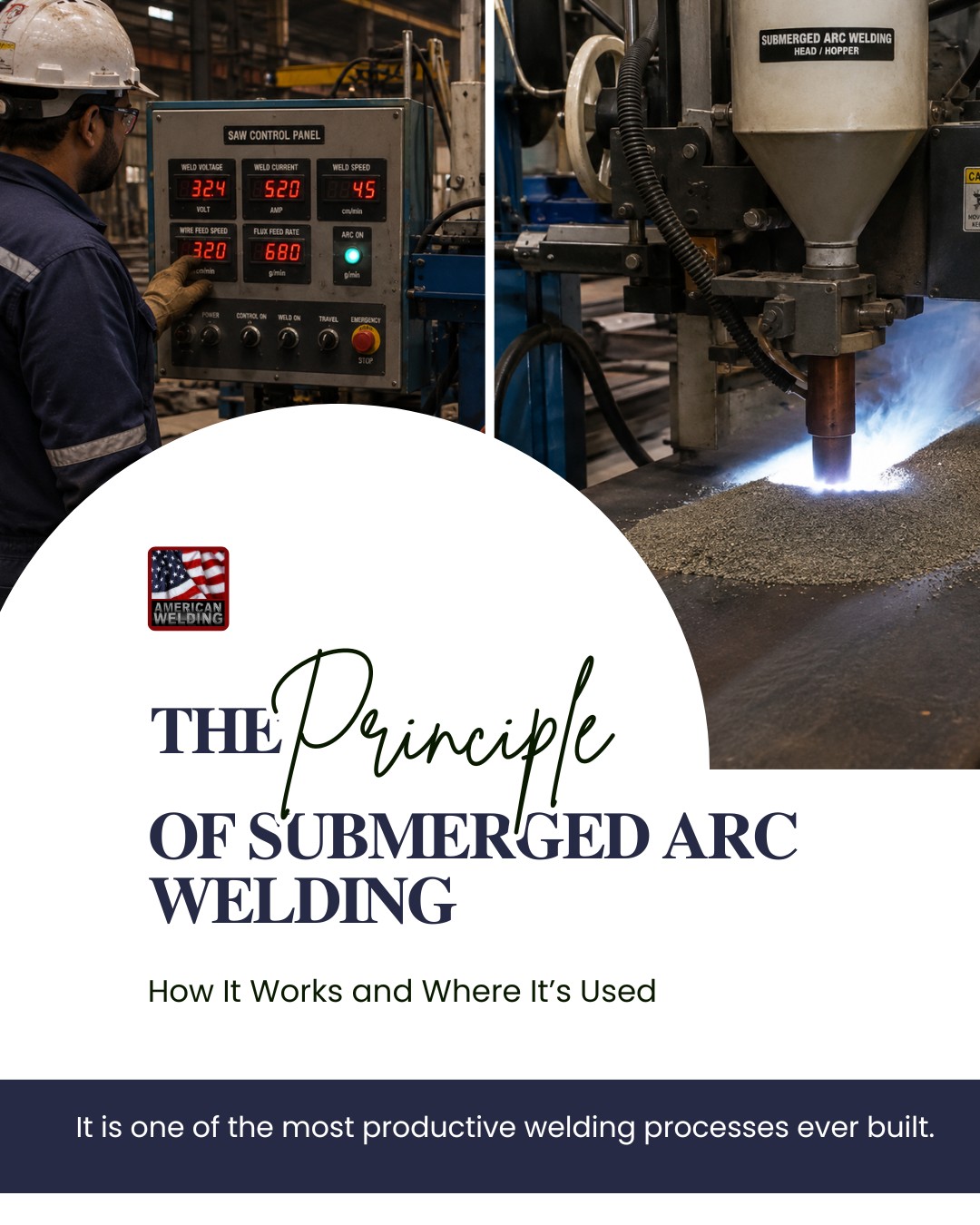
Submerged arc welding (SAW) hides the entire welding arc under a thick blanket of powder. From the outside, all you see is smooth movement and a small trail of smoke. But underneath the powder, one of the strongest, deepest, and most productive welding processes on the planet is running full speed.
This guide walks through the principle of submerged arc welding: what it is, how it works, why the arc gets buried, and where it fits in the welding world—plain talk. Real explanations. Decades of Chicago welding work behind every point.
The Quick Answer
The principle of submerged arc welding is simple. A continuous welding wire feeds into the joint. A layer of granular flux powder gets poured over the joint just ahead of the wire. The arc forms between the wire and the metal, completely hidden under the powder.
The powder protects the weld, shapes the finished surface, and makes SAW one of the most productive welding processes ever built.
Every other arc welding type- MIG, TIG, Stick, Flux-Cored- happens out in the open. Submerged arc welding is the only process that completely hides the arc.
The Principle Behind Submerged Arc Welding
The core idea behind submerged arc welding is straightforward: keep the weld protected, and let the process run non-stop.
Traditional arc welding uses a gas shield, a molten rod coating, or a powder in the wire to protect the molten metal from the air. All three work, but they only cover a small area right around the arc.
Submerged arc welding takes it further. Instead of a small protective zone, it buries the whole weld under a mound of powder. The powder does three jobs at once:
- Protects the melted metal from air, dust, and moisture
- Shapes the surface of the finished weld
- Cools the surrounding metal more slowly, which makes the weld stronger
Because the arc is fully covered, there's no bright flash and no shower of sparks. That means less heat and light stress on the welder, and no need for as much protective equipment.
How Submerged Arc Welding Works — Step by Step
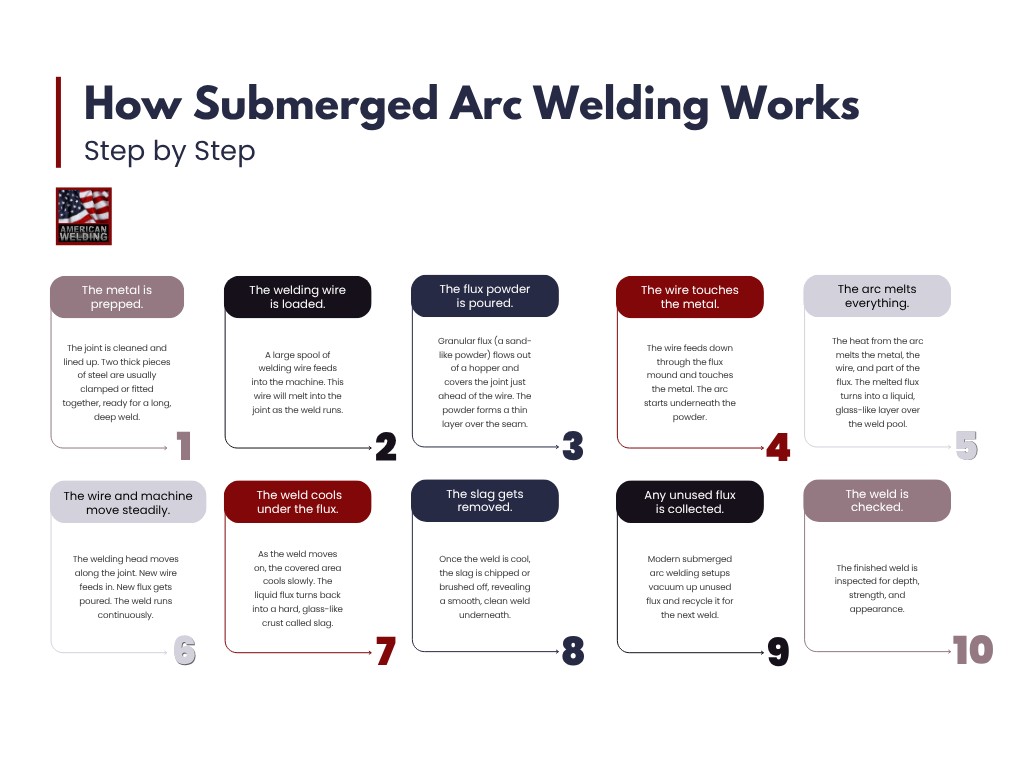
Here's how a typical submerged arc welding job runs from start to finish:
The Key Parts of a Submerged Arc Welding Setup
A submerged arc welding rig has more parts than most other welding types. Each one plays a role:
- The power source — a strong welding machine that supplies steady, high electrical flow
- The wire feeder — pushes welding wire into the joint at a set speed
- The flux hopper — a container that holds and pours the powder over the joint
- The welding head — the moving unit that positions the wire and delivers the flux
- The travel carriage or track — moves the welding head along the joint at a steady speed
- The flux recovery system — vacuums up unused powder for reuse
Most submerged arc welding is done by automated equipment. A welder sets up the machine, monitors it during the run, and inspects the weld after it cools.
Why "Submerged"? The Role of the Flux Blanket
The word "submerged" describes exactly what happens; the arc is completely submerged under the flux powder. Nothing about the arc is visible from the outside.
The flux blanket does more than hide the arc. It gives submerged arc welding several key advantages:
- No bright flash — the powder blocks the intense light of the arc
- Very little spark or scatter — the powder catches almost everything
- Clean welds — no air can reach the melted metal, so no tiny air pockets
- Deeper welds — the flux focuses the heat, letting the weld go deeper into the metal
- Faster work — the setup can run non-stop for long stretches
That combination is why SAW is the top pick for jobs that need long, deep, high-quality welds on thick steel.
Where Submerged Arc Welding Fits — Industries and Jobs
Submerged arc welding isn't a small-shop process. It's built for jobs that need long, deep welds on thick, heavy metal. Industries that use SAW include:
- Shipbuilding — welding ship hulls, decks, and structural beams
- Pipeline construction — long-seam welds on large-diameter pipes
- Pressure vessel manufacturing — boilers, storage tanks, industrial containers
- Structural steel — heavy beams and columns for buildings and bridges
- Wind turbine towers — tall steel sections welded end-to-end
- Railway car manufacturing — chassis and frame welding
- Heavy machinery — large frames, arms, and load-bearing parts
These are jobs where a single weld might be dozens of feet long and needs to hold under enormous stress. That's SAW territory.
The Advantages of Submerged Arc Welding
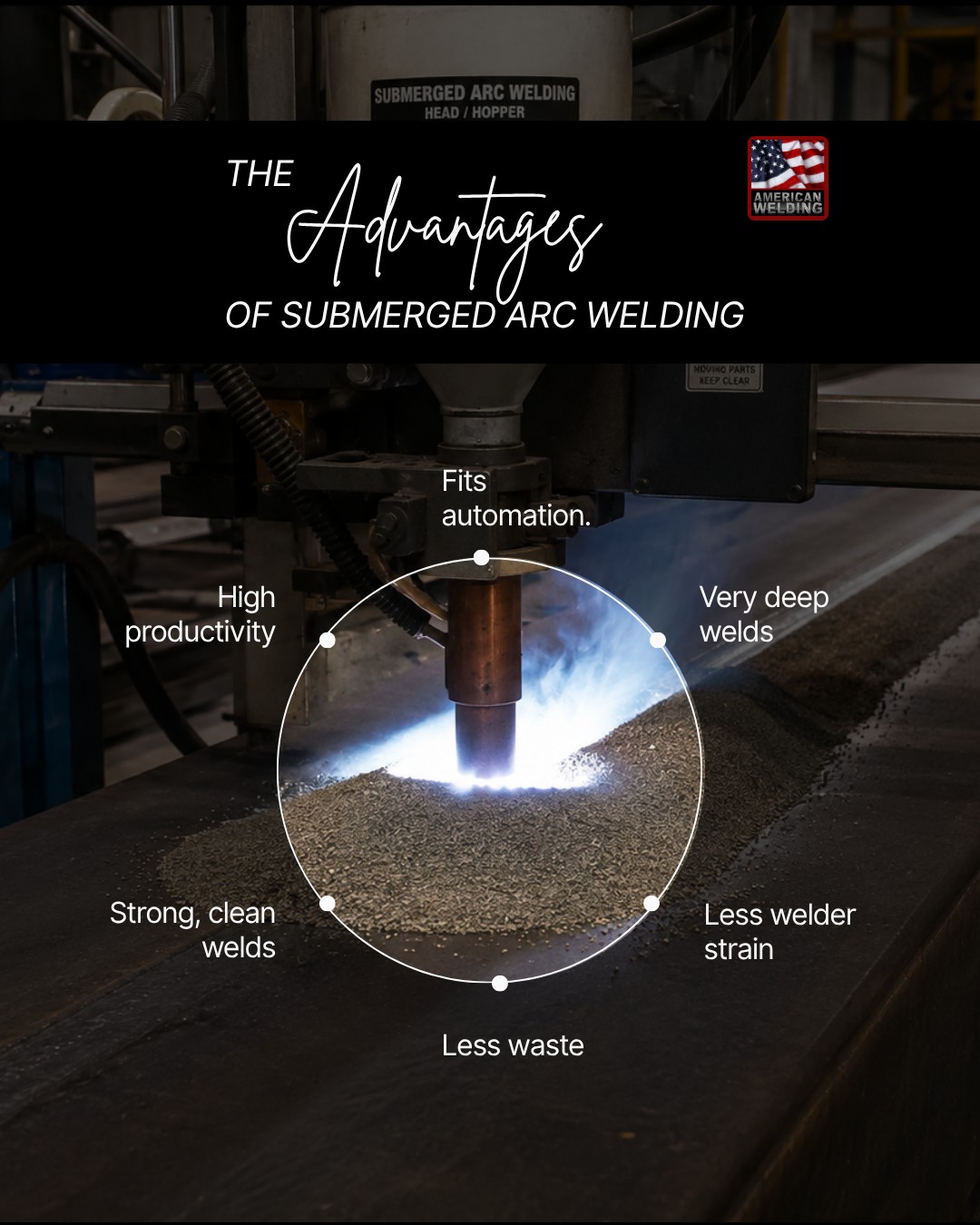
SAW has stayed in use for nearly a century because of what it does well:
The Limits of Submerged Arc Welding
SAW isn't the right pick for every job. Its main limits are:
- Only works flat or horizontal. The flux blanket needs gravity to stay in place. Overhead and vertical welds don't work.
- Not portable. SAW setups are big, heavy, and often built into a factory floor. Not something a mobile welder can bring to a job site.
- Not for thin metal. The heat is too high for thin sheet steel. Regular MIG or TIG is a better fit.
- Not for small jobs. Setting up SAW takes time. For short welds, other arc welding methods are faster.
- Not for repair work. SAW is built for new fabrication, not for patching existing pieces.
- Not for outdoor mobile calls. The flux blows around in wind. SAW belongs indoors, in a controlled shop.
For repairs, small jobs, mobile calls, or outdoor fieldwork, other welding types are the right choice.
Submerged Arc Welding vs Other Welding Types
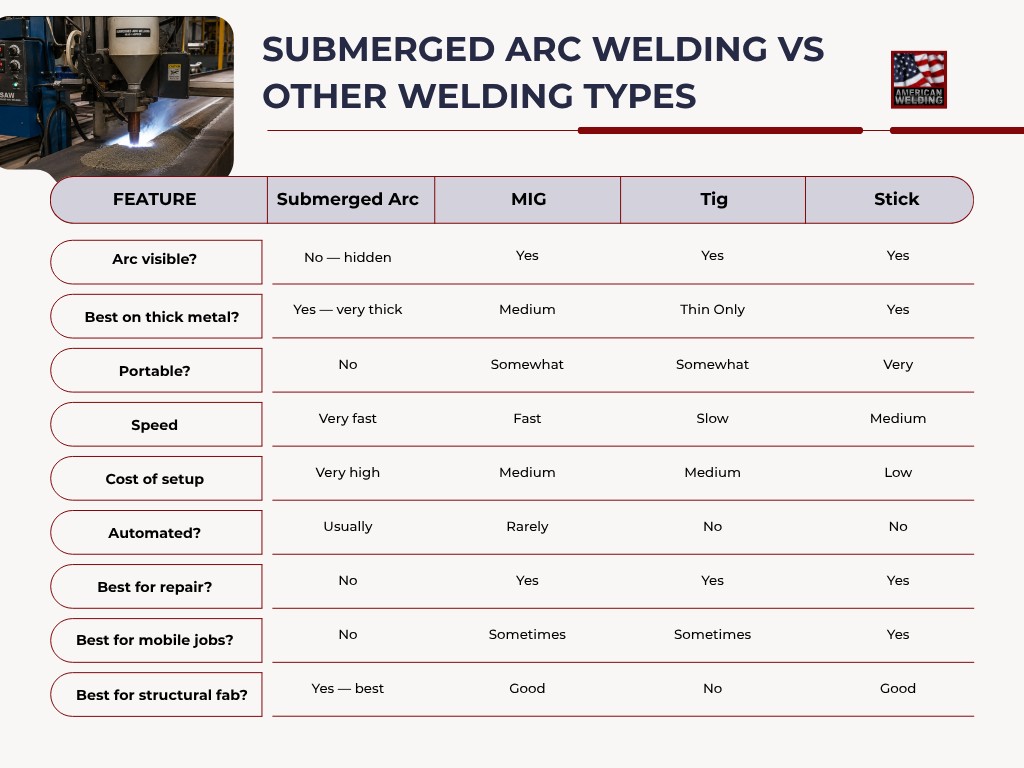
Here's how SAW compares to the more common arc welding types:
For most everyday welding — repairs, mobile calls, custom fabrication — MIG, TIG, and Stick are the right choices. SAW belongs in heavy industry.
Service Areas — Arc Welding Across Chicagoland
American Welding serves Chicago and the surrounding suburbs with the arc welding types most repair and fabrication jobs actually need — MIG, TIG, Stick, and Laser. Submerged arc welding is a specialty industrial process handled by large fabricators, not a service American Welding runs.
For the arc welding, mobile welding, and custom fabrication work most customers need, we cover:
- DuPage County — Naperville, Wheaton, Downers Grove, Lisle, Oak Brook, Hinsdale, Wayne
- Cook County — Elk Grove Village, Schaumburg, Hoffman Estates, Bartlett
- Will County — Joliet, Bolingbrook, Plainfield
- Kane County — St. Charles, Batavia, Geneva, Aurora
- Kendall County — Oswego, Yorkville
- McHenry County and DeKalb County
- Milwaukee to Illinois corridor and NW Indiana for larger jobs
Arc Welding in Batavia — What American Welding Actually Handles
Batavia sits along the Fox River with a strong mix of small manufacturers, machine shops, and industrial suppliers. Every one of those settings runs on regular arc welding — MIG for shop fabrication, TIG for stainless work, stick for outdoor repair, and flux-cored for heavier field jobs.
Going on four-plus decades in the trade, one lesson has held — the right arc welding type saves the job. Large industrial fabricators use submerged arc welding. For the arc welding work that keeps Batavia's shops and small businesses running, MIG, TIG, and Stick handle nearly every call.
Workmanship guaranteed on every arc welding job across the Fox River corridor.
Why Choose American Welding for Arc Welding
- All the arc welding types most jobs need. MIG, TIG, Stick, Flux-Cored, and Laser — the right one for each job.
- The right pick every time. Not the fastest. Not the cheapest. The right one for the metal and setting.
- Decades of hands-on welding. Every welding type has its habits. Time on the job teaches which one to use when.
- Plain answers. Straight talk on what your job needs and why.
- Full mobile welding service. Arc welding at your site when the job can't come to the shop.
- Workmanship guaranteed on every job.
More on welding types and processes:
- The Arc Welding Process Explained
- Arc Welding vs Stick Welding: What's the Difference?
- What Are the 4 Types of Welding?
- How Does a Welder Transformer Work?
- TIG Welding Service
- Mobile Welding & Repair
FAQs About the Principle of Submerged Arc Welding
Q: What is the principle of submerged arc welding?
Submerged arc welding uses a continuous wire feed into a joint beneath a thick blanket of granular flux powder. The arc forms between the wire and the metal, completely hidden under the powder, which protects and shapes the weld.
Q: Why is submerged arc welding called "submerged"?
Because the welding arc is completely buried — submerged — under a layer of flux powder. The arc is invisible from the outside.
Q: What does the flux do in submerged arc welding?
The flux powder protects the melted metal from air, shapes the finished weld surface, cools the surrounding metal at the right speed, and blocks the bright flash of the arc.
Q: What industries use submerged arc welding?
Shipbuilding, pipeline manufacturing, pressure vessel builders, structural steel mills, wind turbine tower makers, railway car builders, and heavy machinery manufacturers.
Q: Is submerged arc welding automated?
Automated machines do most SAW. A trained operator sets up the machine, monitors the run, and inspects the finished weld. Fully manual SAW is rare.
Q: Can submerged arc welding be done on thin metal?
Not usually. The heat is too high, and the setup is too big for thin sheet steel. MIG or TIG welding is a better fit for thin work.
Q: Does American Welding do submerged arc welding?
No. Submerged arc welding is a specialty industrial process typically done at large fabrication plants. American Welding handles the arc welding types most repair, mobile, and custom fabrication jobs need — MIG, TIG, Stick, Flux-Cored, and Laser.
Q: What is the biggest advantage of submerged arc welding?
Productivity. SAW can deposit more weld metal per hour than almost any other welding process, making it the top pick for long welds on thick, heavy metal.
Q: Is submerged arc welding stronger than other welding types?
For right jobs (thick, flat, structural steel), SAW produces some of the strongest, deepest welds possible. On other jobs, MIG, TIG, or stick welding can be just as strong.
Need Arc Welding for Your Chicagoland Project?
For the arc welding work most jobs actually need — MIG, TIG, Stick, Flux-Cored, or Laser — American Welding has all the machines on hand and picks the right one for each project.
Mobile welding service across Chicago and the surrounding counties. Workmanship guaranteed.
Call (630) 927-3030 or email pete@americanwelding.us to walk through your project.