How Does a Welder Transformer Work? Everything You Need to Know
Try welding with a regular wall outlet, and nothing happens. No spark. No arc. No melting metal.
That's because welding requires a very different kind of electricity from the kind that runs your lights, microwave, or TV.
The part inside a welder that changes wall electricity into welding electricity is called the transformer, and it's the reason a welder can do what a wall outlet can't.
This guide walks through what a welder transformer does, how it works, and why it matters, in a simple way. No science-class talk. Just real answers backed by decades of Chicago welding work.
The Quick Answer
A welder transformer takes electricity from the wall, which has high voltage but low current, and converts it into welding current, which has low voltage but very high current.
That high-flow electricity is what makes the arc hot enough to melt metal.
Without a transformer, a welder is just a metal box. With one, it can pour out enough electrical energy to melt steel.
Why Welders Need a Transformer
Wall electricity is designed to run many low-power devices at once: lights, appliances, phone chargers. It has enough pressure to push electricity through long wires, but not much actual flow.
Welding is the opposite. It needs a small amount of pressure but a huge amount of flow. That's what makes the arc jump between the welding rod and the metal, and what makes it hot enough to melt.
A welder transformer bridges the two worlds. It takes wall power on one side and delivers welding power on the other.
How a Welder Transformer Works — Step by Step
The transformer never physically hands over electricity from one coil to the other. It uses magnetism to make new electricity on the other side. That's the trick that makes it work.
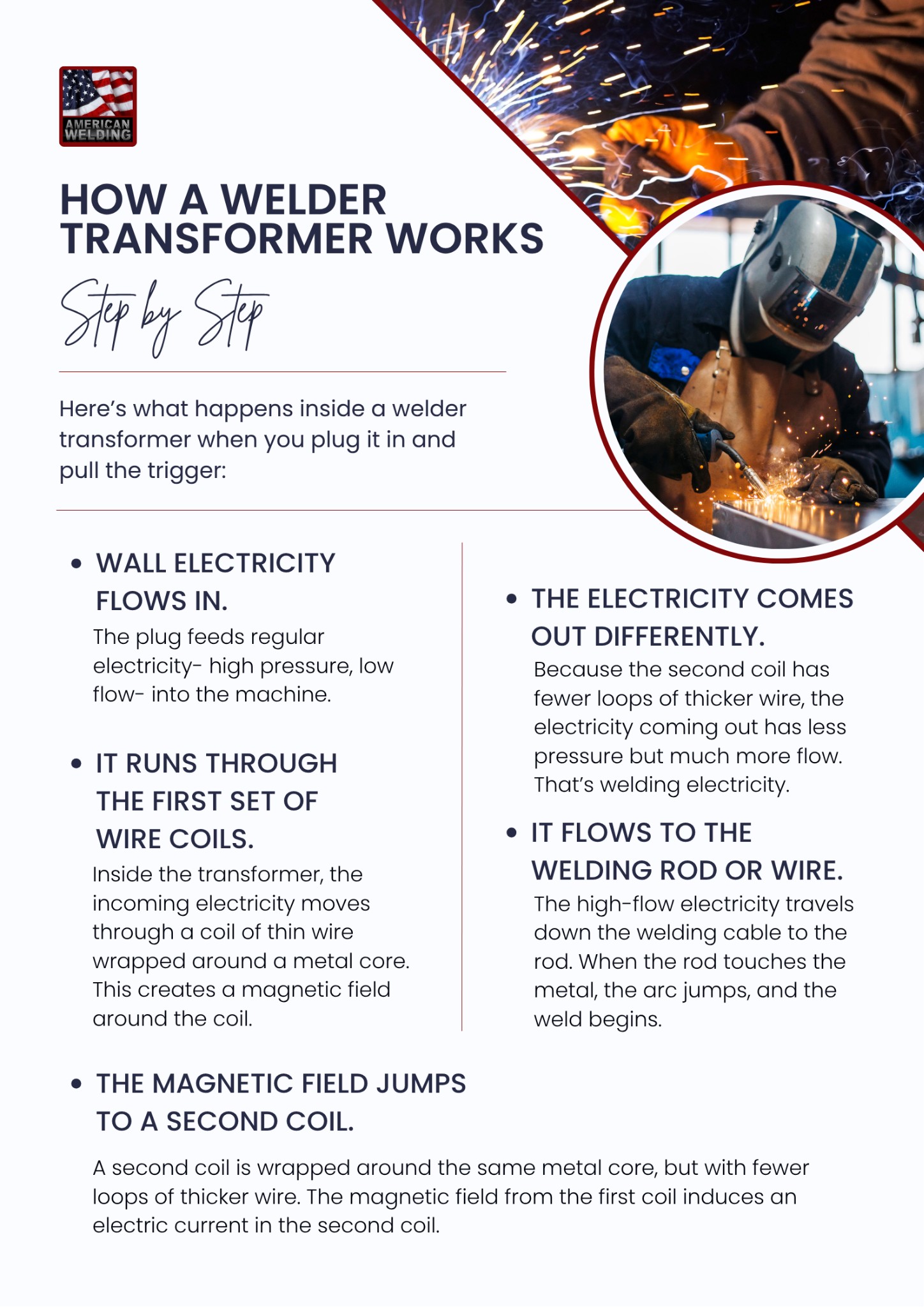
Inside the Welder Transformer — the Main Parts
A welder transformer has three basic parts:
- The first coil: loops of thin wire that take in wall electricity
- The metal core: a chunk of layered iron in the middle that carries the magnetic field between the coils
- The second coil: loops of thicker wire that hand out welding electricity
That's it. Everything else in a welder- the cables, the fan, the controls, the gas system- is built around this three-part core.
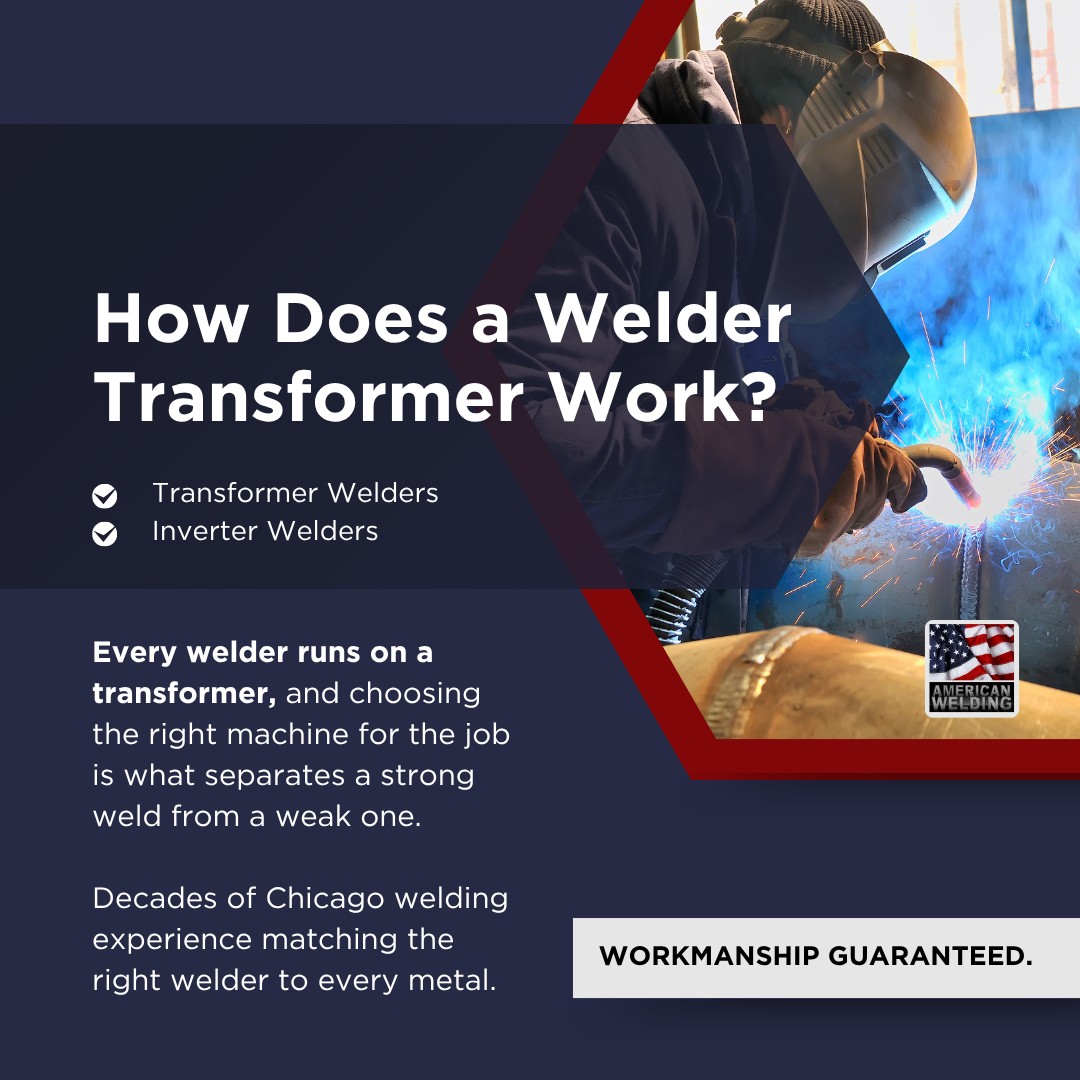
Transformer Welders vs Inverter Welders
Not every modern welder uses the classic transformer setup. There are two main types on the market today:
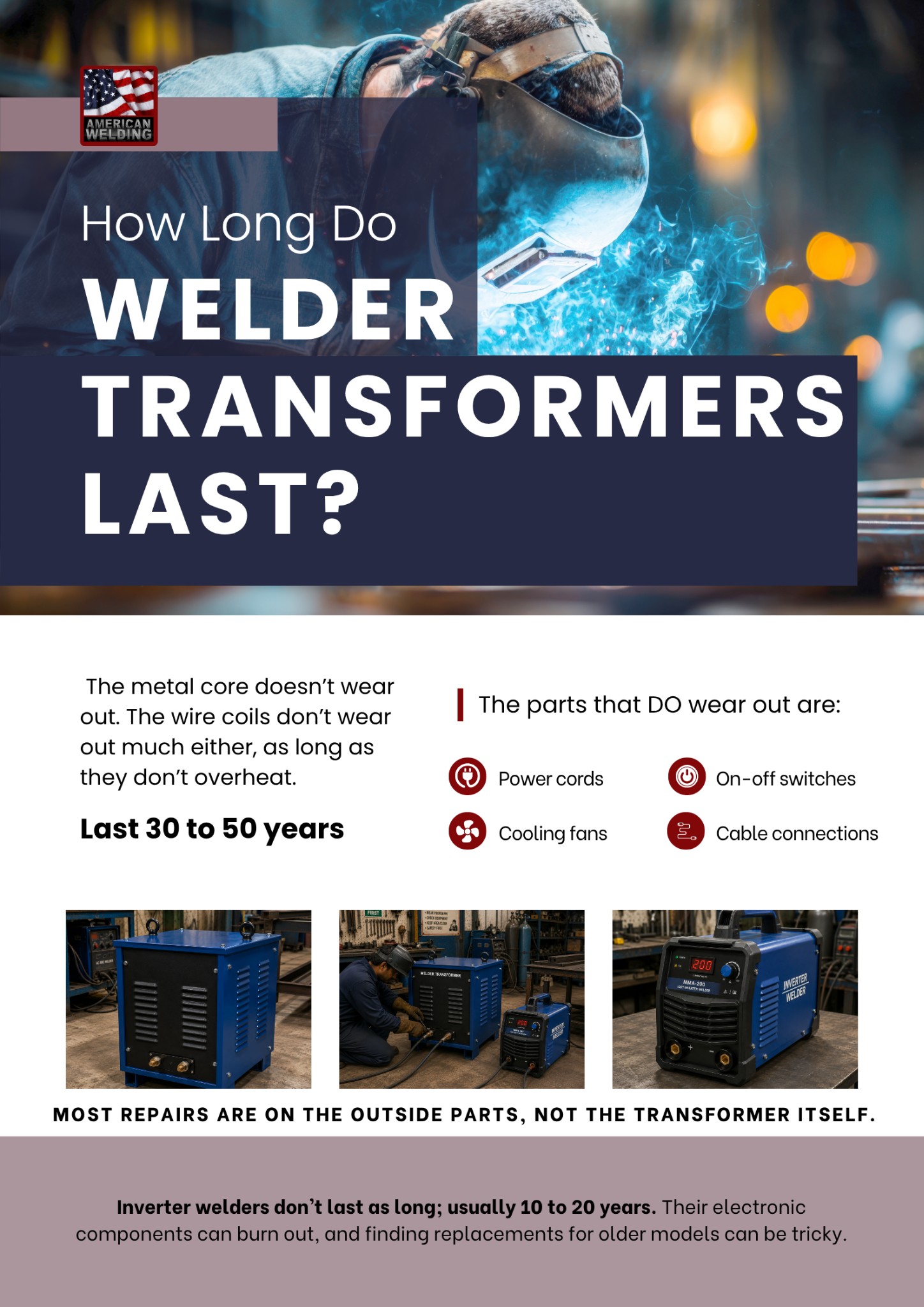
Transformer welders are the older, heavier, simpler design. Big metal core, big coils, big machine. Rugged and long-lasting. Cheap to repair.
Inverter welders are the newer, lighter design. They use electronic parts to do the same job faster and in a smaller box. Lighter to carry. More features. But more expensive to fix if something breaks.
Both types do the same thing: change wall electricity into welding electricity. They just take different roads to get there.
Which One Is Better?
Neither one wins across the board. Each has its right job:
Transformer welders are better for:
- Shops that want a machine that lasts 30+ years
- Buyers on a tight budget
- Jobs where portability doesn't matter
- Welders who value simple, easy-to-repair machines
Inverter welders are better for:
- Mobile welding trucks where weight matters
- Small home shops with limited space
- Jobs that need advanced settings and fine control
- Welders who don't mind higher repair costs
A busy welding shop usually has both types on hand. The right machine is picked for the right job, just as with the welding process itself.
When a Welder Transformer Fails
Even a rugged welder transformer can go wrong. Here are the most common problems:
- The welder won't turn on. Often a blown fuse or a bad power cord; the transformer itself is usually fine.
- Weak or unsteady arc. The transformer may be losing its ability to deliver stable welding power. Common as the machine ages.
- Loud buzzing or humming. Something inside the transformer core has come loose. Not dangerous right away, but a sign to get it looked at.
- Burning smell. The wire coils are overheating. Turn the machine off and get it checked. Running it more can cause serious damage.
- The machine cuts out during a weld. Some transformer welders have safety switches that shut down when they get too hot. Give it time to cool.
- Sparks or smoke from the machine itself. Stop welding right away. This means something serious inside the transformer.
Any of these calls into the shop, and the machine gets looked over. A transformer welder in good shape can outlast the welder who bought it.
How Long Do Welder Transformers Last?
How American Welding Uses Its Welder Machines
Every welding job that comes into American Welding gets matched to the right machine before the arc is ever struck.
Here's what that looks like:
- Understand the job. What kind of metal? How thick? Indoor or outdoor?
- Pick the right welding type. MIG, TIG, Stick, or Flux-Cored.
- Pick the right machine. Transformer welder for heavy shop work. Inverter welder for mobile jobs and precision welding.
- Dial in the settings. Power, wire speed, gas; matched to the metal and thickness.
- Run the weld. Steady and controlled.
- Check the finish. Every weld gets a full look before the job leaves.
With a lifetime of welding behind every job, the right machine is the one that fits the job, not the newest or the most expensive. Workmanship guaranteed either way.
Service Areas
American Welding serves Chicago and the surrounding suburbs:
- DuPage County — Naperville, Wheaton, Downers Grove, Lisle, Oak Brook, Hinsdale, Wayne
- Cook County — Elk Grove Village, Schaumburg, Hoffman Estates, Bartlett
- Will County — Joliet, Bolingbrook, Plainfield
- Kane County — St. Charles, Geneva, Batavia, Aurora
- Kendall County — Oswego, Yorkville
- McHenry County and DeKalb County
- Milwaukee to Illinois corridor and NW Indiana for larger jobs
The Machines Behind DuPage County Welding Jobs
A welding job in DuPage County can come in almost any shape — a home repair, a machine shop project, a restaurant kitchen fix, a corporate building call.
Each one calls for a different welding machine. A heavy-duty shop-based transformer welder handles thick-steel jobs from Naperville industrial parks. A portable inverter welder rides on the truck for mobile calls in Glen Ellyn, Lombard, or Hinsdale. A specialty stainless machine covers restaurant work in downtown Wheaton.
Different machines. Same care. Workmanship guaranteed on every DuPage weld.
Why Choose American Welding
- All welding machines under one roof. Transformer welders, inverter welders, MIG, TIG, Stick, Flux-Cored — the right machine for every job.
- The right pick every time. Not the newest. Not the fastest. The right one for the metal and the setting.
- Decades of hands-on machine work. Every welder has its habits. Time on the job teaches which one to use when.
- Plain answers. Straight talk on what your job needs and why.
- Full mobile welding service. Welding machines come to you when the job can't come to the shop.
- Workmanship guaranteed on every job.
More on welding types, processes, and services:
- What Are the 4 Types of Welding?
- The Arc Welding Process Explained
- Arc Welding vs Stick Welding: What's the Difference?
- TIG Welding Service
- Mobile Welding & Repair
- Aluminum Welding Service
FAQs About Welder Transformers
Q: What does a transformer do in a welder?
It changes wall electricity, which has high pressure and low flow — into welding electricity, which has low pressure and very high flow. That high-flow electricity is what makes the arc hot enough to melt metal.
Q: Is a welder transformer the same as a regular transformer?
Both do the same basic thing: change one type of electricity into another. A welder transformer is built for very high flow at low pressure, which is what welding needs. A house transformer does the opposite.
Q: What's the difference between a transformer welder and an inverter welder?
A transformer welder uses old-school heavy coils and a metal core to change the electricity. An inverter welder uses newer electronic components to do the same job faster and more efficiently. Transformer welders last longer. Inverter welders are more portable.
Q: How long does a welder transformer last?
A well-built transformer welder can last 30 to 50 years with basic care. The transformer itself rarely wears out. Most repairs are on cords, switches, and cooling fans.
Q: Can you fix a welder transformer?
Yes. Transformer welders are known for being easy to repair. The parts inside are simple and long-lasting. A good repair shop can rebuild coils, replace fans, or fix power cords for a fraction of the cost of a new welder.
Q: Why is my welder transformer buzzing?
A soft hum is normal. A loud buzz usually means something inside the metal core has come loose. It's not dangerous right away, but it should get looked at before it gets worse.
Q: Are transformer welders better than inverter welders?
Neither one wins across the board. Transformer welders are cheaper, tougher, and last longer. Inverter welders are lighter, more precise, and better for mobile jobs. Most busy shops use both.
Q: How much power does a welder transformer use?
A big shop welder can pull the same power as a whole small house — sometimes more. That's why welder outlets are usually different from regular wall outlets, and why a welder often needs its own power line.
Q: What happens if a welder transformer overheats?
Most welders have a safety switch that shuts the machine down when it gets too hot. Give it time to cool, and it usually starts back up. If it overheats often, the transformer or the fan may be going bad.
Q: Can a welder transformer shock you?
The electricity inside a welder is enough to cause a serious shock or worse. That's why welders should always be turned off and unplugged before any inside work is done. Machine repair belongs with trained repair techs.
Need a Welding Machine or a Machine Repair?
American Welding has every type of welding machine on hand and selects the right one for each job. Whether you need a repair, a fabrication project, or a mobile call — the machine is ready.
Mobile welding service across Chicago and the surrounding counties. Workmanship guaranteed.
Call (630) 927-3030 or email pete@americanwelding.us to walk through your project.